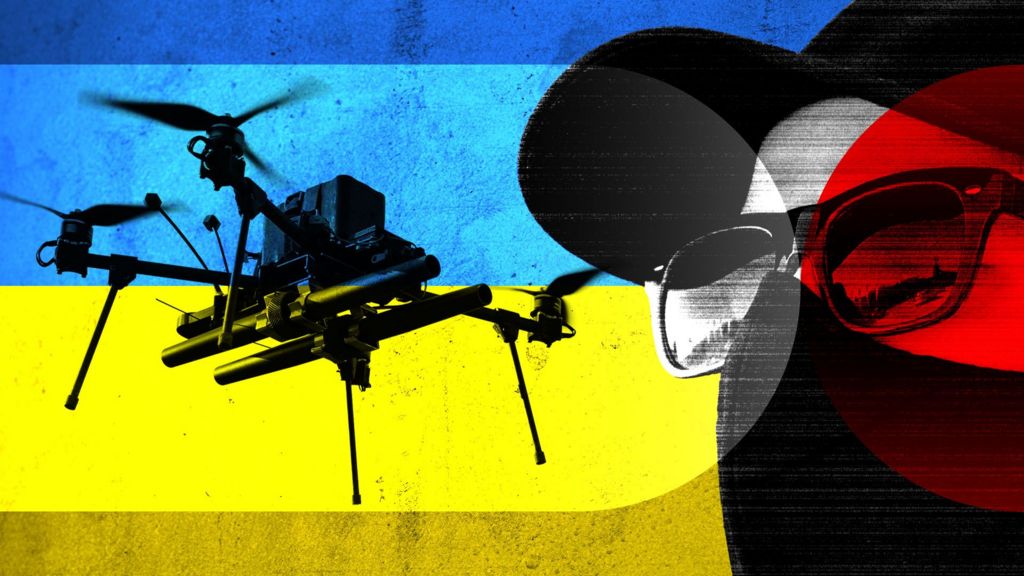
In a revealing new BBC World Service documentary, two Russian men secretly affiliated with Ukraine’s military intelligence agency (GUR) have gone on record to share unprecedented details of their covert operations targeting military infrastructure and personnel within Russia’s borders. The rare firsthand account pulls back the curtain on the shadow network of opposition-aligned Russians supporting Ukraine’s war effort from inside enemy territory. Polish independent journalist Marcin Mamon, who produced the documentary *Shadowmen: Russians working with Ukraine*, profiles two operatives using the pseudonyms Ivan and Foma, each describing distinct roles in the GUR’s coordinated campaign inside Russia.
Ivan, who operates from within Russia, claims to have directly supported Ukrainian drone strikes on key military assets including strategic bombers and munitions factories located on Russian territory. He told Mamon he conducts on-the-ground reconnaissance of military sites, hides drone components in pre-positioned locations across the country, and even smuggles explosives near high-value targets. Mamon verified that Ivan shared reconnaissance video of one such mission near a Russian military airfield. If captured, Ivan would face decades in prison on terrorism charges. He recalled one close call when Russian security officers stopped his car for inspection while he was carrying handmade explosives, yet he avoided detection.
To reduce the risk of the entire network being compromised, Ivan says there is no formal hierarchical structure to the operation, and he has never met any other operatives working for the GUR inside Russia. A former member of Russia’s political opposition, Ivan says he is motivated by ideology: he opposes both Vladimir Putin’s regime and the full-scale invasion of Ukraine, and he believes accelerating the war’s outcome could lead to the collapse of the Putin government. “If Putin loses the war, his regime might fall, and we are working to speed that up,” he told Mamon. He added that even small, covert actions can have outsized impact: properly assembled drone components smuggled by operatives like him can become formidable weapons capable of destroying military assets worth millions of dollars in a single strike. He also acknowledged constant danger, saying, “Fear follows me everywhere. This is Russia.” Even so, he remains optimistic that long-term change is coming, noting “Putin won’t live forever.”
Foma, the second operative, is a former member of the Russian elite who now lives in exile in Poland. He says he runs a network of roughly 300 to 500 undercover volunteers inside Russia that conducts surveillance on high-level Russian military officers and other targets identified by the GUR. He stresses that his network only collects intelligence and never carries out attacks itself. Foma trains new volunteers remotely through online tutorials, teaching them surveillance tradecraft such as trailing targets without being detected, and prohibits recruits from carrying phones while on observation missions to avoid leaving a digital trace. He shares target dossiers with volunteers that include full biographical details, vehicle information, and residential locations, and his network maps everything from weapons storage facilities and military unit positions to the home addresses of senior officers and strategic bomber pilots. Foma says his network conducts independent vetting of all GUR-suggested targets to confirm they are involved in military actions against Ukraine, a step he says justifies the work: “People who commit terrible acts in Ukraine on behalf of Putin must know they will eventually pay for their actions. I want them to be afraid.”
Foma did confirm that his network provided intelligence on Lieutenant General Fanil Sarvarov, a senior Russian officer assassinated by a car bomb in Moscow in December 2024, noting that tracking the general took extensive effort as he frequently changed his schedule and hid his movements. Foma estimates his network has a few dozen operatives split between Russia, Ukraine, and other European countries, with cross-border members handling logistical support such as tracking targets’ digital footprints. Like Ivan, he emphasizes operational security through decentralized structure, warning that any large formal grouping or digital communication trail would quickly lead to the network being rolled up by Russian security services.
While the GUR has publicly confirmed that both Ivan and Foma are working for the agency, even Ukraine’s intelligence service says it cannot independently verify every detail of their claims. When pressed on whether Ivan can be fully trusted, one of his GUR handlers admitted, “I’m not sure of anyone except myself.” Many of the specific activities described by the two men cannot be independently verified by the BBC. That said, Ukrainian officials have openly acknowledged their broader strategy: Kyiv has confirmed it carries out coordinated drone strikes on what it calls legitimate military targets inside Russia, and it admits using undercover agents to support these operations.
For months, there have been media reports of Russian sabotage networks working for Ukraine, but this is one of the first times an operative on the ground inside Russia has spoken publicly about his activities. Since the full-scale invasion began, there have been multiple high-profile assassinations of senior Russian political and military figures. While Ukraine never officially claims responsibility for these targeted killings, a Ukrainian intelligence officer previously admitted to the BBC that the GUR was behind the December 2024 assassination of Lieutenant General Igor Kirillov, another senior Russian military figure.
It is impossible to confirm how many Russians are currently working for Ukrainian intelligence, though Foma estimates the total number is between 300 and 500. Ivan notes that most ideologically motivated Russians opposed to Putin have already either left the country or been arrested, leaving many operatives inside Russia either as unwitting participants (such as truck drivers who unknowingly transport compromised cargo) or paid contractors. Ivan himself is an unusual case: despite being a known former opposition member, he remains able to travel freely in and out of Russia, a fact that has raised questions even within the GUR about his reliability. Foma argues Ivan’s free movement does not automatically mean he is a double agent, pointing to widespread vulnerabilities in Russia’s governance that allow well-connected or lucky operatives to avoid detection. What lends credibility to Ivan’s account is his advance warning to Mamon of a major planned strike on Russian strategic bomber airfields, which came more than a year before a devastating large-scale drone attack on multiple Russian military airfields.
The full documentary *Shadowmen: Russians working with Ukraine* is available to watch on YouTube for audiences outside the UK and can be listened to via the BBC World Service Documentary Podcast.