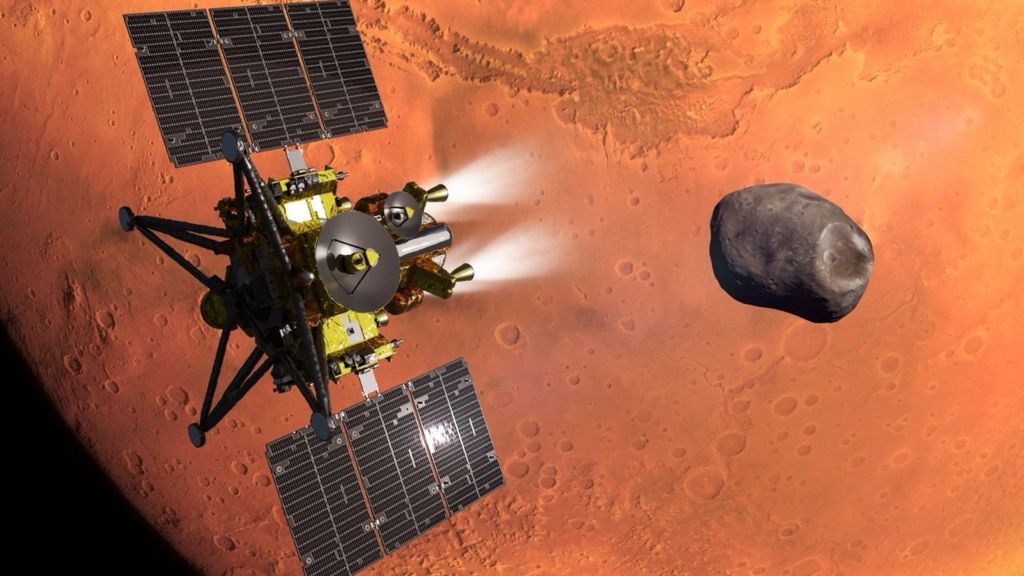
On Monday, Japan’s space exploration effort will reach a historic milestone as the Japan Aerospace Exploration Agency (JAXA) prepares to launch the Mars Moons Exploration (MMX) mission, an ambitious project that aims to collect the first-ever pristine surface sample from Phobos, the larger of Mars’ two tiny moons, and return it to Earth for deep scientific analysis.
Scheduled for liftoff at 04:41 local time on 20 October from the Tanegashima Space Center, the MMX spacecraft will travel through deep space for nearly three years, arriving in the vicinity of the Mars system by August 2027. Once it reaches its target, the mission will first conduct preliminary observations of the smaller Martian moon, Deimos, before shifting its full focus to Phobos – an irregular, 12-mile-wide celestial body often described as looking like a lumpy space potato. One of the mission’s most remarkable technical challenges will be deploying a small rover to Phobos’ surface, a feat never before attempted by any space program. As Professor Sara Russell, deputy lead for sample analysis at the UK’s Natural History Museum and a key member of the MMX science team, explains, the tiny moon’s extremely weak gravity, combined with the overwhelming gravitational pull of nearby Mars, makes landing any craft on Phobos an extraordinary technical hurdle. After the rover scouts a safe landing site, the MMX spacecraft will touch down on Phobos, where it will use a robotic arm and specialized sampling tools to collect approximately 10 grams of lunar dust and surface material. This precious cargo will be sealed in a return capsule that is scheduled to touch down in Australia’s Woomera Desert in 2031.
While 10 grams may sound like a negligible amount of material, scientists say even tiny individual grains of extraterrestrial rock can yield groundbreaking insights. The core scientific goal of the mission is to resolve one of the longest-running mysteries in planetary science: how Mars acquired its two small moons. For decades, two competing hypotheses have dominated scientific debate. One theory argues that Phobos and Deimos formed from debris blasted into orbit after a massive asteroid impact on early Mars, similar to how Earth’s own Moon formed. The alternative theory suggests the two moons are asteroids that formed elsewhere in the solar system and were later captured by Mars’ gravitational pull. By analyzing the chemical and mineral composition of the returned Phobos sample, researchers say they will be able to quickly distinguish between these two competing explanations.
In a happy scientific twist, the mission may also deliver an unexpected bonus: researchers suspect that material blasted off the surface of Mars during ancient asteroid impacts has become embedded in Phobos’ surface regolith. This means the Phobos sample could contain pristine grains of original Martian material, which would give scientists an unprecedented direct look at the Red Planet’s composition. Currently, the only Martian material available on Earth is in the form of rare Martian meteorites, which become contaminated with Earth’s environment after they land, making definitive analysis difficult. Other missions have tried to collect pristine Martian samples: NASA’s Perseverance rover has cached dozens of sample tubes on the Martian surface since 2021, but a joint NASA-ESA mission to return those samples to Earth was effectively scrapped after U.S. Congress cut funding. China plans to launch its own Mars sample return mission in 2028, with a return to Earth targeted for 2031, the same year MMX will deliver its Phobos sample. If successful, MMX will make history as the first mission to return a sample from Mars or its moons to Earth, opening a new chapter in the study of the inner solar system and Mars’ evolutionary history.