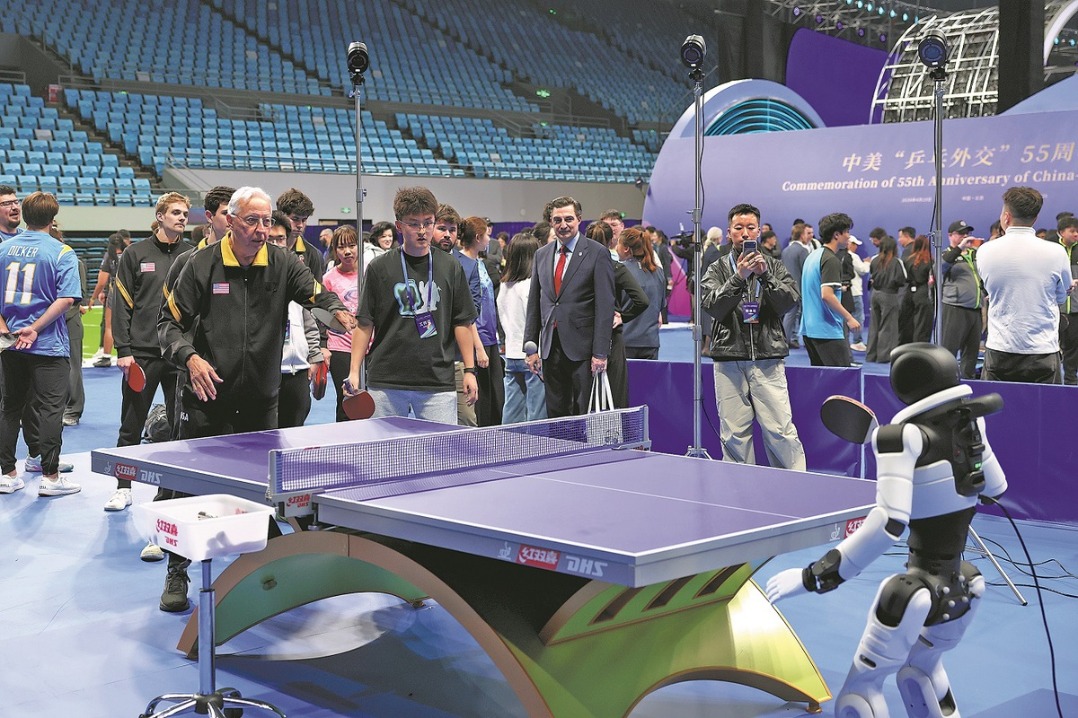
Half a century after a chance encounter on a team bus reshaped the course of modern international relations, participants and new generations alike are marking 55 years since the groundbreaking Ping-Pong Diplomacy that laid the groundwork for normalized relations between China and the United States.
On April 10, 2026, a commemorative event held in Beijing honored this historic milestone, while also launching a new series of sports exchange programs designed to connect young athletes from both countries. Attendees at the event even had the unique opportunity to test their table tennis skills against an AI-powered robot, blending the 1971 moment of diplomatic breakthrough with cutting-edge modern innovation. The event, first reported by China Daily, gathered veterans of the original exchange alongside rising young athletes to reflect on how far bilateral ties have come — and how the core mission of people-to-people connection remains just as vital.
Liang Geliang, now 75, was one of the youngest members of China’s national table tennis team when he traveled to the 1971 World Table Tennis Championships in Nagoya, Japan, the gathering that set the diplomacy in motion. Speaking with reporters from China Daily, Liang, who lives with tinnitus, asked for a slower pace to recount his first-hand memory of the encounter that would change global history. When 19-year-old American player Glenn Cowan missed his team’s bus after a practice session and boarded the Chinese team’s bus instead, Chinese champion Zhuang Zedong extended a warm public welcome, a small gesture that sent shockwaves through a world where Cold War divides had cut off all official contact between the two nations for more than two decades.
Recalling the days after that iconic bus ride, Liang described an impromptu practice between the young players from both sides. “I was 21 that year, it was my first time competing at the World Table Tennis Championship, and Cowan was right there on our bus to the stadium. After we got off the bus, he used simple English and gestures to ask for a practice round,” Liang said. “The group of us, all young men around the same age, played for more than 10 minutes, and we had such a good time together. We all knew even then that this wasn’t just about hitting a ball back and forth — it was the start of a cross-border friendship.”
That unexpected moment of connection quickly snowballed into a historic opening. Just weeks after the Nagoya encounter, on April 10, 1971, an official United States table tennis delegation arrived in China. This was the first official delegation from the United States to be invited and granted entry into China since the founding of the People’s Republic of China in 1949, breaking a 22-year diplomatic freeze. When the visiting American players competed in friendly exhibition matches against their Chinese counterparts across multiple Chinese cities, including a landmark match at Beijing’s Capital Indoor Stadium, the matches sparked widespread excitement among Chinese audiences, turning ordinary athletes into accidental ambassadors for bilateral friendship.
Five and a half decades later, participants say while the geopolitical landscape and both nations themselves have transformed beyond recognition, the personal connections and core lesson of Ping-Pong Diplomacy — that people-to-people exchange can open doors that official diplomacy cannot — has stood the test of time. The new youth exchange initiative launched at this year’s anniversary event carries that legacy forward, aiming to build new bonds between the next generation of Chinese and Americans through the shared love of sport.