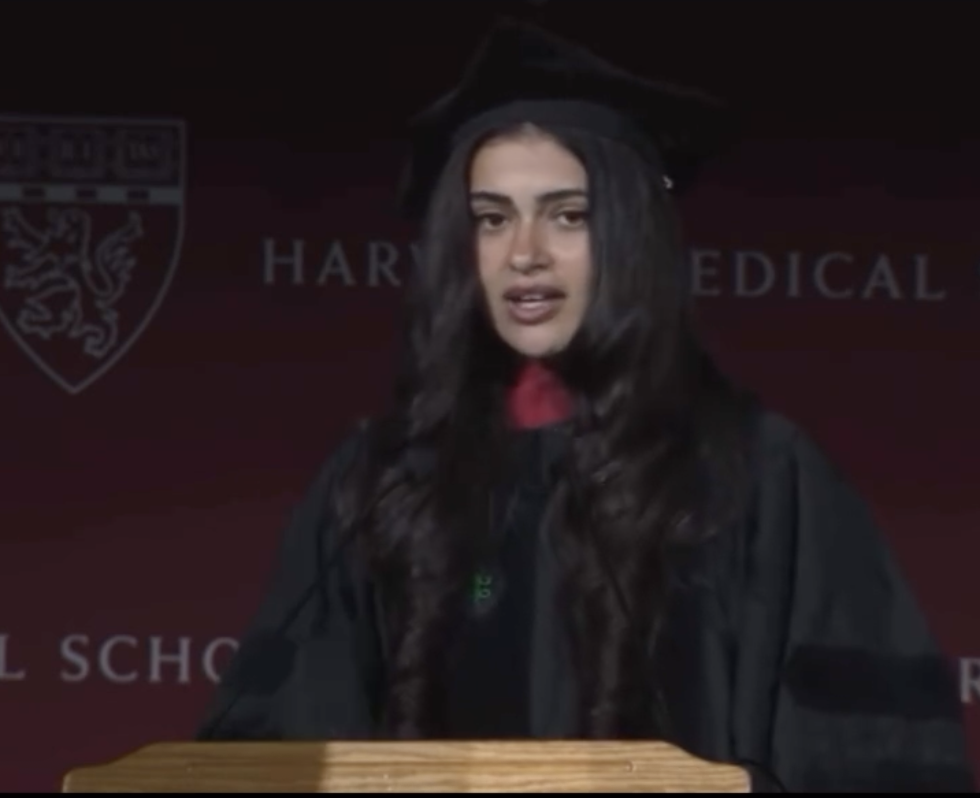
On the surface, Leen Ezzeddine’s 2026 commencement address at Harvard Medical School could have fit neatly into the beloved narrative of immigrant achievement: a young Lebanese woman earning a medical degree from one of the world’s most selective elite institutions. But Ezzeddine rejected that sanitized script, choosing instead to center stark personal and political contradiction in a speech that quickly went viral and reignited long-simmering debates on U.S. campuses over Palestine, academic complicity, and the moral obligations of medical professionals.
Ezzeddine’s connection to the crisis unfolding in her home region is not abstract. Just 18 months before she crossed the commencement stage, a U.S.-supplied Israeli missile destroyed her family’s summer home in Arab Salim, a village in southern Lebanon. Her grandparents, who had lived in the home for decades, were forced to flee to Beirut, and the village has remained under repeated Israeli bombardment even as Ezzeddine delivered her speech. Standing in the sanctity of Harvard’s graduation ceremony, she drew a clear, unflinching line between her own privileged path to medicine and the experiences of equally ambitious medical students across Lebanon and Palestine, who are forced to pursue their degrees amid collapsing infrastructure, bombardment, displacement, and the constant threat of death.
“The only difference between me and students who shared the same dream, the same work ethic, and the same devotion to medicine is that they had to pursue that dream in conditions no student should ever have to endure,” Ezzeddine told Middle East Eye in an interview following her speech. She rejected the common narrative that her success at Harvard stemmed solely from hard work or merit, framing her position as the product of luck and circumstance, not inherent worth.
Ezzeddine’s speech entered a charged, long-running battle over Palestine that has roiled U.S. campuses for years, including at Harvard. Since the outbreak of Israel’s expanded military campaign in Gaza, student activists demanding university divestment from companies linked to the war have faced widespread disciplinary action, police raids, suspensions, and accusations of antisemitism. Just one year before Ezzeddine’s graduation, hundreds of Harvard graduates walked out of the commencement ceremony to protest the university’s decision to bar students who participated in a pro-Palestinian encampment from graduating. The university’s handling of Gaza-related activism has become a central flashpoint in a national debate over whether U.S. academia protects dissenting speech – or punishes it when it centers Palestinian rights.
Rather than delivering an abstract political address, Ezzeddine anchored her argument in personal testimony and the core principles of medical practice. Citing Black liberation activist Assata Shakur, she emphasized that dehumanization is a precondition for violence, noting that people affected by war in the Middle East are too often reduced to statistics or political talking points instead of being recognized as full human beings with their own dreams, families, and aspirations. “Lives no less full, no less sacred, and no less worthy than their own,” she said of those caught in the conflict.
For Ezzeddine, medicine cannot be separated from the political structures that determine who gets access to safety, shelter, clean water, and healthcare. “Medicine is a social science, and politics is nothing but medicine on a large scale,” she explained. “Our work does not begin and end at the bedside. A patient’s health is shaped by whether they have housing, clean water, food, safety, freedom of movement, and access to a hospital that has not been bombed or defunded. So when political decisions determine who is allowed to live with dignity and who is denied the basic conditions of survival, doctors cannot pretend medicine and politics are separate.”
She also challenged the hypocrisy she sees embedded in modern medical education: while students are routinely taught to recognize structural violence, health equity, and the social determinants of health, those very principles are often abandoned when the lives at stake are politically inconvenient for institutional power holders. That contradiction has left countless students and faculty across the U.S. disillusioned since the start of the Gaza war, as universities navigate donor pressure, political backlash, and internal divisions over how to address the conflict.
When asked about the personal and professional risks of speaking out, Ezzeddine situated her choice within a long history of dissident activists whose moral stances were once condemned before being widely celebrated, including Malcolm X, Assata Shakur, Nelson Mandela, and Martin Luther King Jr. “Moral clarity is often most costly before it becomes widely accepted,” she said, echoing activist and thinker Audre Lorde’s famous declaration: “Your silence will not protect you.”
Beyond rhetoric, Ezzeddine has turned the attention drawn by her speech into tangible action. She launched a GoFundMe campaign to provide urgent essentials – including baby formula, diapers, medical supplies, mattresses, and blankets – to pregnant people, newborns, and displaced families in southern Lebanon. What began as a speech has already grown into a community-led response, with Ezzeddine noting that many people in the U.S. are hungry for concrete ways to support those affected by the conflict. Longer term, she plans to build a formal grassroots organization that meets emergency needs in Lebanon while creating pathways for more people from marginalized conflict-affected communities to enter elite institutions like Harvard and enter positions of power. “Because we need more of us in these rooms,” she said.
Ezzeddine’s speech did not resolve the deep contradictions she laid bare. Harvard remains an elite institution embedded in existing power structures, U.S. academia remains a deeply contested terrain over Palestine, and the humanitarian crisis in Gaza and southern Lebanon continues unabated. But her address cut through the comfortable ritual of graduation to demand that medical professionals live up to the ethical principles they claim to uphold. At its core, her message rejects the idea that medicine is separate from the systems that decide which lives are worthy of care – and in a moment where silence too often passes for neutrality, she chose to speak.