A groundbreaking United Nations General Assembly resolution that formally classifies the trans-Atlantic trafficking of enslaved Africans and the racialized chattel enslavement of African people as the gravest crime against humanity has garnered widespread acclaim from leaders across Africa and the globe.
Championed by Ghanaian President John Dramani Mahama, the resolution was approved during a recent General Assembly vote, securing 123 votes in favor, 52 abstentions, and only three opposing votes from Argentina, Israel, and the United States. The landmark initiative seeks to secure formal international recognition of the systemic historical injustice suffered by millions of enslaved Africans, advance collective healing, and open constructive global dialogue around reparations for descendants of enslaved people. It reaffirms the urgent necessity of confronting historical harms that continue to impact African communities and people of African descent globally, and frames reparations as a tangible, actionable step toward redressing these centuries-old wrongs.
Mahmoud Ali Youssouf, chairperson of the African Union Commission, praised the resolution’s passage and commended Mahama’s leadership in advancing the effort. He emphasized that the outcome reflects Africa’s decades-long, principled demand for full global acknowledgment of the trans-Atlantic slave trade and its persisting, intergenerational impacts. “This historic decision marks an important step toward truth, justice and healing, and reinforces the urgent need to address the enduring legacy of slavery,” Youssouf stated.
Youssouf reaffirmed the African Union’s longstanding call for full recognition of both the historical and ongoing ramifications of slavery, including the pursuit of reparative justice, aligned with the AU’s Agenda 2063 and existing UN General Assembly frameworks. He added that the AU remains committed to partnering with the UN, its member states, and global stakeholders to advance historical accountability and ensure the atrocities of slavery are never forgotten, nor allowed to be repeated.
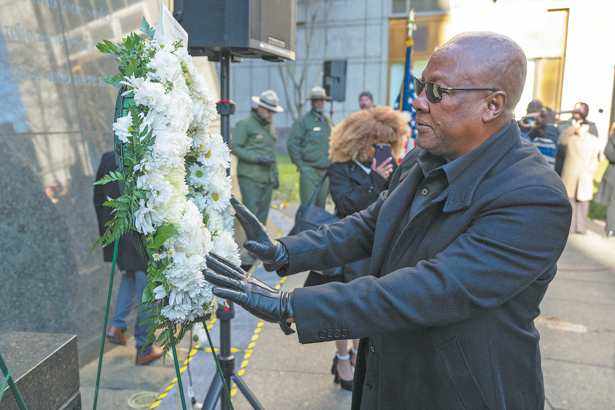
Speaking after the vote, President Mahama expressed profound joy at the resolution’s adoption, noting that the multi-year journey from proposal to final approval was only possible through global solidarity among people committed to justice. “I cannot think of a better way to honor our forebears on the day of remembrance than to have the majority of the world’s countries affirm that the trafficking and enslavement of nearly 13 million human beings is, indeed, the gravest crime against humanity,” Mahama shared in a post on the social platform X, ahead of laying a wreath honoring victims of the trans-Atlantic slave trade at New York’s African Burial Ground National Monument on March 24.
Ghanaian Foreign Minister Samuel Okudzeto Ablakwa framed the resolution’s passage as a meaningful, historic turning point for the global movement for racial justice. “With the adoption of this resolution, we have not simply passed a text. We have affirmed a truth, we have chosen remembrance over silence, dignity over erasure, and shared humanity over division,” he said.
Ablakwa called the outcome a resounding victory for justice, marking the first time that the full humanity and dignity of enslaved Africans and their descendants has been formally affirmed at this scale by the international community. He extended gratitude to all UN member states that backed the measure, while also acknowledging the divergent positions taken by delegations that did not support it.
He emphasized that the resolution’s adoption is not the final milestone in the global push for reparatory justice, but rather a critical starting point for sustained global dialogue. “We urge every member state to consider carefully the actions it must take to ensure inclusive and good faith dialogue on reparatory justice,” Ablakwa added.
Crucially, Ablakwa clarified that the resolution is not aimed at assigning intergenerational blame to nations or communities, nor does it seek to reopen old divisions. Instead, its core goal is to create space for open truth-telling, public education, and a more honest global conversation that allows all nations to move forward together with greater mutual understanding. The resolution also acknowledges the nuance of global history while recognizing the unique, unparalleled horror of the trans-Atlantic slave trade.
The Caribbean Community (CARICOM), a bloc of Caribbean nations that has long advocated for reparations for the legacy of slavery, also issued a statement welcoming the resolution. CARICOM noted that it has consistently pushed the international community to take decisive action to redress the harmful ongoing legacies of African chattel enslavement and trans-Atlantic trafficking, and pledged to continue collaborative work with global partners to fully implement the resolution’s provisions.