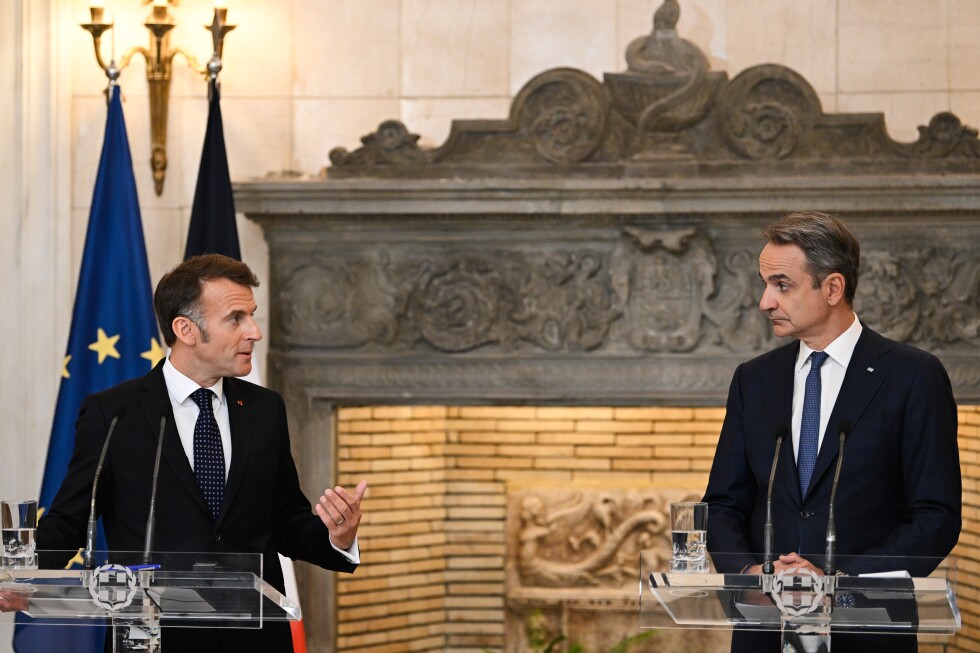
ATHENS, Greece — During a diplomatic visit to the Greek capital on Saturday, French President Emmanuel Macron has clarified the European Union’s accelerated push to strengthen collective defensive capabilities, emphasizing that the initiative is not designed to create a parallel alliance to replace NATO. Instead, it directly responds to a decade of repeated calls from the United States for European nations to take greater ownership of their own regional security.
Macron made the remarks following official talks with Greek Prime Minister Kyriakos Mitsotakis, stressing that the EU has no intention of undermining the transatlantic alliance that binds North America and Europe in collective security. He noted that U.S. leaders have pressed European countries to increase their security responsibility for years, putting the request sometimes politely, sometimes with more urgency. “The core lesson we have to take away is that we can no longer remain reliant on others for our defense,” Macron stated. “We must build up a strong European pillar within NATO, and grow a cohesive European defense sector — this effort is not directed against any nation, and it is never meant to be an alternative to our existing alliances.”
Mitsotakis fully backed Macron’s position, arguing that Washington should welcome the EU’s growing commitment to defense self-reliance and increased defense investment. He called the longstanding U.S. demand for European higher defense spending entirely justified.
Macron’s stop in Athens came after he attended an informal EU leaders’ summit in Cyprus. The primary purpose of his Greek visit was to reaffirm a bilateral 2021 Franco-Greek defense partnership, which includes binding mutual assistance that requires each nation to come to the other’s aid in the event of an armed attack.
Macron underlined the ironclad nature of this commitment: “This mutual assurance and assistance clause is inviolable, it is not open to negotiation between our two countries. There are no question marks, no room for doubt — and any potential or actual adversary must understand this clearly.”
The 3 billion-euro bilateral defense deal has already delivered major military upgrades to Greece, including the acquisition of 24 Rafale fighter jets and four advanced frigates. On Saturday, the two leaders toured one of the newly delivered frigates, the Kimon. For years, Greece has faced persistent geopolitical tensions with neighboring Turkey, leading Athens to carry out a sweeping overhaul of its military capabilities. France has emerged as Greece’s primary supplier for this modernization push, with deals including the versatile French MICA anti-air missile system, deployable on aircraft, ground platforms, and warships.
Both leaders framed the Franco-Greek defense partnership as a model for the rest of the EU to follow, arguing that closer cross-border collaboration can strengthen the 27-nation bloc’s defense industrial competitiveness. Mitsotakis called on EU member states to set aside “national egotism” that shields domestic defense industries from cross-border competition, urging governments to pursue more cross-border industrial mergers to achieve the economies of scale needed for large-scale defense production.
Macron echoed this call, stressing that European defense industry must prioritize innovation to deliver higher-quality, more competitive defense products that can generate the revenue needed to fund the bloc’s long-term defense goals. “The Franco-Greek relationship is a perfect example of what all European nations should do: we need to buy more European defense products, manufacture more goods within the EU, and drive more innovation here at home,” he said.
The two leaders also highlighted Article 42.7, the EU’s own collective mutual defense clause, which Macron emphasized is far more than symbolic rhetoric. He pointed to the rapid deployment of French and Greek warships to Cyprus earlier this March, after a Shahed drone attack targeted a British military base on the island — the first direct drone attack on EU territory linked to the ongoing Iran war — as concrete proof of the bloc’s commitment to mutual defense.
Turning to global energy security concerns amid tensions over the Strait of Hormuz, Macron urged against unnecessary public panic over potential fuel shortages. Around one-fifth of the world’s daily oil and gas supplies pass through the strategic waterway, which has faced widespread disruption amid the ongoing conflict. Macron said current fuel supplies remain “fully under control” and that he does not expect widespread shortages to occur. He added that the EU remains fully committed to diplomatic efforts to reopen the strait to full commercial traffic, even as he acknowledged it will take time for stability to return to the region.
As a major global shipping power, Greece has a direct stake in the strait’s future. Mitsotakis said any diplomatic resolution to the current crisis must include a non-negotiable guarantee of full, unimpeded freedom of navigation through the strait, with no arbitrary tolls imposed on passing commercial vessels — a return to the status quo that existed before the outbreak of the Iran war.