On the second leg of his nine-day official Caribbean tour, King Charles III stepped away from rigid royal protocol to fully immerse himself in Bahamian local life, balancing solemn commemorations, cultural celebration, and critical conversations around historical harms and climate action. The day opened with a solemn tribute at the Flamingo Monument, where the King, adorned with his service medals, laid a wreath to honor four Royal Bahamas Defence Force marines killed in 1980 when Cuban MiG fighters sank the HMBS Flamingo. He spent extended time speaking with active service members, veterans, and RBDF personnel to recognize their sacrifice and ongoing commitment to national security.
Later, the King toured the Bahamas Boxing Academy, a community program that trains young people aged 8 to 18 in the sport. He was greeted by staff and young athletes wearing custom t-shirts emblazoned with his cartoon likeness, complete with a crown, boxing gloves, and championship belt. Delighted by the playful gesture, Charles accepted his own custom shirt, watched a youth sparring session, and encouraged the young participants, telling one group he hoped to see them compete at a future Commonwealth Games.
A core priority of the day’s itinerary centered on climate resilience, as the King visited Bonefish Pond National Park, a restored 1,235-acre mangrove wetland that was once a decommissioned rubbish dump. Walking along a newly constructed boardwalk through the coastal ecosystem, he spoke with local university students conducting field research on marine conservation, asking about their academic progress and aspirations to become marine biologists. Joanne Smith, President of the Bahamas National Trust Council, noted that the royal visit would help drive more local community engagement in national park stewardship, calling the stop a deeply meaningful milestone for the country’s conservation efforts.
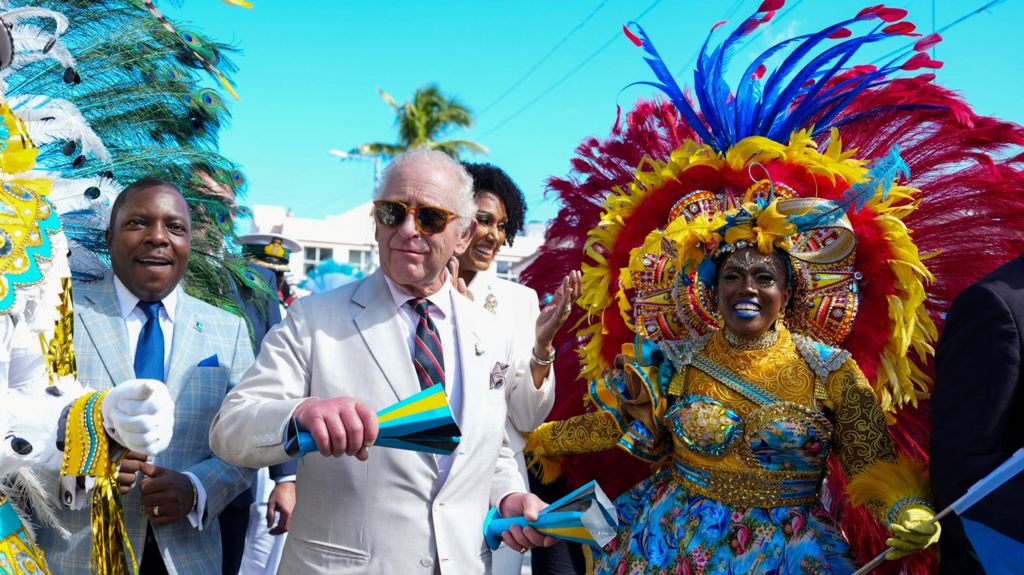
The day’s most viral moment unfolded at the iconic Junkanoo carnival, a vibrant cultural parade rooted in the island’s African diaspora heritage. Wearing a tailored suit and sunglasses, the King took to the front of the parade route, shaking maracas painted in the national colors of the Bahamas and dancing alongside performers in elaborate feathered headdresses and bright, handcrafted costumes to the roar of cheering onlookers. Historians trace Junkanoo’s origins to the era of chattel slavery, when enslaved people were granted limited time off over the Christmas period to celebrate their own cultural traditions.
The festive atmosphere was punctuated by a small, peaceful demonstration organized by the Bahamas National Reparations Committee, whose members held placards reading “Pay us what you owe us” before being escorted away by local police. The group is demanding a formal, unreserved apology from the British Crown for the transatlantic slave trade, as well as targeted reparations for intergenerational harm inflicted by the system. This demonstration came on the heels of the King’s official arrival speech the previous day, in which he explicitly acknowledged the profound, enduring pain of the slave trade, noting that modern Bahamian culture was “born out of darkness” and that acknowledging these historical injustices was an essential moral obligation. Charles has already confirmed that Commonwealth heads of government will hold formal discussions on the legacy of chattel slavery during the upcoming Commonwealth Heads of Government Meeting (CHOGM) hosted in Antigua next week.
The day drew to a close with a formal garden reception at Nassau’s Government House, where the King met dozens of Bahamian community leaders who have made outstanding contributions to public life, education, and civil society. Dame Cynthia A. Pratt, Governor-General of the Bahamas, welcomed Charles warmly, noting that this was the first royal visit to the nation since its independence in 1973, and expressing hope that the tour would deepen long-standing ties between the Bahamian people and the Crown. The King will depart the Bahamas on Thursday to travel to Guyana, where his engagements will center on biodiversity protection, before proceeding to Antigua and Barbuda to join Queen Camilla for the biennial CHOGM summit, which will convene leaders from 56 Commonwealth nations to address shared global challenges ranging from climate change to economic equity.