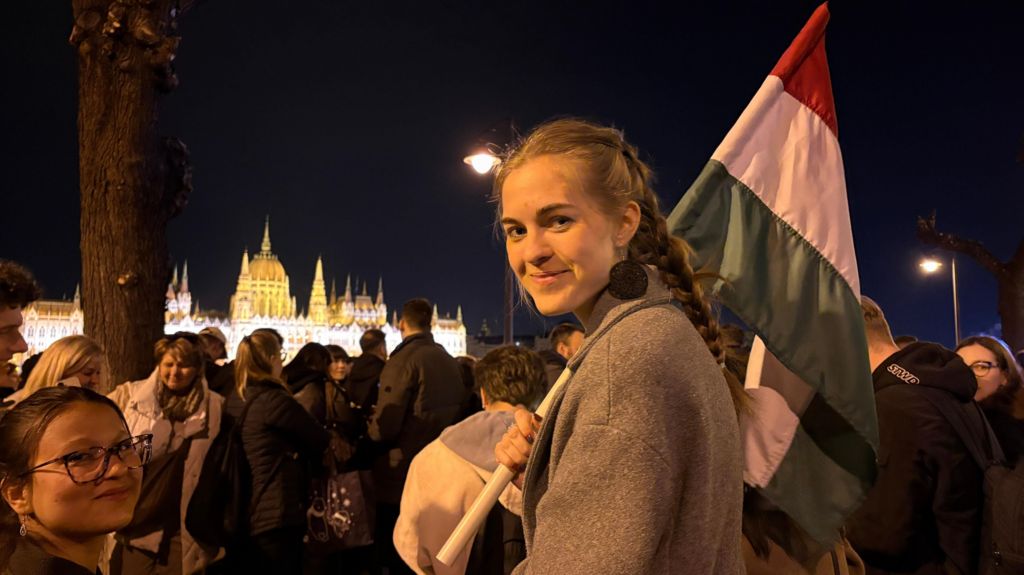
For decades, Budapest’s iconic Chain Bridge has stood as a quiet architectural centerpiece, connecting the rolling hills of historic Buda to the bustling, energetic streets of central Pest across the Danube River. By night, its string of glowing lights reflect off the river’s surface, dancing like scattered tiny moons in the dark water, drawing thousands of tourists each year who crowd its walkways to snap selfies against the postcard-perfect backdrop. But on election Sunday this year, the bridge served a far different, far more historic purpose: draped in the green, white, and red of the Hungarian flag, it became the gathering ground for a nation celebrating the end of an era.
After 16 consecutive years in power, Hungarian Prime Minister Viktor Orbán and his long-ruling Fidesz party were ousted from government in a historic election upset that has sent ripples across Europe and beyond. The victory went to opposition leader Péter Magyar and his Tisza party, whose supporters flooded the Chain Bridge that night, their chants and cheers echoing across the river as they celebrated what they described as the liberation of their homeland. In his triumphant victory speech to the crowd, Magyar doubled down on that shared feeling of renewal: “We did it,” he told the roaring gathering. “We brought down the Orbán regime — together we liberated Hungary. We took back our homeland! Thank you! Thank you all!”
The result capped a seismic shift in Hungarian politics, achieved against all odds. Orbán had spent years consolidating power, building what he openly called an “illiberal democracy” marked by tight control of state media, electoral rule changes designed to favor his party, and deep influence over key government and industry positions held by his allies and family members. Even with these structural advantages, he suffered a decisive defeat at the polls, driven by a record-breaking voter turnout that saw millions of Hungarians turn out to oust his government.
By the early hours of Monday morning, crowds of first-time voters danced through Budapest’s side streets, giddy with a heady mix of hope and disbelief. “I cried when I put the X on my ballot paper,” 20-something voter Zofia told reporters on the ground. “I still can’t quite believe we did it. But we did!” As she spoke, her group of friends chanted a phrase with deep roots in Hungarian history: “Russians Go home!”
That slogan carries a sharp, ironic weight for Orbán, who first rose to national prominence back in 1989, as communist rule in Hungary collapsed. At that historic moment, he made his name with a fiery speech demanding Soviet troops withdraw from Hungarian soil, echoing the same rallying cry that first emerged during the 1956 anti-communist uprising. But over his decades in power, Orbán shifted dramatically, moving steadily to the authoritarian right and building a close, cozy relationship with Russian President Vladimir Putin. On the campaign trail, his own 1989 slogan was thrown back in his face by critics angered by his proximity to Moscow.
Orbán’s removal from power marks a significant strategic blow to Putin, who relied on his loyal ally within the European Union to undermine Western efforts to hold Russia accountable for its full-scale invasion of Ukraine. Over the course of the war, Orbán repeatedly delayed EU sanctions packages against Moscow and has blocked a critical €90 billion EU support loan that Kyiv says it needs to maintain its economic and military stability. For Ukraine, the election result is a clear win: President Volodymyr Zelenskyy was quick to congratulate Magyar on his victory, writing on social media that he looked forward to “constructive work” between the two nations.
Magyar has already signaled he will not fully reverse Orbán’s policy of refusing direct military aid to Kyiv, a cautious move designed to avoid alienating the large share of Hungarian voters who remain wary of being drawn into the conflict — a fear Orbán deliberately stoked throughout the campaign, warning that an opposition win would bring the war across Hungary’s border. But the new leader has pledged to end the block on the €90 billion EU loan to Kyiv, a major shift that will remove one of the biggest obstacles to European support for Ukraine.
Across the EU, Orbán’s departure has been widely welcomed. For years, the Hungarian leader was nicknamed “the Obstructor” in Brussels, widely seen as a persistent fracture in the European union’s unified front against threats from Russia, China, and other global rivals. UK Prime Minister Keir Starmer called the result “an historic moment for European democracy,” while European Commission President Ursula von der Leyen said simply that “Hungary has chosen Europe.”
The upset is far less welcome in Washington, where US President Donald Trump has lost his closest European ideological ally. Trump repeatedly endorsed Orbán during the campaign, even sending Vice President JD Vance to Budapest to speak at a pro-Orbán rally mid-campaign. Both Trump and his former chief strategist Steve Bannon, a key backer of populist nationalist movements across Europe, have long held Orbán up as a hero of their anti-globalist, Christian nationalist political project. Bannon once described Orbán as a trailblazer for the global right-wing movement Trump leads.
Some political analysts have framed Orbán’s defeat as evidence that the wave of populist nationalism that swept across Europe over the past 15 years has reached a turning point, and entered a period of decline. But this narrative overlooks the unique set of factors that led to Orbán’s ouster, and ignores that recent setbacks for other right-wing populist leaders — from Marine Le Pen’s underperformance in recent French local elections to Italian Prime Minister Giorgia Meloni’s recent referendum defeat — are rooted in country-specific political dynamics that don’t add up to a broader regional trend.
In Orbán’s case, his downfall was driven by a combination of long-simmering discontent across multiple segments of Hungarian society, and a final collapse of support even among his traditional base. For years, he alienated liberal and left-leaning Hungarians, as well as LGBTQ+ Hungarians and many women who saw their rights eroded under his socially conservative “pro-family” agenda that rigidly enforced traditional gender roles. But in the end, even long-time Orbán voters abandoned him in droves, driven by economic discontent and growing anger at corruption.
A visit to Orbán’s home village of Felcsút, the day before the election, laid bare that anger. Once a humble boy from the village, Orbán poured public and private investment into the community, building a local football stadium and youth football academy. But his family’s growing wealth has become a flashpoint for anger: his son-in-law is linked to a luxury local golf course, while his father is currently rebuilding a nearby private estate estimated to cost around $30 million. Orbán has consistently denied all corruption allegations, and for years when the Hungarian economy was strong, many locals were willing to overlook the accumulation of wealth among his inner circle. But in recent years, soaring inflation and plummeting living standards have turned that tolerance to anger, even among his onetime supporters.
“He failed us. He failed his country. He hoodwinked us,” Gyárfás Oláh, a former Orbán supporter and one-time local mayor, told reporters wearily. A large share of Magyar’s vote came from Hungarians who voted against Orbán, not necessarily for the new leader — who remains untested in national government. So what can we expect from the new prime minister?
At 45, Magyar is an energetic, telegenic, and shrewd politician who was once a member of Orbán’s own Fidesz party. Like Orbán, he identifies as a conservative nationalist, and often carries a Hungarian flag to every campaign event. Political analysts note that Hungarian voters, who largely lean socially conservative, needed a center-right candidate to unify around to defeat Orbán — and it is likely that many of Orbán’s existing policies, including his hardline anti-immigration stance, will continue under the new government. Where Magyar has promised dramatic change is in institutional reform: he has pledged sweeping changes to “roll back the Orbán regime,” distance Hungary from Russia, and repair the fractured relationship with the European Union.
For most Hungarians, the top priorities remain domestic: rebuilding the struggling economy, fixing underfunded public services, bringing down inflation, and lowering the sky-high cost of living that drove so many to abandon Orbán. There is a long to-do list for the new government, and Magyar has made clear he is ready to get to work. “Tonight we celebrate,” he told jubilant supporters late on Sunday night, grinning as he stood surrounded by cheering supporters. “Tomorrow, we get to work!”
Magyar will not officially take office as prime minister until Hungary’s president formally asks him to form a new government, a step expected to take place within roughly a month.