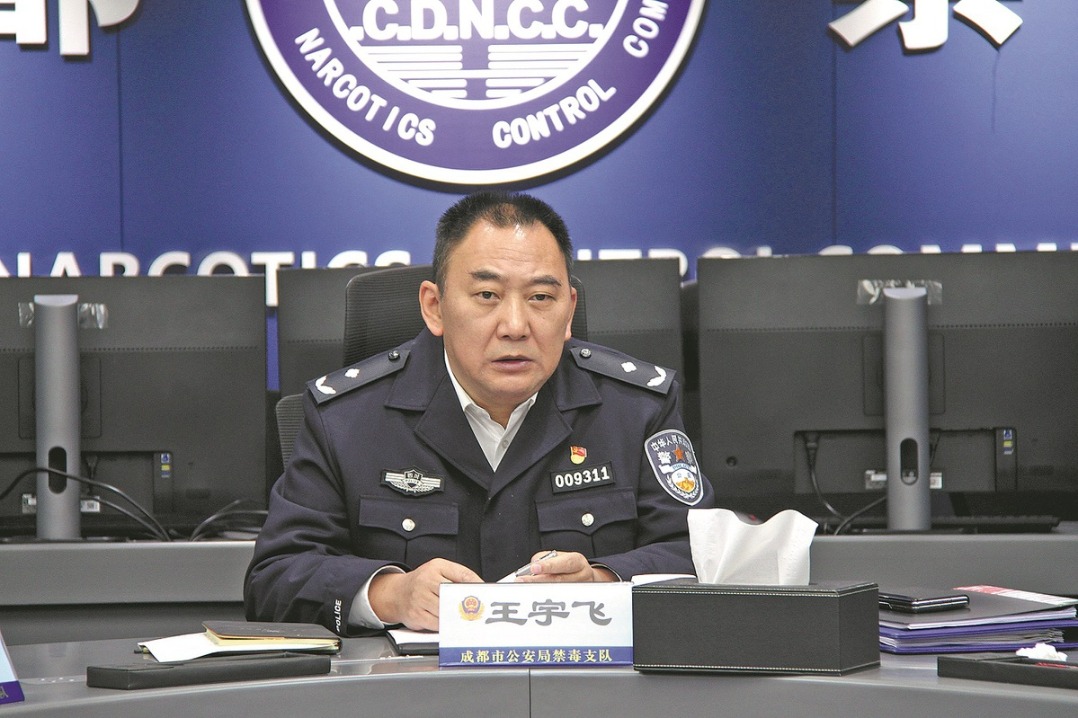
For more than three decades, Wang Yufei’s true identity remained locked away in classified police files, a necessary safeguard for a man who spent his career dismantling violent drug trafficking networks as the head of the Chengdu Public Security Bureau’s narcotics division. Only after his death in May 2025, brought on by work-related complications, could the veil of anonymity be lifted — allowing the public to finally learn the name of the officer who dedicated his entire life to protecting their safety.
Posthumously recognized as an Outstanding Party Member and a national-level anti-drug expert, Wang leaves behind a city dramatically transformed by his decades of relentless work. In 2024, his final full year leading the division, drug manufacturing cases in Chengdu plummeted by 65.2% — a stark, powerful statistic that stands as his quiet, final accounting to the community he served.
Born in Chengdu, Southwest China’s Sichuan Province, in January 1969, Wang joined the local police force in June 1991. He quickly climbed the ranks from a grassroots patrol officer, earning a reputation for stepping forward without hesitation when danger emerged. In his early application for Communist Party membership, Wang wrote that he deeply cherished police work and pledged to devote his entire life to the Party’s mission — a promise he kept unwaveringly across 34 years of frontline service.
One of the earliest testaments to his courage came in May 2003, when he was still serving as a patrol officer with the Zhanqian Police Branch. Called to respond to a hostage situation involving a knife-wielding suspect, Wang remained cool under pressure, made rapid tactical decisions, and led his team to rescue the unharmed hostage and take the suspect into custody. It was around this time that he shared a core belief with his colleagues that would shape all his future work: the police uniform is worn to hold back darkness, so ordinary citizens never have to face it.
When the Zhanqian Branch’s new anti-narcotics brigade was founded in June 2006, Wang was selected as its founding leader. The area surrounding Chengdu Railway Station, the brigade’s primary patrol zone, was a crowded, socially complex neighborhood long plagued by open drug-related crime. Undeterred by the lack of existing infrastructure, Wang moved his team to a base near the station, mapped out local crime patterns through months of on-the-ground observation, and built the brigade’s operational capacity from the ground up.
A defining moment from that early period remains etched in the memories of Wang’s former colleagues. On the night of May 11, 2008, Wang led his team through an overnight drug arrest operation, wrapping up just hours before the devastating Wenchuan earthquake struck at midday on May 12. Wang was the first person in the building to feel the initial tremors. He immediately rushed to wake officers sleeping on the third floor, then sprinted to the unit’s storage facility to secure thousands of dollars’ worth of seized illegal drugs. Colleagues later recalled he was the first to respond to the emergency and the last to evacuate the damaged building, never letting go of his radio to keep command lines open.
By 2009, Wang had been promoted to lead the first brigade of the Chengdu Public Security Bureau’s narcotics division, and he would go on to serve as deputy head, political commissar, and finally division head. Over the next 19 years, he guided the department through some of its most high-stakes investigations, and helped build Chengdu’s anti-narcotics ecosystem into one of the most robust and effective in the entire province.
Across his career, Wang led or contributed to breaking more than 200 major drug cases. He was famous for taking point on every step of high-risk operations: drafting arrest plans, pulling all-night surveillance shifts, and sitting through interrogations that stretched more than 30 hours straight. More than once, he faced down traffickers armed with loaded firearms or sharp-edged weapons.
Beyond his bravery on frontline operations, Wang reshaped local anti-drug work by embracing modern technological innovation. In 2018, he led a 12-month long investigation that leveraged big data analytics to map and dismantle an underground smuggling ring moving drug precursor materials from the Guangxi Zhuang Autonomous Region to clandestine labs in Chengdu. The operation ended with more than 40 arrests, the seizure of over 270 kilograms of finished and semi-finished methamphetamine, 11 million yuan ($1.61 million) in tied drug funds, and two illegal firearms.
Today, as Wang’s legacy is made public for the first time, the dramatic drop in drug crime across Chengdu stands as a quiet monument to the decades of sacrifice he gave to keep his city safe.