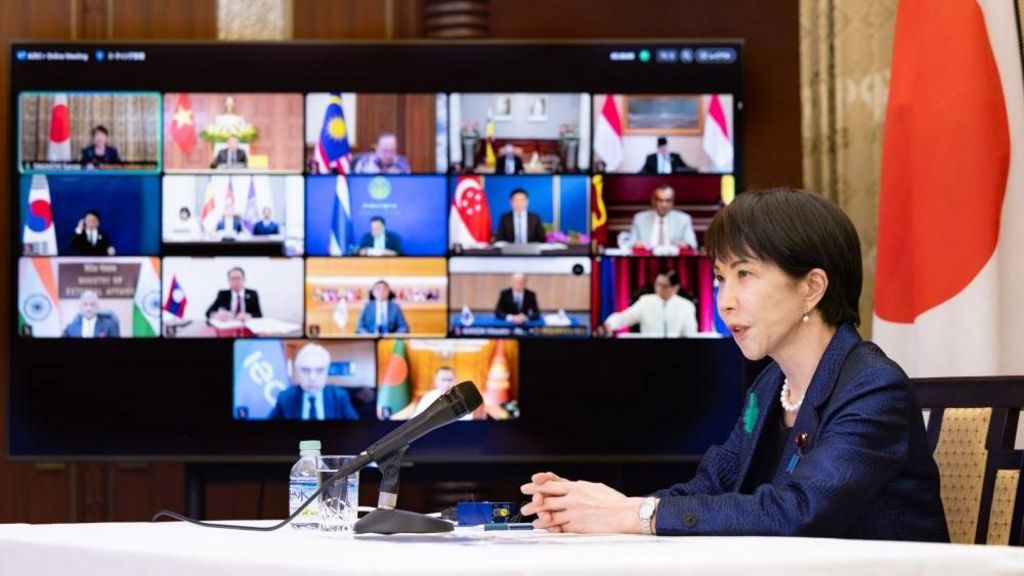
Against a backdrop of sweeping energy market chaos sparked by the ongoing Iran war, Japan has launched a landmark $10 billion (£7.4 billion) cooperation initiative to support neighboring Asian economies, particularly those in Southeast Asia, in stabilizing critical energy supplies including crude oil. The new framework was formally announced Wednesday by Japanese Prime Minister Sanae Takaichi, following a virtual summit that brought together leaders from across the region.
In a post-meeting press briefing, Takaichi emphasized the deep, interconnected economic ties that bind Japan to the broader Asian region, noting that Japan itself relies on Southeast Asian supplies of petroleum-derived products, most crucially for the manufacturing of essential medical equipment. “Japan is closely interconnected with each Asian country through supply chains and mutually dependent with them,” she stated.
The core goals of the cooperation framework are threefold: to help regional states secure steady access to crude oil and refined petroleum products, to preserve the integrity of cross-border supply chains, and to expand strategic energy stockpiling capacity across the region. Geographically, Asia faces uniquely high risk from energy disruptions tied to tensions around the Strait of Hormuz: nearly 90 percent of all oil and gas moving through the critical global chokepoint is destined for Asian markets, leaving the region disproportionately exposed to blockades or shipping interruptions.
According to Japan’s Ministry of Foreign Affairs, the $10 billion pledged is roughly equal to the total annual value of crude oil imports by all member states of the Association of Southeast Asian Nations (ASEAN). The initiative received broad backing from participating leaders, including representatives from the Philippines, Malaysia, Singapore, Thailand, Vietnam, Bangladesh and South Korea. Funding for the plan will be pooled from multiple sources, including Japan’s state-backed financial institutions such as the Japan Bank for International Cooperation, Nippon Export and Investment Insurance, and the Japan International Cooperation Agency, alongside contributions from the Asian Development Bank.
Takaichi moved to reassure the Japanese public, confirming that the new initiative would not compromise domestic energy security in Japan. As of the end of 2025, Japan holds strategic crude oil reserves sufficient to cover 254 days of domestic consumption, though the ongoing global energy crisis has already prompted Japanese authorities to draw down these stockpiles. Last month, Japan released a historic volume of reserves equal to 50 days of domestic use, with a further release equivalent to 20 days of consumption scheduled for early May.
Domestically, Japan continues to grapple with growing anxiety over potential shortages of naphtha, a crude-derived petrochemical that serves as a foundational raw material for plastic manufacturing. These concerns are most acute in the country’s healthcare sector, where critical supplies ranging from syringes and disposable gloves to dialysis equipment depend on naphtha inputs. Japan’s healthcare system is already operating under significant strain from an aging population, and shortages of the material could exacerbate existing pressures. While Takaichi has called for calm, affirming that no immediate supply disruptions are expected, market jitters and public worry persist.
Energy insecurity has already spread across Southeast Asia, where skyrocketing oil prices have hit household budgets and government budgets hard. Many regional governments have rolled out public energy conservation campaigns, urging citizens to carpool and reduce air conditioning use to cut demand. The Philippines has already gone a step further, declaring a national energy emergency. Speaking at Wednesday’s Japan-hosted summit, Philippine President Ferdinand Marcos Jr. called on ASEAN to activate its longstanding regional fuel-sharing pact to mitigate the crisis. “No single country in Asia can insulate itself from supply chain shocks of this scale by acting alone,” he told attendees.