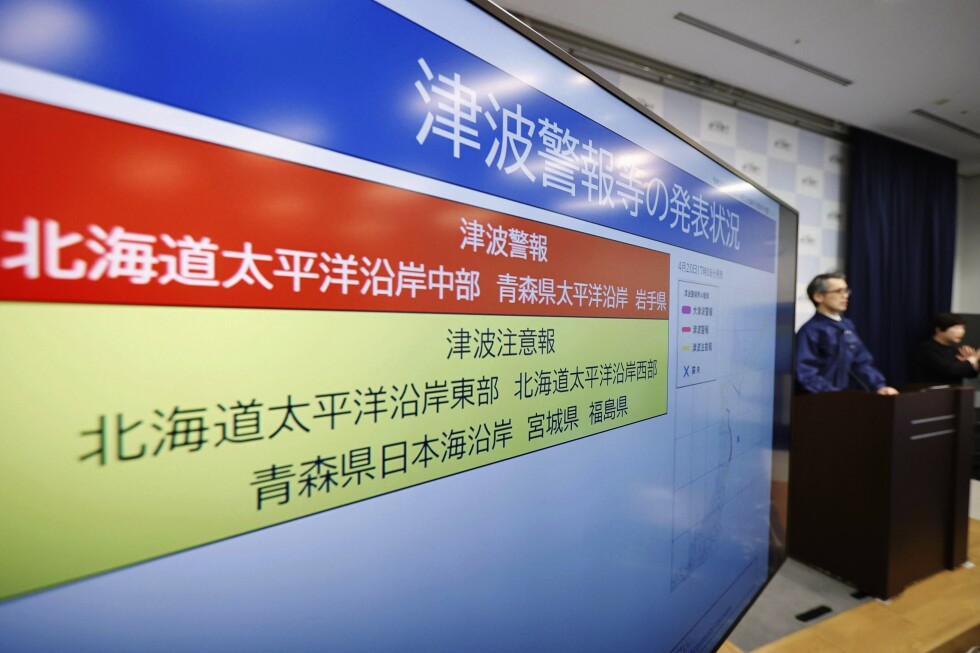
On Monday, a 7.5 magnitude preliminary earthquake shook the seabed off northern Japan’s Sanriku coast, triggering immediate tsunami warnings, mass evacuations, and a rare official advisory warning of an elevated risk of a subsequent massive quake over the coming week.
According to Japan’s Cabinet Office and the Japan Meteorological Agency (JMA), the shallow tremor — which struck at roughly 0753 GMT at a depth of just 10 kilometers near the Chishima Trench — has left a 1% probability of a catastrophic mega-quake striking the region within the next seven days. Officials emphasized that the advisory, only the second such notice issued in the past four months, is not a formal earthquake prediction, but urged local residents to prioritize emergency preparedness, including checking stockpiles of non-perishable food and updating emergency go-bags, while continuing regular daily activities.
Within an hour of the initial quake, JMA detected an 80-centimeter tsunami at Kuji Port in Iwate Prefecture, followed by a smaller 40-centimeter surge at a second port in the same region. Immediately after the tremor, JMA issued a full tsunami alert warning of potential waves reaching up to 3 meters, ordering coastal and riverside residents to evacuate to higher ground immediately. By contrast, the U.S.-based Pacific Tsunami Warning Center later confirmed that the overall tsunami threat from the event had fully passed.
Local disaster management authorities issued non-binding evacuation orders covering more than 128,000 residents across Iwate and three other northern prefectures. Public broadcaster NHK footage showed crowds of residents driving to elevated parks and safe shelters, with many leaving work and school abruptly to reach higher ground. In Tomakomai, a Hokkaido town, one resident told reporters he picked his child up from cram school directly and drove to a hilltop park, where he planned to remain until official alerts were lifted.
As of the latest updates, no significant structural damage, injuries, or casualties have been recorded across the affected region. Japan’s Nuclear Regulation Authority confirmed that all nuclear power facilities in northern Japan remained fully operational with no abnormalities detected, and the Fire and Disaster Management Agency said assessments of critical infrastructure including power grids are still ongoing, with no harm reported so far.
This latest seismic event comes on the heels of another 7.5 magnitude quake that struck the same broader region in December 2023, which injured dozens of people and prompted an identical mega-quake advisory that ultimately proved unnecessary when no major subsequent quake occurred.
Monday’s advisory also arrives amid a somber national milestone: 2026 marks 15 years since the catastrophic 9.0 magnitude 2011 Tohoku earthquake and tsunami that devastated northern Japan. That disaster killed more than 22,000 people, displaced nearly 500,000 residents, and triggered a catastrophic meltdown at the Fukushima Daiichi Nuclear Power Plant. Roughly 160,000 people fled Fukushima Prefecture in the wake of the disaster due to radiation contamination, and more than a decade later, around 26,000 of those displaced have never returned to their hometowns, having resettled elsewhere, facing continued exclusion from contaminated areas, or holding long-term concerns over residual radiation exposure.
JMA officials have additionally warned local residents to remain vigilant for strong aftershocks across the region throughout the coming week.