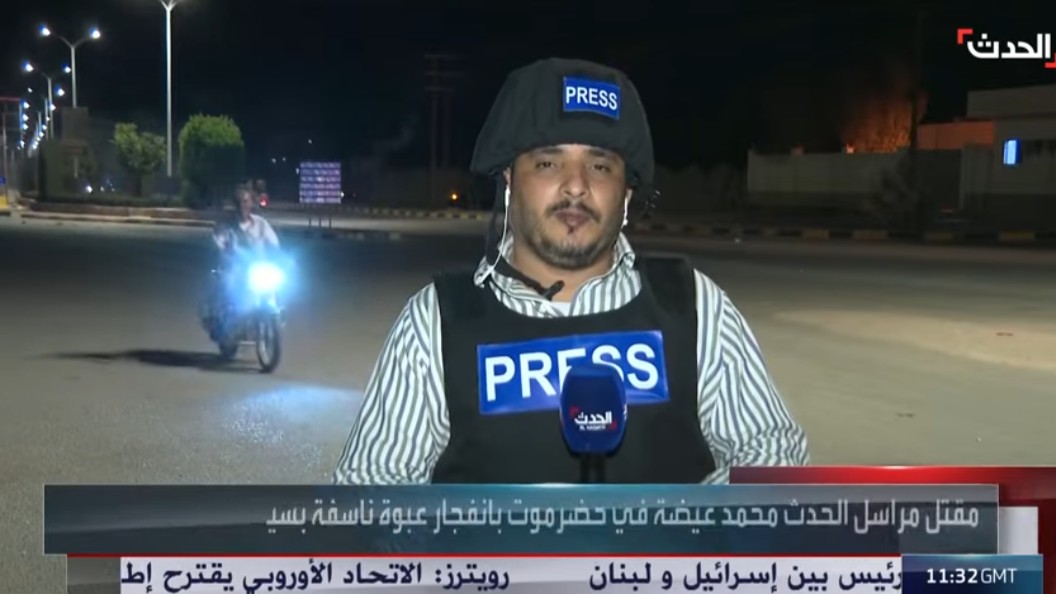
On the evening of June 24, a deadly attack unfolded in central Mukalla, the capital of Yemen’s eastern Hadramaut governorate, that cut short the life of a seasoned regional journalist and pulled back the curtain on deep unresolved political and security fractures in southern Yemen. Forty-year-old Mohammed Aydah, a freelance photographer and correspondent for Saudi state-owned outlet Al Arabiya, had just dropped his family at their residence and was preparing to drive to meet a friend when an improvised explosive device hidden beneath his driver’s seat detonated. The blast engulfed his vehicle in flames on Sitteen Street, close to the city’s Pakistani School, and killed Aydah instantly.
Local security sources confirm Aydah was explicitly warned of threats to his life roughly one month before the attack, with authorities urging him to take strict safety precautions. Since 2019, Aydah had covered political, security, and development beats across eastern Yemen, and his reporting on demonstrations organized by the UAE-backed Southern Transitional Council (STC) – along with his on-the-ground documentation of the group’s governance activities – had made him targets of hostile actors, sources close to the journalist confirm.
As of this report, no faction among Yemen’s deeply fragmented political landscape has claimed responsibility for the killing. The Saudi-backed Presidential Leadership Council (PLC), which is based in Aden, has issued a formal condemnation of the attack. Salem Ahmed Al-Khanbashi, Hadramaut’s governor and the general who led the military operation that retook the region from STC control in early January, has ordered a full official investigation into the incident. Prime Minister Shaya Mohsen al-Zindani has also directed Yemen’s Interior Ministry and all relevant security agencies to prioritize identifying and apprehending those responsible for the assassination.
Political finger-pointing began almost immediately after the attack, with STC representatives quickly shifting blame to Al-Qaeda in the Arabian Peninsula (AQAP) and other independent armed groups. However, this accusation has been widely challenged by regional analysts, who note that AQAP’s established modus operandi centers on sudden, unclaimed large-scale violence rather than forewarned targeted assassinations of specific individuals. Many observers also frame the STC’s statement as political opportunism: by attributing the killing to extremist “terrorist” groups, the organization implicitly argues that such violence was contained during its period of administrative control over southern Yemen.
An anonymous STC National Assembly member rejected all claims of the group’s involvement in an interview with Middle East Eye. “It is true that we consider Saudi Arabia a major enemy, as it has been damaging the south, but that doesn’t mean we will assassinate or welcome the assassination of a civilian journalist,” he said. “We are a project of peace, not death. If we were going to create chaos, we would target Saudi-backed officials, not a journalist.” He also pushed blame onto the Saudi-backed Aden-based government and Hadramaut’s governor, arguing their administration had failed to uphold security, noting that multiple assassinations have rocked southern Yemen in the six months since the STC lost territorial control.
The Houthi movement, which controls Yemen’s capital Sanaa and has fought the Saudi-led coalition for more than a decade, condemned the assassination via its Al Masirah media outlet without assigning blame, while using the incident to emphasize chronic instability in PLC-held territory.
Senior Yemeni and Gulf analyst Ibrahmi Jalal notes that both the Houthis and the STC – which announced its own dissolution in a controversial 2025-2026 political deal – had motive to target Aydah over his critical coverage. “When we look at the landscape and examine who might have access to sleeping cells and sabotage activities with the intent to disrupt and undermine the stability of government-held areas, there are two primary actors: the Houthis and the quote-unquote self-dissolved STC,” Jalal explained.
Aydah’s killing is far from an isolated event. Since the STC’s military defeat and contested dissolution between late December 2025 and early January 2026, targeted political assassinations across southern Yemen have increased sharply. Just last month, Wesam Qaid, CEO of Yemen’s Social Fund for Development, was abducted and killed in Aden. In April, Abdulrahman Al Shaer, an educator and senior leader of the Islah political party, was assassinated. In January, a senior Salafi brigadier general, Hamdi Shukri, who now commands a large southern military region, survived an attempted assassination.
Senior Yemeni political analyst Baraa Shiban notes that in the Al Shaer assassination case, authorities arrested members of a cell with ties to former counterterrorism units that previously operated under the STC’s umbrella. “The prosecution has started the process of making charges, but it will take time,” Shiban said. He added, “Whoever targeted Mohammed wanted to silence him, but it was also a threat to all other journalists.”
Prior investigations by the BBC have already documented direct links between the UAE-backed STC and a string of earlier assassinations in Aden. Many commentators have drawn a key inference from the current trend: while targeted killings were relatively rare during the STC’s period of direct administrative control, their recent surge suggests that STC-affiliated armed networks still retain influence as a militia that no longer holds territory but retains the capacity to carry out coordinated attacks. One anonymous source familiar with Aden’s political climate noted that STC members publicly condemned Aydah’s killing but privately celebrated his death, given his consistent critical coverage of the group’s activities.
Crucially, the STC’s formal dissolution did not result in the full dismantling of its security and military structures. Some units were redeployed to new posts, while others were nominally absorbed into official Yemeni Interim Regional Government institutions. Jalal explains that even integrated units still retain large numbers of personnel loyal to the STC, whose core political goals and loyalties remain unchanged. “It remains to be seen how well they would be absorbed and demonstrate a sense of belonging to an institution that protects the people above all,” he said.
The STC’s exiled leader, Aidarous al-Zubaidi, fled to Abu Dhabi in January and continues to issue political statements from abroad. Regional analysts widely agree that the UAE does not view the STC’s recent territorial setback as a permanent defeat, and continues to back the group as a proxy in Yemen’s ongoing internal conflict.
Aydah’s assassination comes at a particularly sensitive moment for Saudi Arabia’s engagement in Yemen. Just two weeks before the attack, Riyadh signed a $150 million agreement to supply petroleum derivatives to Yemeni power plants – the latest installment of more than $12.6 billion in Saudi development and humanitarian support for Yemen since 2012. A high-profile ceremony was even held in Mukalla itself to open a new 100 MW power plant, developed through a tripartite partnership between the Saudi Development and Reconstruction Programme for Yemen, Yemen’s Ministry of Electricity, and Gulf Power International.
Yemeni President Rashad al-Alimi has publicly framed Saudi economic assistance as the critical foundation holding Yemeni government institutions together, and has asked Yemenis to exercise “more patience” to see the full benefits of these investments. For ordinary Yemenis across government-held territory, access to basic services like electricity and clean water remains the top priority, and many express support for whichever political faction can deliver these necessities.
Murad Ali, a 60-year-old construction laborer from Aden supporting seven family members, says his only focus is securing food and basic needs for his household, but he still holds out hope the government can expand access to critical services. “Our government failed to provide us with electricity, healthcare, or any other basics, and it is Saudi Arabia that has been helping us since January 2026 to access basic services,” he told Middle East Eye.
Yet public patience is wearing thin. In early June, as temperatures soared across southern Yemen and chronic power outages continued, hundreds of Aden residents took to the streets, sleeping outside on mattresses to protest the lack of consistent electricity. Local sources describe the protests as fundamentally apolitical, driven by anger at failing infrastructure rather than opposition to the PLC administration, and note that STC organizers attempted to co-opt the demonstration and ultimately failed. “When we took to the streets, we were calling on Saudi Arabia to help us because we know it is the only country that can. We cursed our government because it deserves it, but we didn’t call on them because we know they are unable to help,” Ali said.
Jalal argues that the growing gap between Saudi-backed reconstruction rhetoric and on-the-ground security reality represents a major vulnerability for the PLC and its backers. “When we look at the profiles of those targeted – a journalist, a religious figure, teachers, a social development champion, military commanders – the picture indicates that most societal figures, regardless of their walk of life, are under a sustained elimination attempt,” he explained. “The motive is to instil fear, demonstrate instability, question trust in the government and its backer Saudi Arabia, and shake the image that is now enabling the government to seek increased support from international development institutions like the World Bank and the IMF.”
Underpinning all current tensions is an unfinished national political process. Following the military recapture of southern territory from the STC, PLC President Rashad al Alimi called for a comprehensive Southern Dialogue Conference to be hosted by Saudi Arabia, but no date has yet been set for the talks. In February, STC-affiliated demonstrators stormed a government building in Ataq; security forces responded, killing five protesters and wounding 39 others.
Saudi Arabia’s current strategy hinges on using infrastructure investment, an inclusive southern political process, and the unification of military command under the PLC to consolidate control over southern Yemen before turning its full attention back to the northern front against the Houthis. Jalal notes that meaningful stabilization will require a far more comprehensive multi-pronged approach than Riyadh has pursued to date.
“Economically, the government needs more than emergency funding: it needs to improve domestic revenue collection and resume oil and gas exports, which have been hampered since 2015 and 2022 respectively,” he said. “On security, undoing a decade of fragmentation requires time, but also a more adaptive and proactive approach. The full cabinet leadership needs to return to the country, to be with the people, rebuild institutional trust, and pave the way for recovery.”
Whether Aydah’s assassination is ultimately linked to STC remnants or another armed faction, the killing makes clear just how much of Yemen remains politically unsettled, even in territory formally controlled by the Saudi-backed PLC. Shiban struck a defiant note on the implications for press freedom in the country: “Whoever targeted Mohammed wanted to silence him, but it was also a threat to all other journalists. At the end of the day, they won’t be able to silence everyone if everyone is speaking up and everyone is active.”