Israel’s recent intensification of military operations against Hezbollah in southern Lebanon has triggered a devastating humanitarian crisis, with official casualty counts topping 1,300 people killed and more than one million residents displaced from their homes. Intensive Israeli airstrikes have leveled critical civilian infrastructure across southern Lebanon, including residential neighborhoods, places of worship, medical facilities, and key bridge crossings over the Litani River. One of the most heavily targeted areas has been Dahieh, the densely populated southern suburbs of Beirut, a site that holds outsized significance for Israeli military strategy: it was here that the Israeli Defense Forces first formally put the so-called “Dahieh Doctrine” into practice two decades ago.
This controversial military strategy has since been systematically deployed by Israel across multiple conflict zones, most infamously in its ongoing military campaign in the Gaza Strip that began in October 2023, which has killed more than 72,000 people to date, the vast majority of them civilians. Even before the current Lebanon offensive launched on March 5, Israeli far-right Finance Minister Bezalel Smotrich explicitly teased the coming application of the doctrine in a video posted to X, stating that “very soon Dahieh will look like Khan Younis” — the decimated southern Gazan city that has been reduced to ruins by months of Israeli bombardment. This analysis from Middle East Eye unpacks the origins, implementation, and global legal standing of the polarizing Israeli military tactic.
At its core, the Dahieh Doctrine advocates for the use of massively disproportionate force against civilian populations and civilian-held infrastructure in areas where armed groups are alleged to operate. The strategy’s explicit goal is to inflict widespread suffering on local civilian communities to stoke domestic resentment against the armed group in question — whether that is Hezbollah in Lebanon or Hamas in Gaza — and ultimately deter future attacks against Israeli territory.
Dahieh, located immediately south of central Beirut, is a densely packed urban neighborhood whose population is overwhelmingly Shia Muslim, with a smaller share of residents from other Lebanese communities. A large share of the area’s residents identify as Hezbollah supporters or voters, and it also hosts many active members of the group. Many analysts, including prominent American economist Paul Krugman, traced the doctrine’s intellectual roots back to the U.S. military’s “shock and awe” strategy, which was deployed during the 2003 U.S.-led invasion of Iraq.
The term “shock and awe” was first coined by military theorists Harlan K. Ullman and James P. Wade in a 1996 academic work. The framework argues that displays of overwhelming, overwhelming force can quickly overwhelm and demoralize both enemy combatants and the civilian population supporting them. The strategy explicitly targets core civilian infrastructure, including communication networks, transportation hubs, food production systems and water supplies to cripple everyday function in enemy-held territory. In the 2003 Iraq invasion alone, more than 6,700 Iraqi civilians were killed in the initial invasion phase, and cumulative civilian deaths across the entire subsequent conflict are estimated to reach at least 200,000. Ullman and Wade themselves cited earlier historical precedents for the approach, including the 1945 U.S. nuclear bombings of Hiroshima and Nagasaki, and the 1994 Russian assault on Grozny during the First Chechen War.
Unlike formal, publicly documented Israeli military doctrines, the Dahieh Doctrine was first outlined explicitly by Israeli military officials and independent analysts in the aftermath of Israel’s 2006 war on Lebanon. During that conflict, Israel justified widespread bombardment across Lebanon after Hezbollah captured two Israeli soldiers. Then-Israeli Major General Udi Adam, who commanded the 2006 operation against Hezbollah, stated publicly in July 2006 that “once it is inside Lebanon, everything is legitimate – not just southern Lebanon, not just the line of Hezbollah posts.” Over the 33-day 2006 war, Israel killed more than 1,200 people and wounded more than 4,400, with the worst destruction concentrated in Dahieh, where Israeli bombing destroyed more than 15,000 residential homes.
Major General Gadi Eisenkot, who served as Head of Israeli Military Operations during the 2006 assault, later went on to become IDF Chief of Staff from 2015 to 2019 and a cabinet minister in Benjamin Netanyahu’s far-right government from 2023 to 2024. In October 2008, two years after the end of the Lebanon war, Eisenkot openly confirmed the doctrine’s core principle: “What happened in the Dahieh quarter of Beirut will happen in every village from which Israel is fired on. We will wield disproportionate power against every village from which shots are fired on Israel, and cause immense damage and destruction. From our perspective, these are military bases. This isn’t a suggestion. This is a plan that has already been authorized.”
That same week, Tel Aviv University’s Institute for National Security Studies published a landmark report by Israeli Colonel Gabriel Siboni titled “Disproportionate Force: Israel’s Concept of Response in Light of the Second Lebanon War” that formalized the doctrine. The report argued that “with an outbreak of hostilities, the IDF [Israeli military] will need to act immediately, decisively, and with force that is disproportionate to the enemy’s actions and the threat it poses. Such a response aims at inflicting damage and meting out punishment to an extent that will demand long and expensive reconstruction processes.” The report added that disproportionate force was necessary “to make it abundantly clear that the State of Israel will accept no attempt to disrupt the calm currently prevailing along its borders.”
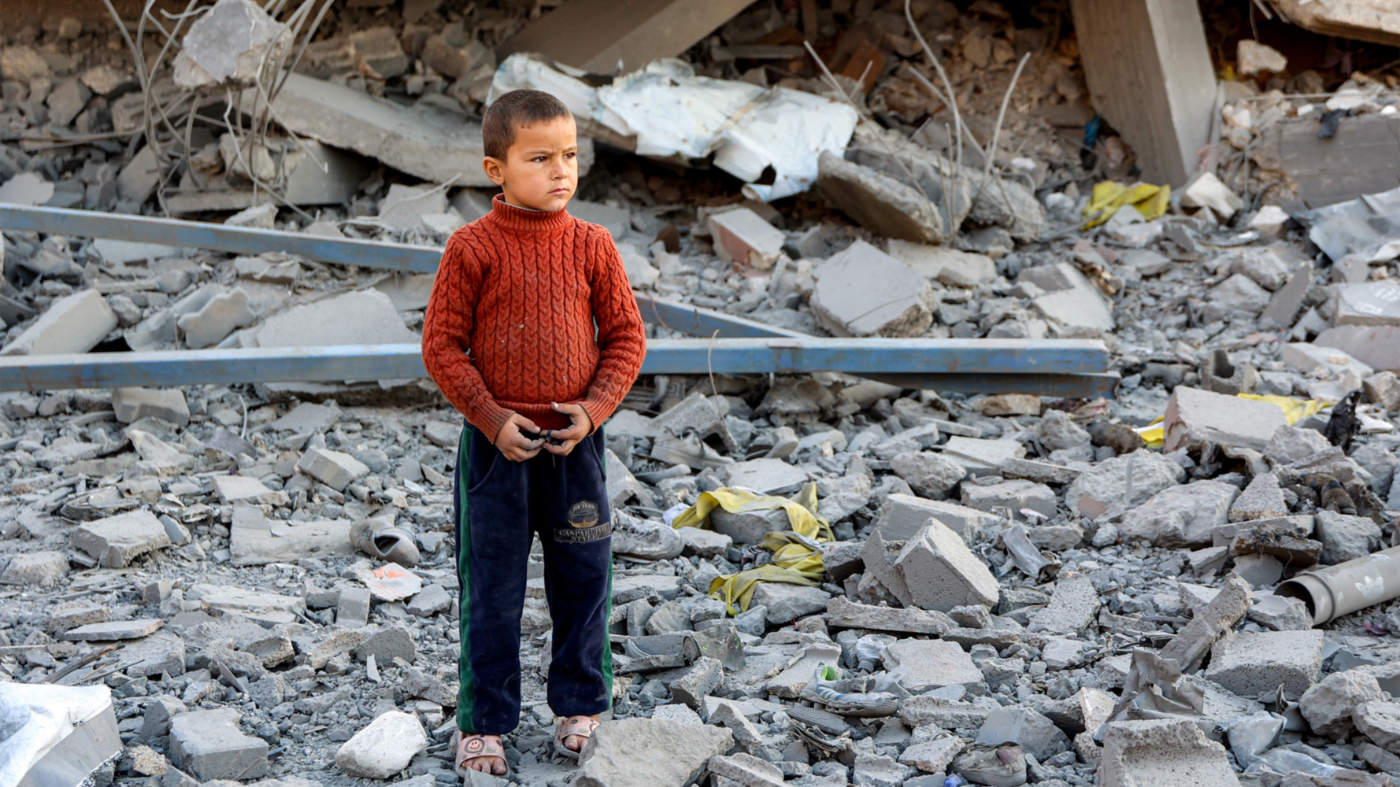
Israel has deployed this strategy repeatedly against civilian populations in the Palestinian territories, which it has occupied illegally under international law since 1967. In Gaza, data from the United Nations Satellite Centre shows that Israeli bombardment has destroyed roughly 80 percent of all structures across the strip, including residential homes, schools, hospitals, sewage treatment plants and marketplaces. Just three days into the October 2023 Israeli campaign, IDF spokesperson Daniel Hagari publicly confirmed the strategy’s priorities, stating: “While balancing accuracy with the scope of damage, right now we’re focused on what causes maximum damage.”
As the current Lebanon offensive has expanded, Israel has already renewed heavy strikes on Dahieh itself, echoing the 2006 destruction. Before the 2023 Gaza war, Israel deployed the Dahieh Doctrine in two major prior offensives in Gaza. During the 2008-2009 invasion, Israel killed more than 1,400 Palestinians, destroyed more than 4,000 residential homes, and deployed white phosphorus munitions — weapons that cause permanent, often fatal burns — in densely populated civilian areas; just 13 Israelis were killed in the conflict. In the 2014 Gaza war, Israel killed more than 2,000 Palestinians, two-thirds of whom were confirmed civilians, including more than 500 children and nearly 300 women.
Under core international humanitarian law treaties, the deliberate targeting of civilian populations and civilian infrastructure is explicitly classified as a war crime. Article 48 of the Fourth Geneva Convention requires that “The Parties to the conflict shall at all times distinguish between the civilian population and combatants.” Article 51 further prohibits any attack “which may be expected to cause incidental loss of civilian life, injury to civilians, damage to civilian objects, or a combination thereof, which would be excessive in relation to the concrete and direct military advantage anticipated.”
The Rome Statute, which establishes the legal framework for the International Criminal Court (ICC) and codifies the international crimes of genocide, crimes against humanity, and war crimes, also explicitly bans disproportionate attacks on civilian communities. The statute prohibits “intentionally launching an attack in the knowledge that such attack will cause incidental loss of life or injury to civilians or damage to civilian objects or widespread, long-term and severe damage to the natural environment which would be clearly excessive in relation to the concrete and direct overall military advantage anticipated.” Currently, ICC arrest warrants are active for Israeli Prime Minister Benjamin Netanyahu and former Defense Minister Yoav Gallant, accusing the pair of committing war crimes and crimes against humanity during Israel’s ongoing military campaign in Gaza.
The Dahieh Doctrine was formally identified and condemned by the 2009 Goldstone Report, a United Nations fact-finding commission investigation into Israel’s 2008-2009 Gaza war. The commission found that Israeli strategy during the conflict was “designed to punish, humiliate and terrorize a civilian population” and added: “The tactics used by the Israeli armed forces in the Gaza offensive are consistent with previous practices, most recently during the Lebanon war in 2006. A concept known as the Dahiya doctrine emerged then, involving the application of disproportionate force and the causing of great damage and destruction to civilian property and infrastructure, and suffering to civilian populations. The Mission concludes from a review of the facts on the ground that it witnessed for itself that what was prescribed as the best strategy appears to have been precisely what was put into practice.”
The doctrine has also faced repeated condemnation from leading international human rights experts, including Richard Falk, the former United Nations Special Rapporteur on Palestinian human rights. Writing in April 2024, six months into Israel’s ongoing Gaza campaign, Falk noted that there was not “the slightest effort on Eisenkot’s part to reconcile the Dahiya Doctrine with international humanitarian law, which imposes a limit of proportionality on any use of force in situations of international combat.”