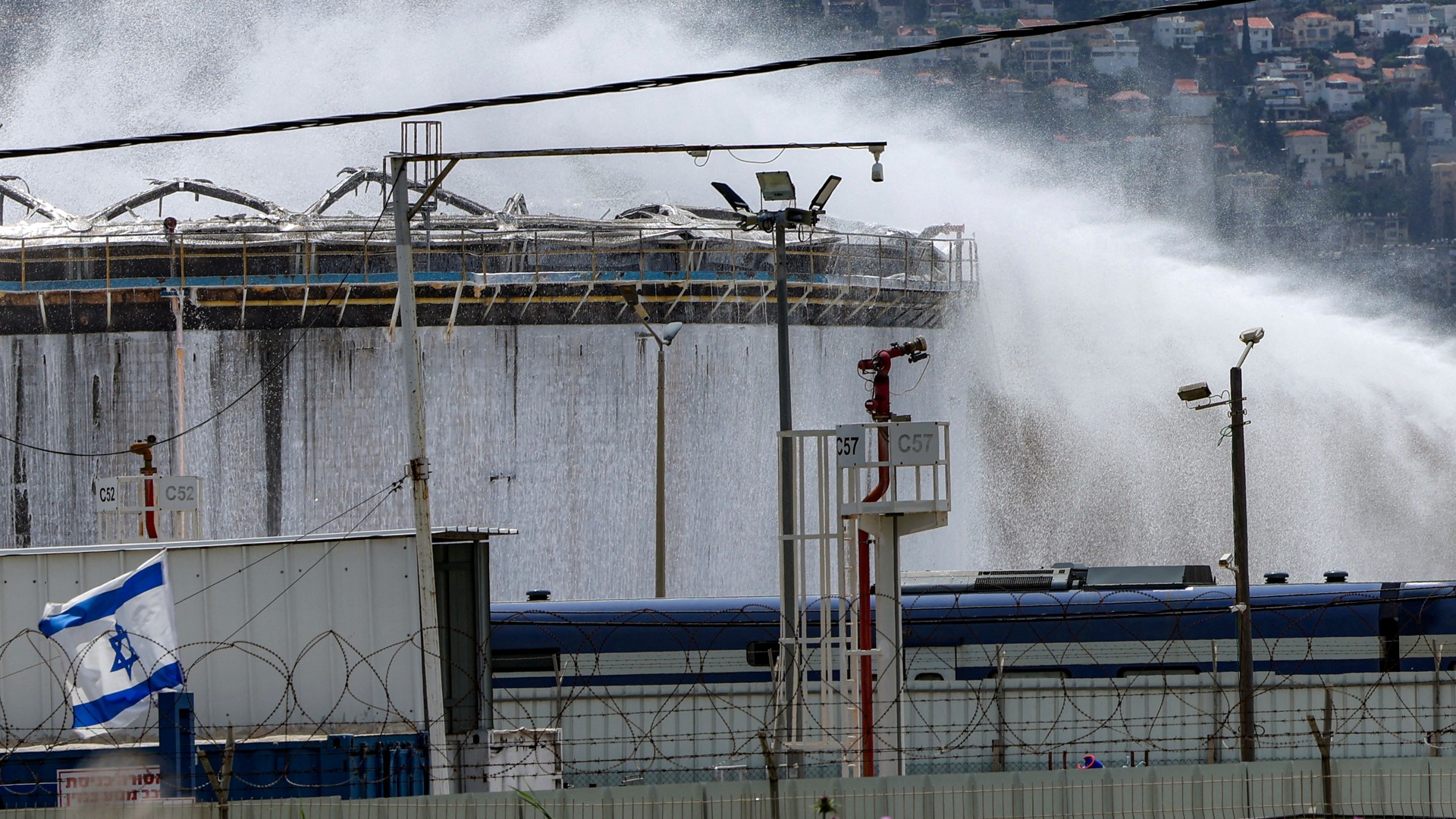
For months, Israeli officials and the operator of the country’s largest oil refining complex downplayed the impact of Iranian missile attacks on the strategic Haifa Bay facility. But new reports from multiple Israeli media outlets have pulled back the curtain on far more extensive destruction than was originally disclosed to the public, revealing a years-long reconstruction timeline that will reshape the site’s operational capacity for the foreseeable future.
The revelation comes amid longstanding Israeli military censorship that has restricted the flow of information about damage from Iranian strikes during ongoing US-Israeli military conflict with Iran, raising new questions about government transparency around the economic and security costs of regional hostilities.
Israeli Channel 12 News first broke the revised account of the damage on Monday, confirming that two separate Iranian strikes carried out earlier this year inflicted critical harm to the refinery complex, directly contradicting prior statements from Energy Minister Eli Cohen and Bazan, the private company that manages the site. Just months ago, in a formal filing to the Tel Aviv Stock Exchange in March, Bazan sought to downplay the incident, acknowledging only “localised damage” to the roof of a single distillate storage tank, and insisting all production infrastructure remained fully operational. “The company estimates that the damage is not significant. As of the time of this announcement, all the company’s facilities remain operational,” the company stated at the time.
But an unreleased official internal report from Israel’s Ministry of Interior, cited by Israeli outlet Yeshiva World, documents harm to critical infrastructure that was never made public: gas turbines, steam boilers, and central electrical rooms all sustained heavy damage that was hidden from public view. The Interior Ministry has now approved a massive reconstruction project that is not scheduled to reach full completion until 2028, a timeline that would have been unthinkable based on the original, minimal damage assessment.
Worse still, one large oil derivatives storage tank hit in the March 2025 strike is completely beyond repair, and cannot be salvaged or returned to service. The damage did not begin this year, either: Channel 12 confirmed the refinery also sustained significant damage during the 12-day 2024 Israel-Iran war. In that June 2025 strike, three Bazan employees were killed after Iranian missiles successfully penetrated the US-backed Iron Dome mobile air defense system, a defensive barrier that Israeli officials have long claimed provides near-total protection against incoming projectile attacks. After that earlier strike, Bazan publicly pegged losses at only $150 million to $200 million, and officials insisted domestic fuel supplies would remain completely unaffected, a claim that can now be reexamined in light of the new disclosures.
The Haifa Bay refineries are far more than a standard industrial site: they are one of Israel’s most strategically critical energy assets, meeting the majority of domestic demand for refined oil products that power manufacturing, agriculture, national infrastructure, and household consumption across the country. Per Bazan’s own public data, the complex processes roughly 26,000 tonnes of crude oil per day, and has an annual throughput capacity of 9.8 million tonnes of crude oil.
The facility also carries deep historical significance: it was originally constructed during the British Mandate for Palestine, when British authorities built the complex to receive crude oil transported from Iraq via the historic Kirkuk-Haifa pipeline. When Israeli forces seized control of Haifa during the 1948 Arab-Israeli war and established the State of Israel, the new government nationalized and took full control of the refineries, and the site’s iconic Bazan cooling towers have since become one of the most recognizable landmarks of the northern port city.
The underreporting of damage to the refinery is not an isolated incident: for years, Israel has enforced strict military censorship to conceal the full extent of damage caused by Iranian missile attacks across the country. Data collected by independent Israeli outlet +972 Magazine, which has tracked military censorship trends since 2011, shows that censorship reached a 13-year peak in 2024, when roughly 8,000 articles were either fully banned from publication or partially redacted. While the total number of censored articles declined slightly in 2025 to around 5,000, that still marks the second-highest annual censorship total recorded since +972 began its tracking.
Iran has targeted a wide range of high-value strategic sites across Israel during the ongoing conflict, beyond the Haifa Bay refineries: reported targets have included the Kirya, Israel’s central military headquarters in Tel Aviv, the prestigious Weizmann Institute of Science, the Nevatim Airbase in southern Israel, and the commercial port of Haifa. Earlier this month, the Times of Israel published confirmation of additional damage at the Ramat David airbase, based on analysis of low-resolution satellite imagery of the site.
This story was originally published by Middle East Eye, an independent outlet specializing in original, on-the-ground coverage of the Middle East and North Africa region.