On Thursday, tens of thousands of Israeli nationalists poured through the winding cobblestone alleyways of Jerusalem’s Old City for the annual Jerusalem Day parade, an event marking Israel’s 1967 capture and unilateral annexation of East Jerusalem that has a long history of escalating into conflict. As hardcore ultranationalist marchers chanted virulently anti-Palestinian slogans including “Death to Arabs” and “May your villages burn,” most Palestinian residents of the historically contested neighborhood locked themselves inside their homes, boarding up storefronts to avoid targeted intimidation and violence.
Jerusalem Day commemorates what Israeli officialdom calls the “reunification” of the city after the 1967 Arab-Israeli War, a conflict that left Israel in control of East Jerusalem – a territory home to a majority Palestinian population that the United Nations and much of the international community have never recognized as legally annexed by Israel. For decades, the annual parade has been a flashpoint for intercommunal tension, with young ultranationalist participants regularly targeting local Palestinian communities with verbal abuse, threats, and physical assault. This year’s march unfolded against a fragile regional backdrop, coming just weeks after a ceasefire halted fighting between Israel and Hamas in Gaza that has been violated by near-daily incursions and strikes on both sides.
Local Palestinian residents described scenes of deliberate harassment and property damage during the 2024 march. Mustafa, a resident of the Old City’s Via Dolorosa, told Agence France-Presse that a group of roughly 20 ultranationalist Israeli youth forced their way into his home’s courtyard, shattering glass and breaking down doors while screaming racist chants. “If you push them, you’ll go to prison… you can’t do anything,” he explained, describing the helplessness many residents feel amid the annual show of force. Most Palestinian shop owners closed their businesses for the day, pulling down metal shutters and abandoning the busy commercial lanes of the Old City.
A small group of grassroots activists from the joint Israeli-Palestinian movement Standing Together deployed across the neighborhood to protect remaining open shops and residents from attack, but social media footage and on-the-ground reporting showed activists being shoved and surrounded by aggressive marchers. In one viral clip, young marchers hurled plastic chairs at a Palestinian shopkeeper while screaming anti-Arab slurs, before the shopkeeper responded by throwing one chair back and brandishing a stick in self-defense. One anonymous Palestinian shop owner told AFP that tensions and aggression have escalated annually: “The situation gets worse every year.”
Among the march’s high-profile participants was Israeli far-right National Security Minister Itamar Ben Gvir, who used the occasion to visit the contested Al-Aqsa Mosque compound – the third-holiest site in Islam, known to Jews as the Temple Mount and Judaism’s most sacred site. “Fifty-nine years after the liberation of Jerusalem, I raised the Israeli flag on the Temple Mount, and we can say with pride: we have restored sovereignty over the Temple Mount,” Ben Gvir wrote on his Telegram channel, as he was photographed marching alongside crowds flanked by a heavy security detail.
Many participating marchers expressed openly exclusionary views about Palestinian and non-Jewish presence in the city. Reuven, a 37-year-old who attended the parade with his young son, told AFP: “Christians and Muslims can stay here, but this city, one united city, belongs to the Jews.” The crowd also included members of Hilltop Youths, a hardline settler movement linked to routine attacks on Palestinian communities in the Israeli-occupied West Bank, one of whom stated “They have no place here” when asked about Palestinian residents. Marchers also targeted journalists covering the event, shoving reporters and blocking them from filming the unrest.
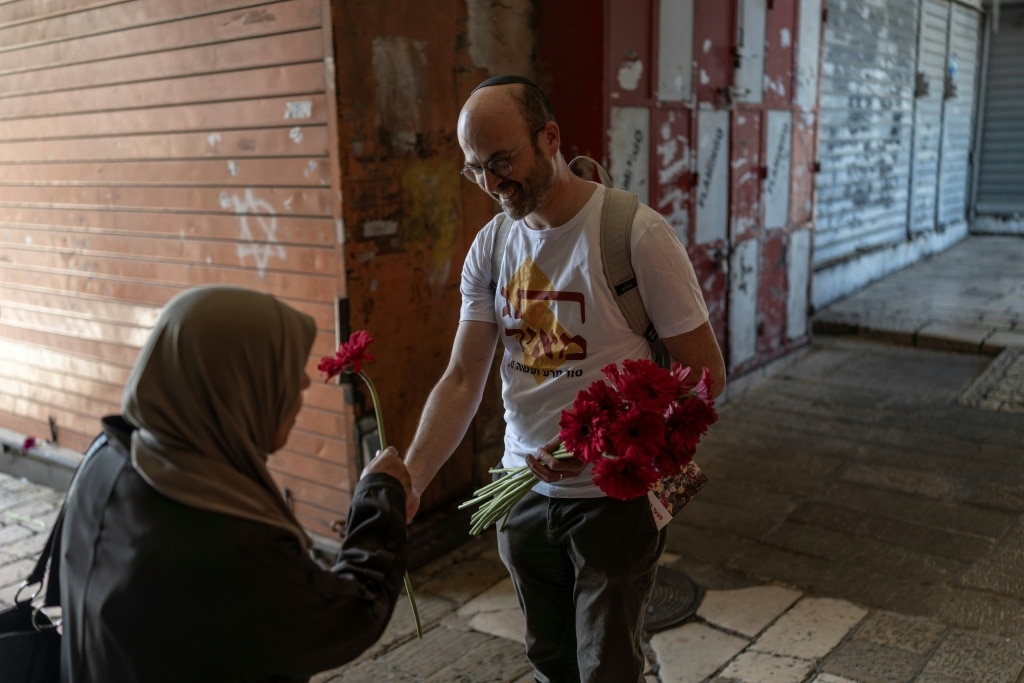
AFP correspondents on the ground confirmed that racist chants and vandalism unfolded under the direct observation of Israeli police deployed heavily across the area, with marchers pounding on the closed shutters of Palestinian shops in a deliberate show of intimidation. Not all attendees supported the aggressive rhetoric, however: a small contingent of Israeli peace activists handed out flowers to local residents to show solidarity with the Palestinian community. “It was important for me to come in order to show some solidarity with the local community and say that as a Jew, as a Zionist, as someone who wants a Jewish state here, I want them to be part of it and be part of the nation with equal rights,” said 52-year-old tech worker Ilan Perez, who traveled from the Tel Aviv suburb of Raanana to participate in the counter-protest.