The world’s most-watched live televised music competition has narrowed its field, as the second semi-final of the 70th Eurovision Song Contest concluded Thursday night at Vienna’s Wiener Stadthalle, locking in the final 10 spots for Saturday’s grand finale. Among the advancing acts are Romania’s boundary-pushing heavy metal entry, Denmark’s love letter to nightclub culture, and Australian pop icon Delta Goodrem, joining 15 other countries already qualified for the 25-act final showdown.
Fifteen competing artists from across Europe and beyond took the iconic stage Thursday, each vying for a chance to compete for Eurovision’s highest honor in front of a global audience expected to top 150 million viewers. Joining front-runners Australia, Denmark, and Romania in the final line-up are Albania, Bulgaria, Cyprus, the Czech Republic, Malta, Norway and Ukraine. Five nations saw their Eurovision 2025 journeys end on Thursday: Armenia, Azerbaijan, Latvia, Luxembourg and Switzerland failed to earn enough support to advance. Like the final, semi-final results are determined by a combination of public televoting and scores from professional industry juries. As crowds waited for the tense result announcement, they marked the Vienna host city with a mass, audience-wide Viennese waltz, turning the arena into a giant dance floor.
The semi-final was packed with the over-the-top spectacle and emotional storytelling that Eurovision is famous for. Bulgaria’s pop star Dara kicked off the party energy with her choreography-heavy performance of “Bangaranga”, while Cyprus’ Antigoni delivered a sultry rendition of her track “Jalla”. The Czech Republic’s Daniel Zizka turned in an intimate, visually striking performance of “Crossroads”, filmed in close-up against a swirling hall of mirrors that evoked the effect of a vintage zoetrope. Armenia’s Simon brought high energy to “Paloma Rumba”, a track about working-class frustration, with a staging that saw him trapped inside a lift wearing a jacket plastered with yellow sticky notes. Ukraine’s Leleka earned cheers for her powerful, ear-splitting high notes, while Switzerland’s Veronica Fusaro performed tangled in dramatic red stage webbing, and Latvia’s Atvara delivered a soft, haunting performance of “Ena” against a backdrop evoking broken glass.
Romania’s entry “Choke Me” sparked minor controversy in the lead-up to the contest over its provocative title and lyrical themes, but the heavy rock act turned in a showstopping performance that won over voters. Singer Alexandra Capitanescu, a master’s student in physics at the University of Bucharest, has defended the track’s artistic meaning, explaining that “Unlike the classic heart, which represents romance or cute love, the anatomical heart suggests vulnerability… and emotions that feel intense, physical and almost painful.”
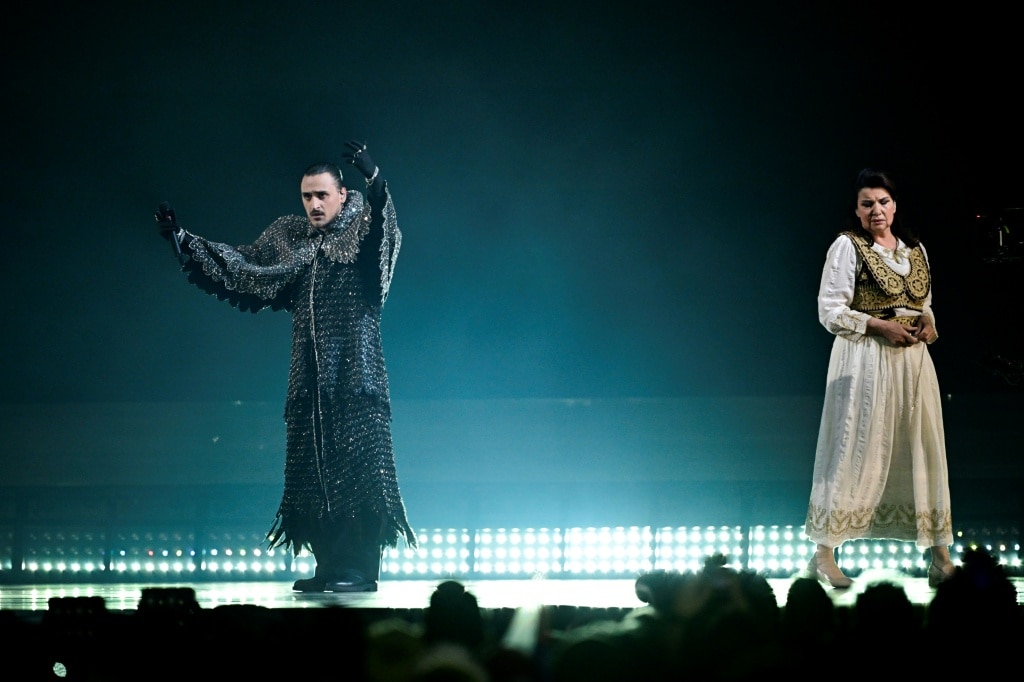
Albania’s entry offered one of the night’s most moving quiet moments: Alis performed “Nan”, a heartfelt ballad about grieving a lost mother, with a cameo from 67-year-old veteran Albanian actress Rajmonda Bulku playing the fleeting maternal figure. Alis shared after the performance that he originally planned to have his own mother appear on stage, but scrapped the idea because “I would get so emotional” performing with her.
Australia, which has competed as an invited guest at Eurovision since 2015, advanced with Goodrem, the 41-year-old singer who rose to global stardom with a string of hits in the early 2000s. Her performance of “Eclipse”, a track inspired by the astronomical alignment of planets, wowed the more than 10,000 fans packed into the Wiener Stadthalle. Goodrem performed atop a glittering grand piano before rising into the air on a hydraulic lift as sparks rained down from the arena ceiling. “It’s higher than it looks! I can see the whole room. I definitely get a great vantage point up there,” she said after her set.
Denmark’s Soren Torpegaard Lund, a former musical theatre performer, brought the crowd to its feet with “For Vi Gar Hjem” (Before We Go Home), an ode to late-night club nights that has quickly become a fan favorite. “I did a little wave around and just hearing the roar is crazy. I’ve never played for so many people,” Lund said after advancing.
This year’s contest also included a pre-taped segment addressing common misperceptions about Eurovision’s long ties to the LGBTQ community. Presenter Victoria Swarovski took to a fictional lecture hall to respond to the question: “Why are there only gays at the Eurovision now? Have they taken over?” She walked through the contest’s 70-year history of embracing queer communities and concluded with a joke: “No takeover detected”. Eurovision director Martin Green told reporters the segment was a timely statement of the contest’s values. “It’s timely, and I think it is a message to the world that we, for 70 years, have given a voice to the voiceless and welcomed the disenfranchised,” he explained.
Going into Saturday’s grand final, Finland remains the bookmakers’ overall favorite to take home the Eurovision trophy, with Romania and Australia ranked among the top contenders. Fans around the world are now gearing up for the glitzy, drama-filled final that has become a cultural staple for more than half a century.