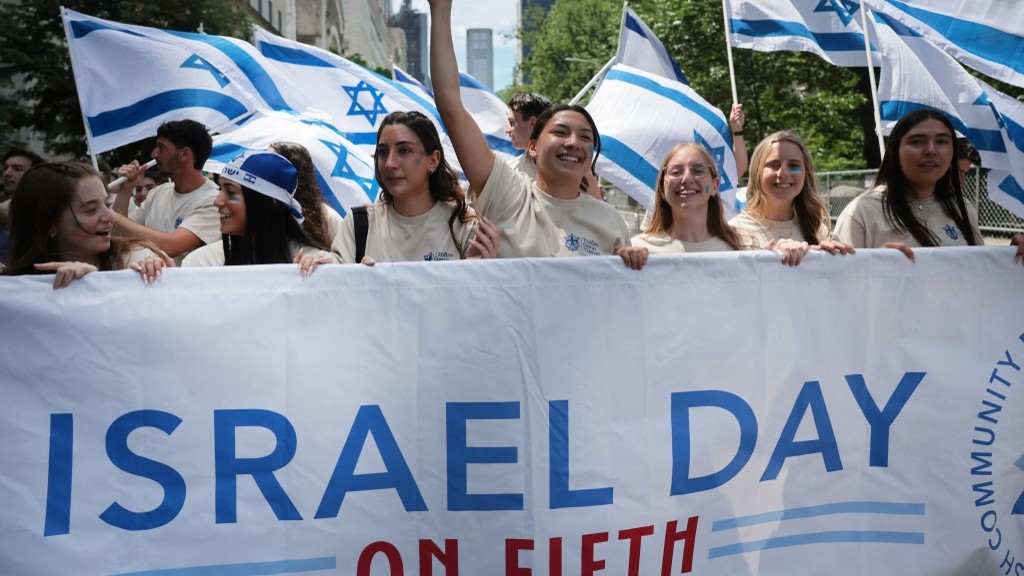
On a sunny Sunday in New York City, one of the most high-profile annual pro-Israel events on the U.S. political calendar unfolded against a shifting global and domestic landscape, marked by growing condemnation of Israel’s military campaign in Gaza and rising international isolation for the Israeli government. At the center of controversy this year were two far-right Israeli cabinet ministers who have openly advocated for extreme anti-Palestinian policies, who led a delegation of 13 Knesset members to the parade.
Bezalel Smotrich, Israel’s extremist Finance Minister, has long pushed for the total expulsion of Palestinian people from Gaza and the complete destruction of the blockaded enclave. As early as May, Middle East Eye revealed that the Office of the Prosecutor at the International Criminal Court had submitted a confidential application for an arrest warrant against Smotrich, citing allegations of multiple war crimes and crimes against humanity against Palestinians in the Israeli-occupied West Bank. The charges against him include forced displacement, the illegal transfer of Israeli civilian settlers into occupied territory, and systemic persecution and apartheid, all classified as crimes against humanity under international law.
Speaking to crowds gathered for the parade, Smotrich drew parallels between the New York event and the Jerusalem Flag March, an infamous ultra-nationalist procession that cuts through the Muslim Quarter of Jerusalem’s Old City. That annual event has a well-documented history of participants chanting violent anti-Arab slogans and physically assaulting Palestinian and Christian residents of the city.
Smotrich was joined on the delegation by Amichai Eliyahu, Israel’s Heritage Minister, who gained global infamy last year for openly calling for the use of nuclear weapons against Gaza, which was home to 2.1 million Palestinian civilians before the outbreak of the current conflict. Eliyahu has also publicly supported a deliberate policy of starvation against the enclave’s population, stating there was nothing wrong with bombing Palestinian food and fuel stockpiles, and that the territory’s residents “should starve.”
For decades, the New York Israel Day Parade has been a staple of local and national political life, widely regarded as an informal loyalty test for U.S. elected officials hoping to demonstrate their support for the Israeli government. But the 2025 iteration came as criticism of Israel’s military operations across Gaza, Lebanon, and Iran reaches new heights around the world.
In a historic break with precedent, New York Mayor Zohran Mamdani — the city’s first Muslim mayor, and a longstanding public critic of Israeli policy — became the first mayor in the event’s history to skip the parade entirely. Mamdani has repeatedly accused Israel of perpetrating genocide in Gaza, and has publicly stated he would move to arrest Israeli Prime Minister Benjamin Netanyahu if Netanyahu visited New York City.
Mamdani’s boycott comes as U.S. public opinion on Israel has shifted dramatically over the past three years. A recent April survey from the Pew Research Center found that 60% of American adults now hold an unfavorable view of Israel, a jump from 53% one year ago, and an increase of nearly 20 percentage points since 2022.
This declining public support has coincided with growing scrutiny of decades of unwavering U.S. backing for Israel, which has received tens of billions of dollars in military aid and consistent diplomatic cover from successive U.S. presidential administrations.
Israel’s global standing has also taken a hit from the economic ripple effects of recent escalating conflict between Israel and Iran, which has driven up global energy prices. Data from Moody’s Analytics shows that U.S. consumers have paid nearly $60 billion in extra fuel-related costs in just three months, with the average American household seeing an additional $447.19 in annualized costs as energy prices and air travel fares spiked across the country.