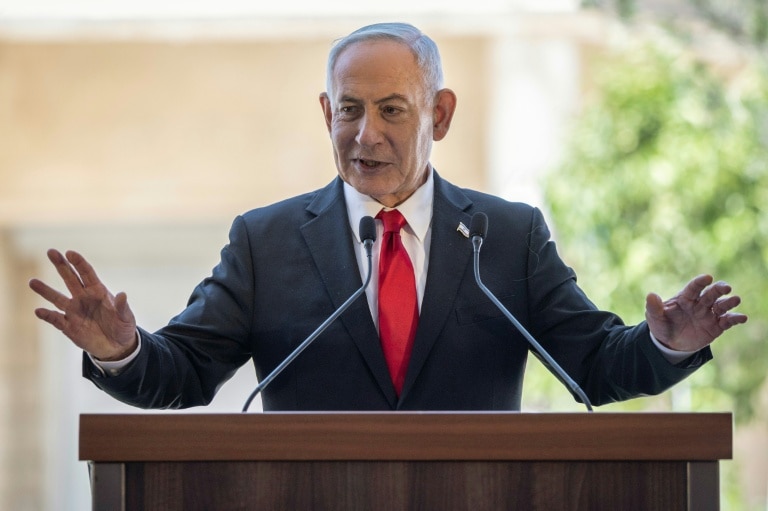
Israel’s parliament, the Knesset, announced Sunday that the country’s next national general election will take place on October 27 — the final date permitted under Israeli law — in a vote that is widely framed as a public referendum on Prime Minister Benjamin Netanyahu’s tenure in office, shaped heavily by the fallout of the ongoing Gaza conflict. This election will mark the first time in decades that a sitting Israeli legislature has completed its full four-year term, with the current Knesset’s mandate set to expire on July 17.
In an official statement, the Knesset clarified that no dissolution legislation would be required to pave the way for the vote, noting that “since the current Knesset is expected to serve its full term and the next general election is already set by law for October 27, with no intention of shortening the legislature’s tenure, there is no need to enact a Knesset Dissolution Law in the usual sense.”
At 76 years old, Netanyahu — Israel’s longest-serving prime minister, who has held office across multiple non-consecutive terms — has already confirmed he will seek re-election, declaring publicly that he “intends to win” the upcoming contest. Political analysts widely view this election as the most consequential race of his decades-long political career.
In recent weeks, Netanyahu’s ruling coalition, one of the most right-wing governments in Israel’s history, has rushed to advance a slate of priority legislation to shore up support within his alliance and position the government strongly ahead of the vote. In a shift from his previous ideological alignment, Netanyahu revealed last month that he aims to form a broad cross-party national unity government after the election, stating it would be “not a right-wing, not a left-wing government that depends on Arab parties, but a broad national government.” The move appears designed to reframe his campaign around national cohesion rather than partisan ideology, a pivot intended to broaden his appeal to centrist voters.
Despite these strategic adjustments, recent public opinion polling paints a grim picture for the incumbent prime minister. Most Israeli voters currently support removing Netanyahu from office, with former Israeli military chief Gadi Eisenkot emerging as his most formidable challenger. A recent poll conducted by the Hebrew University of Jerusalem found that over 92% of Israeli respondents believe Iran emerged as the winner from recent regional conflict, while public support for Netanyahu’s leadership has plummeted from 40.5% in early March to just 29.4% in June.
Widespread public criticism has centered on the February ceasefire between Israel and Iran, brokered with U.S. involvement, which resulted in a bilateral agreement between Tehran and Washington that many Israelis view as disadvantageous to their country’s security interests. Persistent public anger also continues over the major security failures that preceded the October 7 Hamas attacks, a controversy that has steadily eroded Netanyahu’s public standing over the past year.
Several other divisive issues will shape voter sentiment ahead of the October vote. A bitter, long-running dispute over mandatory military service for ultra-Orthodox Jewish men has emerged as a major flashpoint. Netanyahu’s key ultra-Orthodox coalition allies have repeatedly threatened to bring down the current government if their community members are not granted continued exemption from military service, while the Israel Defense Forces and a large share of the general public argue that expanded conscription is critical amid years of ongoing conflict that have left the armed forces stretched thin. Other contentious issues include the controversial judicial overhaul package Netanyahu proposed before the Gaza war began, the prime minister’s ongoing personal corruption trials, and persistent uncertainty over long-term governance plans for the Gaza Strip post-conflict.
Regional conflicts against the Lebanese militant group Hezbollah and Iran have created a uniquely volatile political backdrop for the election. Still, Netanyahu has framed his post-election agenda as advancing Israel’s regional strategic goals, arguing that a new unity government will help the country cement its military gains. “After we have removed the Iranian existential threat, the broad national government can make peace within ourselves, deal with the remnants of the Iranian axis and reap the fruits of our victory in political agreements like the one we are making with Lebanon — and there are a few more on the way,” he said in a recent statement.
Netanyahu’s comments confirm that his campaign will center on Israel’s recent military campaigns against Iran and Hezbollah, as he shifts from governing through a narrow ideologically aligned right-wing coalition to campaigning for a broader, security-focused governing mandate from Israeli voters.