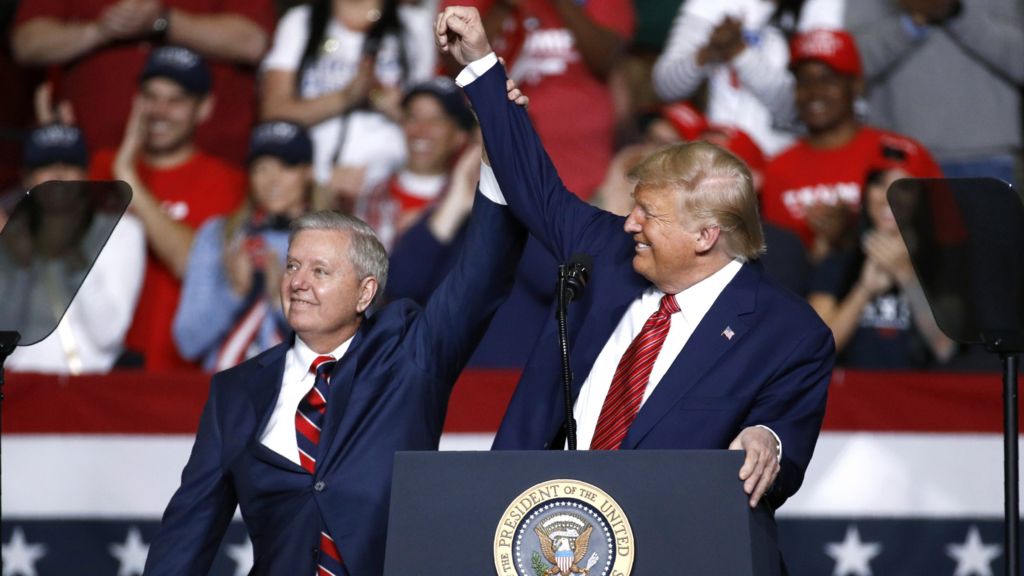
Lindsey Graham, the South Carolina Republican senator whose 23-year congressional career became a defining case study of the seismic political shift that reshaped the U.S. Republican Party during the rise of Donald Trump, has died at the age of 71. Widely remembered as a skilled political survivor, Graham’s ideological and tactical trajectory over decades traced the growing influence of populist conservatism that upended traditional GOP politics. Throughout his tenure, he retained a set of core policy positions: a staunchly hawkish foreign policy centered on containing Russian expansion, unwavering support for Israel, and a longstanding call for regime change in Iran. Yet what marked his career most profoundly was his willingness to adapt to the shifting partisan currents that accompanied Trump’s takeover of the Republican Party.
Graham launched his Senate career in 2002, quickly emerging as a close ally to legendary Arizona Republican senator John McCain, a staunch conservative who built a national reputation for his willingness to buck party orthodoxy and work across the aisle. When Graham launched his own 2016 presidential bid, bipartisan cooperation and de-escalating partisan tensions sat at the heart of his campaign platform. “If I get to be president, we’re going to open up a bar in the White House,” he once joked. “We’re going to get liquored up and solve problems.”
His early relationship with Trump was defined by open, ferocious hostility. When Trump infamously mocked McCain’s status as a Vietnam War prisoner of war — declaring at a rally “He’s a war hero because he was captured. I like people that weren’t captured” — Graham hit back, calling the New York real estate developer a “jackass” unfit for the presidency. Trump retaliated by publicizing Graham’s personal phone number at a rally, flooding the senator’s phone with thousands of angry messages, a confrontation that ended with Graham posting a viral stunt video destroying a stack of his own phones in protest.
As Graham’s presidential campaign collapsed in 2015, he doubled down on his criticism, labeling Trump a “race-baiting, xenophobic, religious bigot.” In a viral May 2016 tweet that would later be repeatedly cited by his critics, Graham warned that nominating Trump for president would lead to electoral disaster, writing “if the Republican Party chooses Trump as its nominee it ‘will get destroyed … and we will deserve it.’” Graham remained openly opposed to Trump through the 2016 general election against Hillary Clinton, refusing to back either major party nominee and instead supporting independent conservative candidate Evan McMullin.
But once Trump secured an upset victory in 2016, Graham dramatically shifted his stance. As Trump consolidated total control over the Republican Party during his first term, Graham evolved from a fierce critic into one of Trump’s most vocal congressional allies and close personal friends. The pair regularly golfed together, and Graham, a staple of cable news political programming, used his platform to repeatedly defend Trump and his policy agenda. His most high-profile intervention on Trump’s behalf came during the 2018 Supreme Court confirmation battle for Brett Kavanaugh, when Graham aggressively pushed back against sexual assault allegations against the nominee (who denied all wrongdoing), helping to push through confirmation by the narrowest possible margin.
Graham’s only major break from Trump came after the 2020 presidential election, when Trump lost to Joe Biden — a former Senate colleague of Graham’s, whom Graham once described as “the nicest person I’ve ever met in politics.” When a mob of Trump supporters stormed the U.S. Capitol on January 6, 2021, disrupting the certification of Biden’s victory and forcing Graham and other lawmakers to evacuate for safety, Graham announced he was cutting all political ties with the outgoing president. “Trump and I had a hell of a journey,” he said at the time. “I hate it to end this way… All I can say is count me out. Enough is enough.”
Yet the break proved temporary. Just weeks later, Graham voted to acquit Trump in his second Senate impeachment trial over the Capitol attack. As Trump began building his 2024 comeback campaign for the Republican nomination, Graham once again lined up behind his former rival, framing his earlier break as a reaction to a singular moment rather than a long-term rejection. “He was a very good president from my point of view,” Graham explained in a 2023 interview with the BBC. “I am judging him by what he did as president.” After Trump won re-election in 2024, Graham returned to his role as a reliable ally, consistently backing Trump’s cabinet and judicial nominees, supporting his legislative agenda, and praising Trump’s military actions in the Middle East, even as he encouraged Trump to continue U.S. strikes until the Iranian regime collapsed. Though he publicly pushed for greater U.S. military support for Ukraine amid its war against Russia, he softened his criticism of Trump’s friendly overtures to Russian President Vladimir Putin and refused to back new Russian sanctions without Trump’s explicit approval.
Despite his deep alignment with Trump, Graham retained longstanding personal friendships with Democratic lawmakers across the aisle, a fact reflected in the widespread cross-partisan condolences that poured out after his death, even from outspoken Trump critics including California’s Adam Schiff and Massachusetts’ Elizabeth Warren. Trump himself acknowledged Graham’s unique cross-party ability during a Sunday morning television interview: “He was able to deal with Democrats. If I had a problem with a Democrat, he could work it out.”
Graham’s relationship with anti-Trump Republicans was far more complicated, however. “Before Trump, we were friends,” former Congressman Adam Kinzinger, who served on the bipartisan committee investigating the January 6 attack, posted on X. “I choose to remember the man I knew before our paths diverged — the one who cared deeply about America’s role in the world and wasn’t afraid to see suffering up close.”
Graham’s sudden death has created immediate upheaval for congressional Republicans and South Carolina’s GOP establishment. Graham, who had already secured the Republican nomination unopposed for a new six-year Senate term in the upcoming 2026 general election, was seeking re-election, leaving the party scrambling to fill the vacant spot. South Carolina Governor Henry McMaster, a Republican, will appoint an interim replacement to serve the remainder of 2026, and the state party will hold a new primary to select a general election candidate for November. While South Carolina is a deeply reliable red state, political analysts note that if Trump’s approval ratings remain stagnant and Republicans face strong national headwinds this cycle, the party will be forced to divert extra resources to defend the now-open seat, a race that was previously considered safe. Whoever wins the nomination will enter Congress as a junior senator, lacking the decades of seniority, institutional influence, and access to power that Graham built over his tenure through one of the most tumultuous eras in modern American political history.