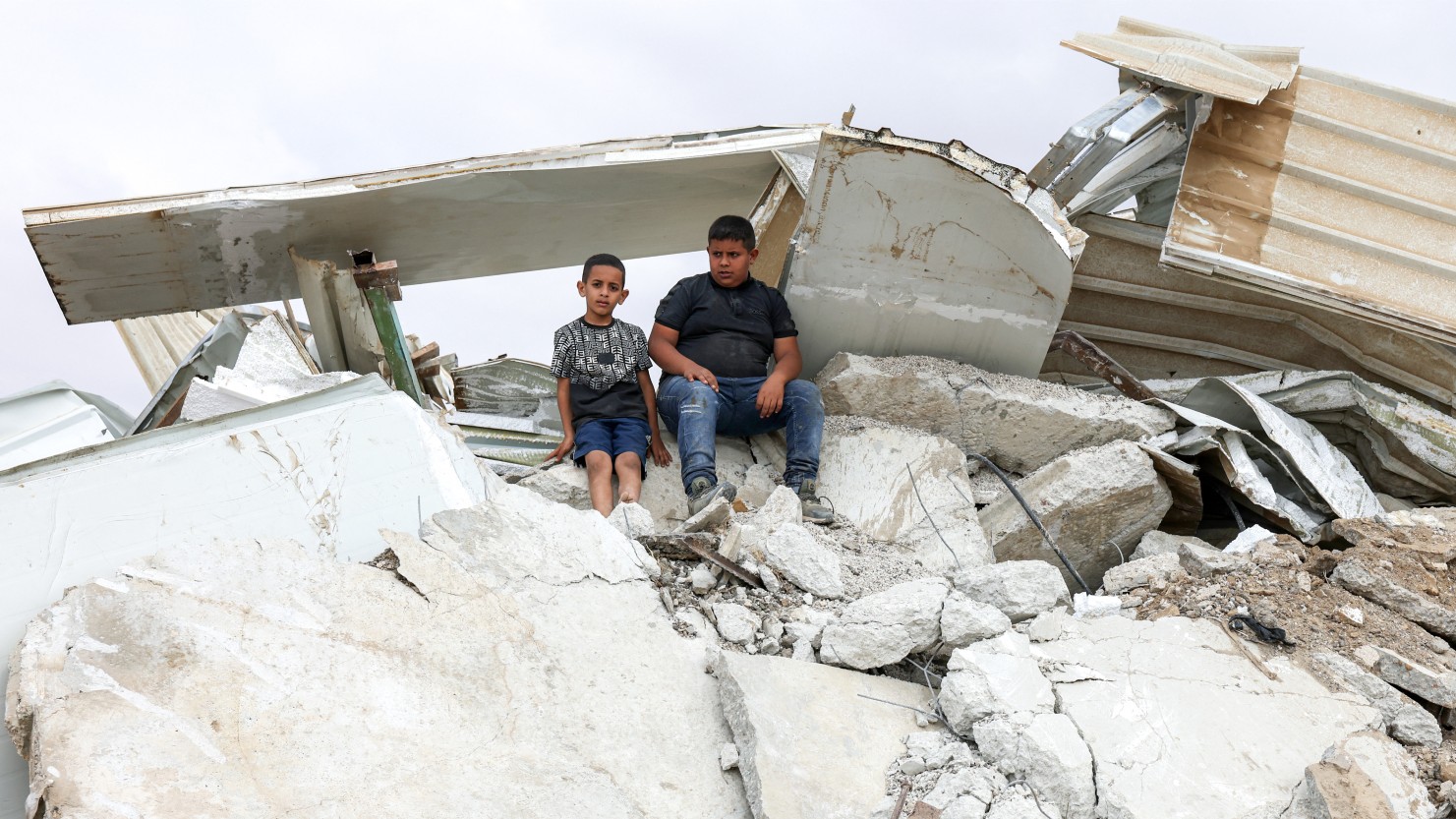
A devastating mass demolition of residential structures carried out by Israeli forces has upended the lives of hundreds of Bedouin Palestinians, leaving an estimated 250 members of the Abu Wadi clan without permanent shelter after between 50 and 80 family homes and a local mosque were razed this week, according to on-the-ground reporting from Israeli outlet Haaretz.
The operation did not begin abruptly on Monday, the date the final demolitions concluded. Instead, clearance work launched late Sunday in the unrecognised Abu Wadi neighbourhood, located just outside the southern Israeli city of Rahat, after an Israeli court turned down a last-ditch appeal to delay the demolition orders. In a cruel twist of policy, members of the Abu Wadi clan – who have lived on the land continuously for multiple generations – were forced to disassemble their own homes, and no alternative housing has been allocated to the displaced community by Israeli authorities.
Interviews with displaced residents paint a grim picture of uncertainty and trauma. One resident, who described the act of demolishing his own home, called the experience “catastrophic, impossible to describe”, adding that it was the hardest day of his entire life. “I have no roof over my head. I don’t know where I’ll be tomorrow, there are no plans,” he said, noting that rental prices in Rahat are far out of reach for most low-income clan members. A female resident who watched her home being torn down said she was left feeling hollow: “I feel like I have nothing left. We’ll probably sleep under a tree.” A young mother of two small children echoed that despair, saying that surviving under these circumstances was nearly impossible with nowhere to relocate. Despite the loss, the community remains defiant: “No one is thinking of leaving the neighbourhood. We will stay under the trees. We won’t move from here,” two residents stated.
The demolitions come amid what Palestinian community leaders describe as a rapidly escalating government campaign targeting Bedouin Palestinian communities in the Negev (known as Naqab in Arabic). This push is being led by two far-right members of Israel’s governing coalition: National Security Minister Itamar Ben Gvir and Settlements Minister Orit Strook, who have made displacement of Palestinian communities in the region a core policy priority.
Multiple Palestinian political figures have accused the current Israeli government of leveraging the demolitions for electoral gain ahead of the country’s upcoming national elections scheduled for October 27. Talal Alkernawi, mayor of Rahat, called the mass destruction “a crime and a disgrace of the Israeli government” and called on the Israeli parliamentary opposition to publicly condemn the policy. Taleb el-Sana, chair of the Higher Steering Committee of the Arabs of the Negev, compared the scene after the demolitions to “scenes of war, of an earthquake”, adding that “a village that has been struck by a disaster, except that here it is a disaster of racism.” El-Sana also echoed the accusation that demolitions are being used as an election campaign tactic, vowing that the community would continue to fight “for full equality and justice”.
Waleed Alhwashla, a Knesset member from the Palestinian-led Islamist party Ra’am, directly tied the operation to Ben Gvir’s far-right Otzma Yehudit party’s voter mobilization efforts. “This is the election campaign of Otzma Yehudit and Ben Gvir here in the Negev: to demolish and leave families without a roof over their heads,” Alhwashla said.
While Israeli authorities have stated they offered displaced residents the option to relocate to another section of Rahat, community members say the proposed site carries major risks, warning that relocation could spark violent inter-clan clashes in the crowded area.
This week’s demolitions are not an isolated incident, but rather part of a decades-long systemic housing crisis facing all Bedouin Palestinian communities in the Negev. For generations, these communities have faced routine home demolitions, strict construction bans that make legal building impossible, and chronic underinvestment in public infrastructure. Today, roughly 320,000 Bedouin Palestinians live in the Negev, making them one of the most economically marginalized groups within Israel. Of that population, around 100,000 reside in 36 villages that the Israeli state refuses to grant official recognition, cutting them off from basic public services including grid electricity and running water.
Data collected by the Regional Council for Unrecognised Bedouin Villages in the Negev (RCUV) underscores the scale of the ongoing displacement crisis. Over the past three years alone, Israeli authorities have demolished more than 19,300 structures and community facilities in Bedouin communities, including 2,900 residential family homes. The council estimates that the demolition of a single average home costs a displaced household roughly 100,000 shekels, adding up to a total of 290 million shekels in financial losses for Bedouin families since the start of 2021. Beyond the financial damage, the RCUV also warns that repeated demolitions have caused severe and long-lasting psychological harm, disproportionately impacting women and children in affected communities. During this week’s operation, the council added, bulldozers also buried an animal shelter holding puppies under excavated soil, though local residents were able to rescue all the animals before they were harmed.
The broader context of this campaign stretches back decades. Before the establishment of the state of Israel, an estimated 65,000 to 100,000 Bedouin lived across the Negev. Today, only around 11,000 remain in the region. Just last month, far-right Finance Minister Bezalel Smotrich announced plans to rapidly expand Jewish settlement in the Negev and Galilee as a core plank of his election campaign, saying he intends to replicate the same settlement expansion policies he has overseen in the occupied West Bank. “The goal: one million additional Jews in the Negev and Galilee,” Smotrich stated publicly.