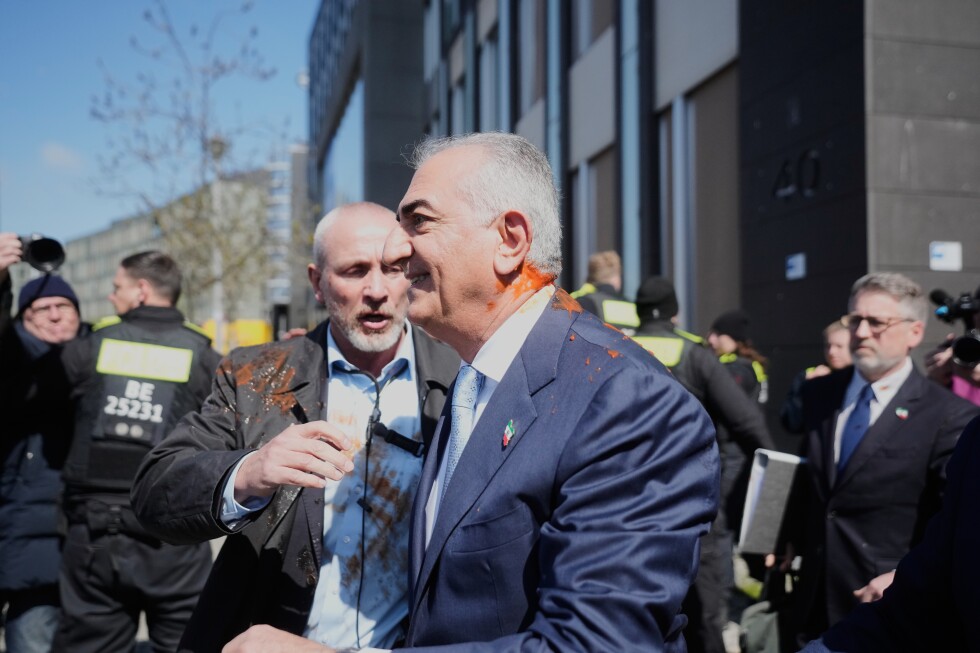
BERLIN — A high-profile incident involving Iran’s exiled crown prince Reza Pahlavi has put a spotlight on ongoing tensions surrounding Iran’s political future and international diplomacy, after the 65-year-old opposition figure was doused with red liquid outside Berlin’s federal press conference building Thursday.
The attack occurred moments after Pahlavi wrapped up a press briefing where he delivered sharp criticism of the recently negotiated ceasefire between the United States and Iran. Witnesses report the liquid covered the back of Pahlavi’s blazer and neck, but German law enforcement confirmed the former royal was uninjured in the incident. After the attack, Pahlavi waved to gathered supporters before departing the scene in a private vehicle. Investigators have identified the substance as tomato juice, according to preliminary police statements.
The unnamed perpetrator was taken into custody immediately following the altercation; German privacy regulations prevent the release of the suspect’s identity at this time.
Pahlavi, the son of Iran’s ousted former shah who was forced from power in the 1979 Islamic Revolution, has lived in exile for nearly five decades. In recent years, he has positioned himself as a leading opposition figure vying for a political role should Iran’s current Shiite theocracy collapse, and he has openly backed U.S.-Israeli military intervention across the Middle East. It remains unclear how much popular support he retains within Iran’s borders decades after his exile.
Thursday’s appearance marked a high-profile public outing for Pahlavi in the German capital, though the exiled prince was not scheduled to meet with any sitting German government officials during his visit. During his briefing, Pahlavi pushed back against the core logic of the US-Iran ceasefire, arguing that the agreement relies on an unfounded assumption that the Iranian government will moderate its behavior.
“I don’t see that happening,” Pahlavi said. “I’m not saying that diplomacy should not be given a chance, but I think diplomacy has been given enough chance.”
He also called on European powers to step up support for pro-democracy activists inside Iran, claiming that Iranian authorities have executed 19 political prisoners over the past two weeks and sentenced an additional 20 people to death. “Will the free world do something, or watch the slaughter in silence?” he asked attendees.
Concurrent with Pahlavi’s press briefing, hundreds of his supporters gathered for a demonstration near Germany’s federal parliament building, according to reporting from German national news agency dpa.
More than an hour after the attack, German Chancellor Friedrich Merz issued an official statement breaking with Pahlavi’s position and backing the ceasefire extension. “This presents an important opportunity to resume diplomatic negotiations with the aim of making peace and averting further escalation of the war,” Merz’s statement read, adding that “Tehran should seize this opportunity.”
This report included contributions from Ciobanu, reporting out of Warsaw, Poland.