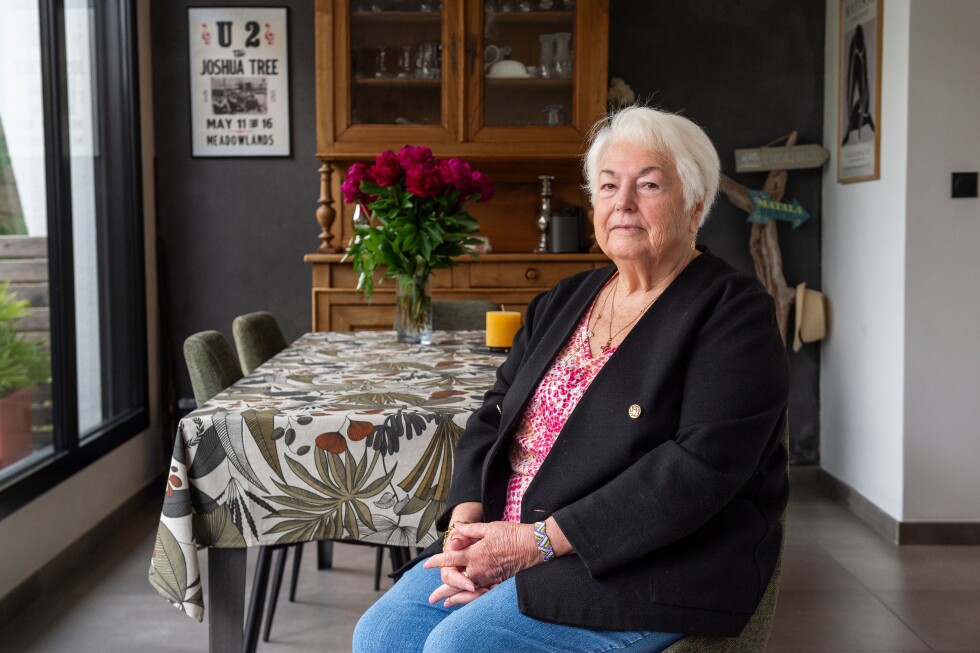
For 85-year-old Marie-Thérèse Ross, the haunting memory of Louisiana’s immigration detention center does not fade. The French widow of a U.S. military veteran, whose arrest in an Trump-era immigration enforcement sweep drew global outrage, now recounts her harrowing 16 days in federal custody from her home in a Nantes suburb, where she is recovering after being released and repatriated to France.
Ross’s journey to detention began with a late-in-life love story that brought her across the Atlantic. Decades after meeting William Ross, a retired American soldier stationed in France in the 1950s when she worked as a NATO secretary, the pair married in Alabama in April 2025. Their quiet new life together was cut short when William died of natural causes just three months later in January 2025, triggering a bitter estate dispute with Ross’s stepson, a U.S. federal employee. Court records have linked the stepson’s intervention directly to Ross’s subsequent immigration detention.
The arrest came abruptly on the morning of April 1. Ross, still dressed in her bathrobe, pajamas and slippers, was grabbed by five plainclothes immigration officers who pounded on her Alabama home’s doors and windows before cuffing her and forcing her into a waiting vehicle. She told the Associated Press she barely understood what was happening as it unfolded. Two days after her arrest, she was transferred to the Louisiana detention facility where she would spend more than two weeks locked in a dormitory-style unit with 58 other women, the vast majority of whom were migrant mothers.
What struck Ross most deeply, beyond the strict facility rules and the constant, aggressive yelling from guards that she described as condescending and dehumanizing, was the nightly sound no one can block out: the wailing of separated children. “At night, when everything else went quiet, the crying started,” she recalled. “Children crying, and even babies. There are infants in this jail.” Many of her cellmates had no idea where their own children had been placed after they were detained, a reality Ross called unforgivable. “I think it’s terrible for a woman not to know where her children are,” she said. Even with the facility’s clean facilities and passable food, the dehumanizing treatment of detainees left a permanent mark, shifting her entire worldview of U.S. politics and the country she once admired.
Even in the trauma of detention, Ross found small moments of solidarity among the detained women. They called her “Grandma” for her advanced age, and looked after her through the nights. “During the night, if my bed cover slipped away, I felt a small hand putting it back,” she said. “I didn’t know who it was, but they pampered me because I was older than them.” She still wears a hand-woven friendship bracelet one anonymous detainee gave her as a gift, a memento she keeps close.
French officials publicly pushed for Ross’s release, with the foreign minister saying that the enforcement tactics used by U.S. Immigration and Customs Enforcement fell far short of French human rights standards. She was released within weeks of her arrest and returned home to western France to be with her family. But the experience has left her with lasting trauma: family members report she struggles with memory gaps and ongoing emotional distress, and Ross says she will seek specialized care in France for symptoms consistent with post-traumatic stress disorder.
Ross, whose late husband was a vocal supporter of Donald Trump and who used to watch conservative Fox News alongside him daily, says her firsthand experience has completely upended her view of the United States. She once saw the U.S. as a beacon of freedom, “where people are not arrested based on how they look, and where those who are detained are treated fairly and with respect.” Now, she says that belief is shattered. Pointing to the majority South American women she was detained with, she said “Their only fault was to be South American. None of them deserved to be locked up like this.”
The U.S. Department of Homeland Security has confirmed Ross had overstayed her 90-day tourist visa at the time of arrest, but has not responded to repeated AP requests for comment on her arrest or conditions at the facility. For her part, Ross has kept the promise she made to the women she left behind in Louisiana: “When I left this jail in Louisiana, I told them that if I ever had the chance to speak about them, I would do it, to help them.” Today, she continues to advocate for the migrant mothers still detained, their names and faces etched into her memory.