On the dusty, sprawling hillsides of San Juan de Lurigancho, one of Lima’s most vulnerable working-class suburbs, bus driver Toño grips his steering wheel with a lingering trauma that never fully fades. Months ago, a local criminal gang ambushed him after the bus company he worked for refused to meet a $15,000 extortion demand. Bullets tore through his legs and abdomen, leaving him unable to work for four months. Though his external wounds have healed, the psychological scars remain.
“I work every day in fear,” Toño told reporters, his voice tight with anxiety. “My wounds are closed on the outside, but the pain inside never goes away. If I had the money to leave this country, I would go — I’m terrified every time I leave my children at home.”
Toño is far from alone. His attack is one of nearly 30,000 reported extortion incidents recorded across Peru in 2025, a crisis that has disproportionately targeted small business owners and public transport workers. According to an independent crime and violence observatory, 239 transport drivers were killed in gang-related attacks last year alone. At Toño’s bus depot, security chief Eiffel Calla confirms that five company drivers have been attacked in recent months: one killed, another left permanently brain-damaged in a vegetative state. Today, armed police guard the depot’s entrance, and Toño drives with plainclothes armed officers on board for protection. Like many Peruvians, he is calling for the next president to take a hard line against the growing wave of violence.
Rising violent crime and widespread extortion have pushed public insecurity to the top of voter priorities ahead of Peru’s Sunday presidential runoff, which pits right-wing candidate Keiko Fujimori against left-wing challenger Roberto Sánchez. The race marks Fujimori’s fourth bid for the presidency, and she has centered her entire campaign on a hardline “tough-on-crime” platform, leaning into the legacy of her father, former president Alberto Fujimori, who ruled Peru from 1990 to 2000. Though Alberto Fujimori died in prison while serving a sentence for human rights abuses committed during his crackdown on insurgency, his supporters still credit him with restoring domestic order and stabilizing Peru’s economy.
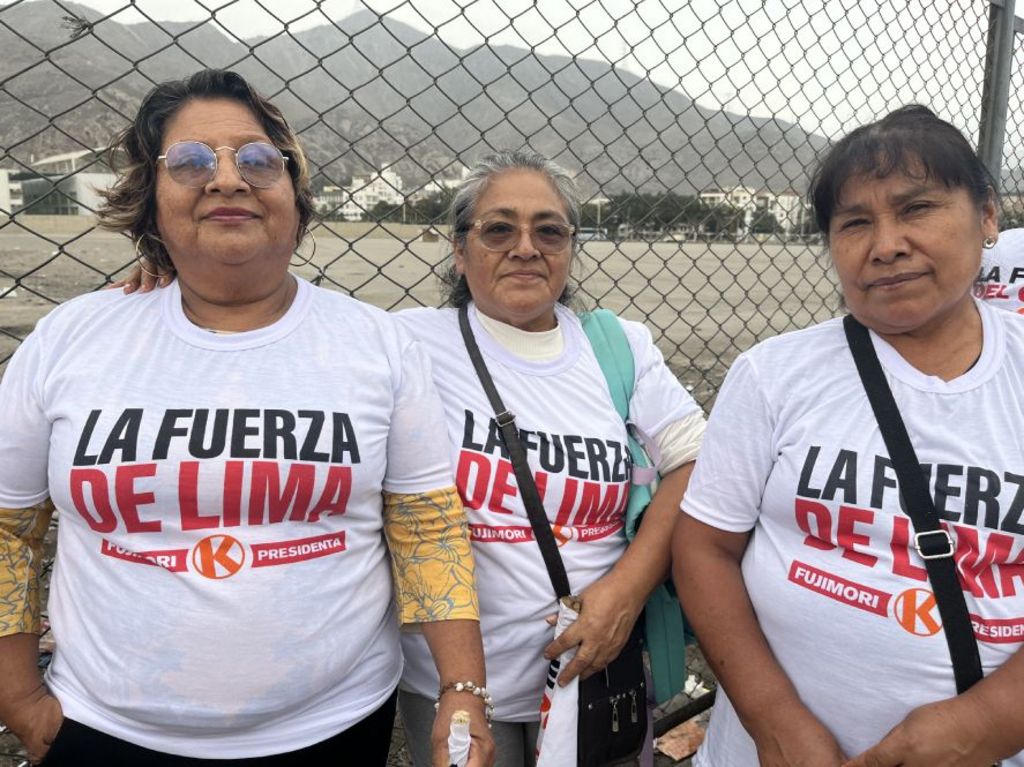
At her final campaign rallies, Keiko Fujimori declared open “war” on criminal extortion networks, promising to deploy military forces to combat organized crime, strengthen prison security, and work with financial institutions to freeze funds tied to extortion schemes. Economically, she champions a free-market agenda focused on attracting foreign direct investment, particularly from the United States, and building on Peru’s position as a leading global exporter of critical minerals like copper. Her supporters argue that her approach will deliver both the public safety and economic stability that Peruvians crave. “A heavy-handed response to insecurity is sorely lacking in these times,” said Piero, a rally attendee. “Peru is overflowing with crime right now, and we need someone who will fix it.” Janeth, another supporter, added that she backs Fujimori specifically to protect the country’s stable economic footing.
Fujimori’s opponent, left-wing candidate Roberto Sánchez, has campaigned on a platform of sweeping structural change, promising to increase public spending, raise the minimum wage, renegotiate private mining contracts, expand state control over natural resources, and boost corporate taxes to redirect mineral wealth toward marginalized communities. He has also pledged to pardon former left-wing president Pedro Castillo, who was imprisoned in 2022 after attempting to dissolve congress to avoid impeachment.
Sánchez’s supporters reject claims that his nationalist economic policies will trigger instability. “We are open to foreign investment that benefits our country,” said María Elena Linares, a local activist. “Claims that we will throw out all foreign investors are completely wrong. Our gold, our copper, all our raw materials flow out of this country to enrich other nations, and we are left in misery. That has to change.” Raúl, another backer, added that he supports Sánchez’s promise to increase public investment in health, education, and rural infrastructure outside of Lima and other major urban centers.
The race has been roiled by ongoing political controversy even in its final days. Last week, a judge announced that Sánchez would face trial over allegations of undeclared campaign finances dating back to regional elections held between 2018 and 2020. Sánchez has denied all wrongdoing and pledged to appeal the ruling. Fujimori herself spent nearly 18 months in pre-trial detention between 2018 and 2020 over her own campaign financing allegations, though those charges were ultimately dropped in 2024.
Peru has faced extreme political volatility over the past decade, with eight presidents holding office in 10 years and frequent congressional gridlock, as no single party has ever held a majority. Fujimori’s Popular Force party holds the largest minority bloc in congress, but analysts warn that deep ideological division between the two candidates will make governing difficult no matter the outcome.
Young voters, who make up roughly a quarter of Peru’s eligible electorate, have been particularly vocal about their frustration with the country’s political class. Last year, mass “Gen Z” protests swept Lima, with young activists accusing the state of failing to address crime, corruption, and systemic inequality. Many young voters now say the election offers little more than a choice between two unsatisfactory options.
Consuelo, 21, vice president of the student federation at Peru’s Pontifical Catholic University, described the race as a choice between the “lesser of two evils.” She says she fears that a Fujimori presidency would revive the authoritarianism associated with her father’s rule. “Fujimorism is synonymous with authoritarianism, and that represents an enormous fear for many students,” she explained. Cielo, 23, another student who has participated in anti-Fujimori protests, says even though her own family’s small business was targeted by extortionists, she cannot bring herself to support Fujimori. Alvaro, 22, says his preferred candidate was eliminated in the first round of voting, so he plans to vote critically for Sánchez solely to block Fujimori from office.
Across the political spectrum, Peruvians are united in a shared desire to end years of political instability and deliver tangible progress on crime, inequality, and economic development. But analysts warn that deep polarization and ongoing congressional gridlock make meaningful change unlikely in the near term. José Luis Pérez Guadalupe, a former Peruvian interior minister and professor at Pacific University, noted that the country’s long history of institutional volatility creates steep barriers to any new administration. “We have had eight presidents in 10 years, 24 justice ministers, 32 interior ministers. That is extremely high political volatility,” he explained. “With this level of great polarization, whoever wins will face enormous difficulty implementing their policy agenda.”
For many voters like Consuelo, that reality leaves little room for optimism. “Whether Fujimori wins or Sánchez wins, we know there will most likely be a lot of instability,” she said. “In reality, it’s a pretty hopeless choice.”