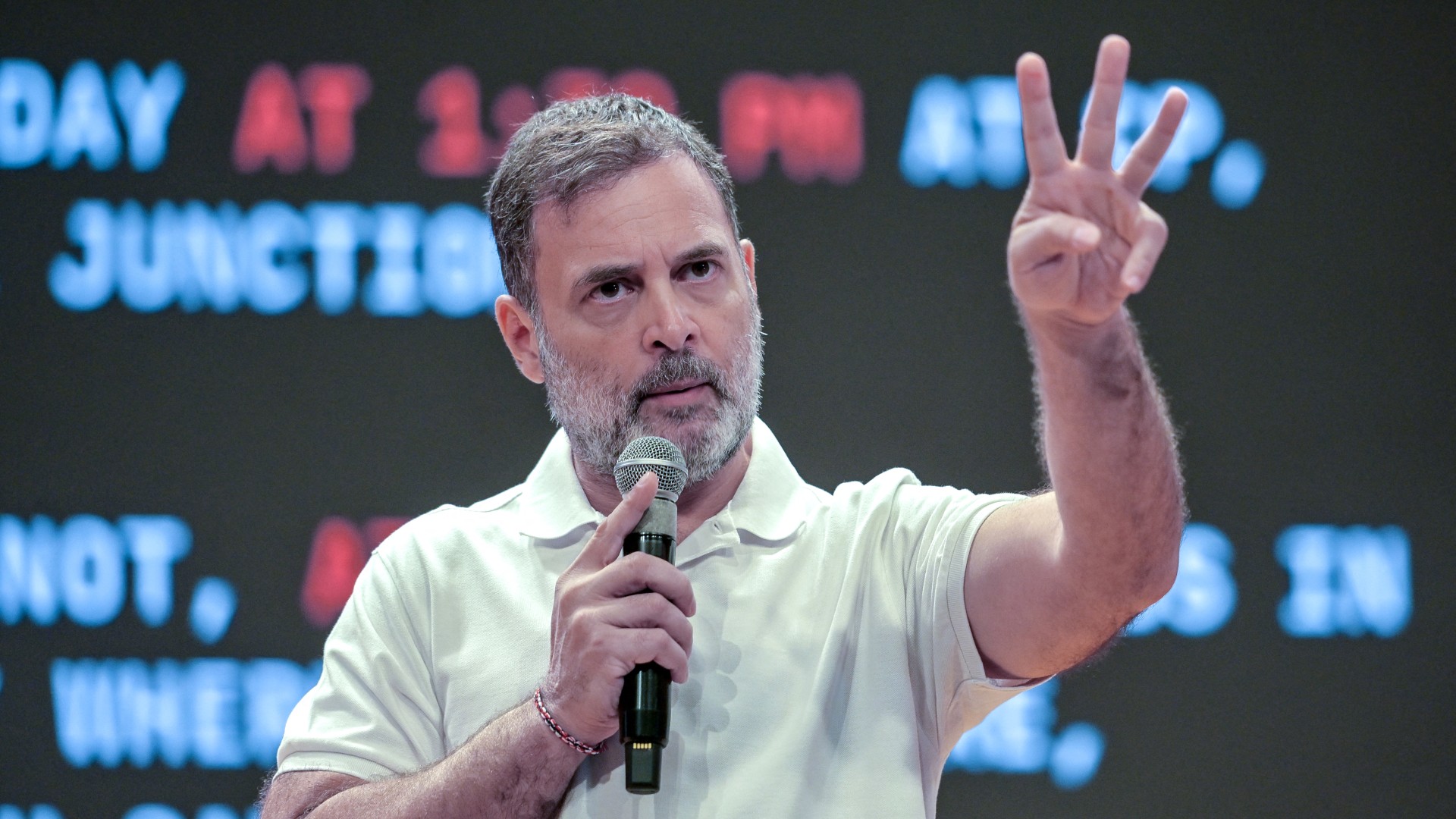
During a public policy dialogue hosted by the University of Chicago alongside prominent political scientist Robert Pape on Wednesday, senior Indian National Congress leader and opposition figure Rahul Gandhi publicly reiterated his full support for sustaining robust military and strategic partnerships between New Delhi and Israel, even as widespread global condemnation of Israel’s military campaign in Gaza continues to escalate.
Gandhi, who was in the middle of a three-day official visit to the United States, framed his stance as a core tenet of India’s sovereign foreign policy decision-making. “We maintain robust bilateral relations with Israel, and a significant share of our defense procurement comes from Israeli suppliers,” he stated during the discussion. “I unreservedly back preserving these strong ties.” He further emphasized that as a 1.5-billion-people nation, India retains full autonomy to select the most suitable defense hardware for its armed forces, and must never allow its foreign policy priorities to be dictated by the national interests of third-party countries. While he offered a brief condemnation of civilian casualties caused by Israeli operations in Gaza, he also denounced the October 7, 2023, Hamas-led attacks, framing all deliberate killing of non-combatants as unacceptable. Later, Gandhi shared clips of the Chicago event on his X social media account, doubling down on his argument that India’s global engagement must always center its own national interests above external pressures.
Notably, Gandhi’s public comments landed on the exact same day that India’s Ministry of Defense formalized a $211 million contract with Israel Aerospace Industries (IAI), a deal signed on November 18 that covers full hardware and software overhauls for the Barak point-defense missile systems deployed across the Indian Navy’s fleet, alongside comprehensive management plans for obsolete system components.
The timing of these intertwined developments lays bare how deeply entrenched India’s cross-partisan political commitment to security and military cooperation with Israel has become in recent years. Earlier this month, a disclosure from the Internet Freedom Foundation revealed that Indian Home Minister Amit Shah had approved a procurement order for advanced phone-unlocking surveillance tools from Israeli digital forensics firm Cellebrite for the National Investigation Agency. Even several state governments led by Gandhi’s own Congress party have faced public backlash from activists for purchasing Israeli phone-extraction surveillance technology.
Critics have been quick to push back against the opposition leader’s remarks. A grassroots local activist, who requested anonymity to avoid professional and personal retaliation, told Middle East Eye that Gandhi’s position was inherently contradictory: “On one hand he claims India’s foreign policy should prioritize its own national good, but on the other he is advocating for deep strategic ties with a state that has had its actions thoroughly discredited over the past three years. The reality is that Israel needs strong ties with India far more than India needs them.” Apoorvanand Jha, a distinguished professor in the Hindi Department at the University of Delhi, went further, describing Gandhi’s framing that equates the October 7 attacks with the ongoing atrocities in Gaza as “repulsive.” “It is an undisputed fact that India maintains strong relations with Israel and purchases large volumes of Israeli military equipment, but what he should have acknowledged is that these ongoing arms transfers are actively harmful to global peace,” Jha added.
Under the administration of Indian Prime Minister Narendra Modi, New Delhi has evolved into one of Israel’s most valued and unwavering global strategic partners. Modi traveled to Israel for a high-profile state visit in early 2026, just weeks before the outbreak of the U.S.-backed Israeli military campaign against Iran. Israeli Prime Minister Benjamin Netanyahu has repeatedly singled out India for praise, noting that his country faces growing global isolation and what he frames as a coordinated international campaign of “delegitimization,” yet enjoys what he described to The Independent as “absolutely crazy, truly crazy” levels of public and political support within India.
A 2025 report from Amnesty International documented no fewer than 2,596 separate shipments of arms, ammunition, and critical military components from India to Israel between October 2023 and November 2025, including artillery shells, machine gun parts, explosive warheads, and replacement components for armored military vehicles. The human rights watchdog warned that New Delhi’s continued transfer of military equipment to Israel, in the face of mounting, well-documented evidence of grave international law violations in Gaza, could expose India to formal legal liability for complicity in war crimes.
While a handful of rank-and-file Congress officials have publicly criticized the Modi administration’s muted response to the Gaza conflict, the party’s official leadership has never endorsed a full arms embargo on Israel, nor has it called for India to formally join South Africa’s ongoing genocide case against Israel at the International Court of Justice. The historical roots of the two countries’ deep security partnership stretch back decades: formal diplomatic ties were first established in January 1992 under the Congress-led premiership of P.V. Narasimha Rao, while the groundwork for rapprochement was laid during the tenure of Rahul Gandhi’s father, former Prime Minister Rajiv Gandhi, who pursued incremental normalization with Israel throughout the 1980s, including a landmark 1985 meeting with then-Israeli Prime Minister Shimon Peres on the sidelines of the UN General Assembly. Even earlier, under the premiership of Rahul Gandhi’s grandmother Indira Gandhi, formal intelligence sharing ties were established between India’s external spy agency the Research and Analysis Wing and Israel’s Mossad.
India’s Rahul Gandhi backs continued arms trade with Israel despite Gaza genocide