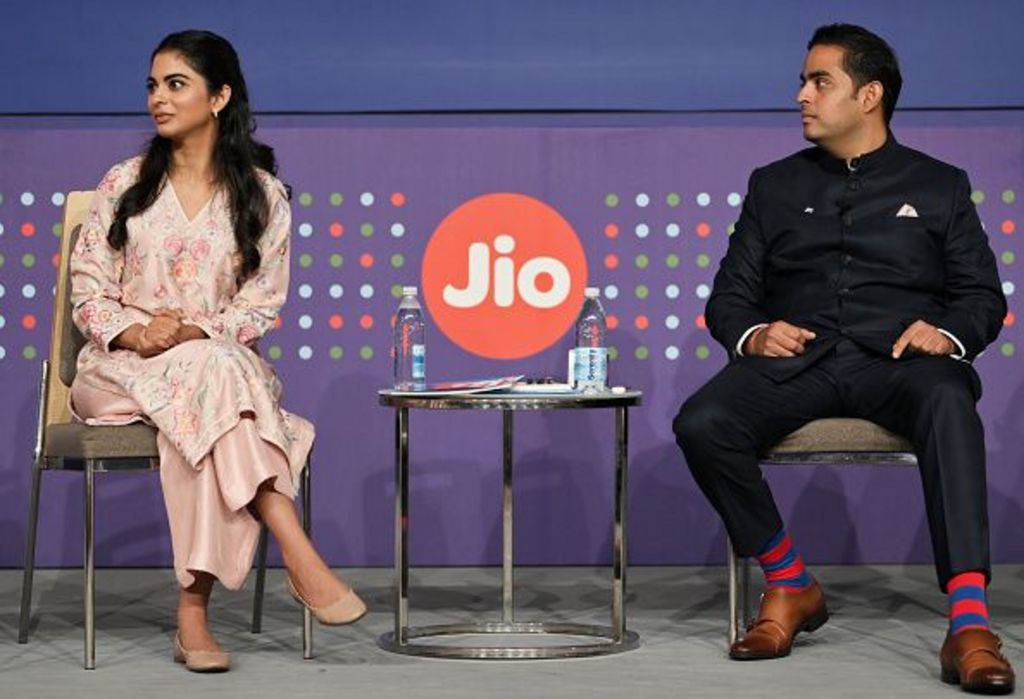
Backed by global tech giants Meta and Google, Jio Platforms — the telecom crown jewel of Asia’s wealthiest individual Mukesh Ambani — is set to make its highly anticipated public market debut on Wednesday, in what stands as India’s largest initial public offering to date, valued at $3.2 billion. Even amid a recent turbulent stretch for India’s broader public markets, the historic share offering has seen overwhelming, cross-spectrum demand, with bids surpassing the total available shares mere hours after subscription windows opened on October 21, drawing interest from top-tier global fund managers, large domestic institutional players, and millions of ordinary retail investors across the country.
Since its disruptive 2016 market entry, Jio has reshaped India’s entire digital landscape by rolling out near-zero, industry-upending mobile data tariffs that pulled tens of millions of previously offline Indians onto the internet for the first time. The ripple effects of that launch were seismic: what was once a crowded telecom market of 17 competing operators rapidly consolidated into a tight oligopoly of just three remaining players, with critics long arguing that Ambani’s deep-pocketed firm waged an unfair predatory price war that pushed smaller rivals out of operation. Most recently, SpaceX chief Elon Musk publicly took aim at Ambani, labeling him the “real boss of India” and claiming Jio was actively working to block Starlink’s market entry in the country, allegations that Reliance immediately dismissed, stating it fully welcomed fair competition from Musk’s satellite internet venture.
For all the controversy and regulatory scrutiny Jio has faced over the past decade, its ultra-low cost data plans have served as the unshakable foundational pillar of India’s ongoing digital revolution, catalyzing the explosive growth of the nation’s digital economy and democratizing access to online payments, food delivery, and e-commerce across Asia’s third-largest economy. In just three years following its launch, average customer data usage across India surged 50-fold, while national data prices plummeted to some of the lowest levels in the world. As of 2026, the firm has amassed a staggering 553 million mobile subscribers, capturing 50% of India’s wireless broadband market and over 40% of the fixed broadband segment. Brokerage Emkay Global notes Jio now carries 60% of all India’s wireless data traffic, and hosts the largest 5G subscriber base anywhere outside of mainland China, hailing the firm as the “digital engine of India.”
Industry analysts widely agree that the IPO — which will see Jio’s parent promoters dilute their stake by roughly 3% — will mark a defining turning point for the company’s long-running pricing strategy, likely bringing an end to the era of rock-bottom, market-share-focused tariffs. “The era of Jio weaponizing cheap data plans to capture new subscribers is drawing to a close,” explained Nitya Shah, co-founder of KamayaKya Wealth Management. “A publicly listed Jio now has direct accountability to minority shareholders, which structurally eliminates its past incentive to suppress pricing to unsustainably low levels.” As outlined in a public note from brokerage Motilal Oswal, Jio’s future growth trajectory will no longer rely primarily on subscriber expansion via discounted offers, and will instead center on boosting average revenue per user through widespread 5G migration, gradual targeted tariff adjustments, and expanding fixed wireless broadband access to rural households that have never been reached by traditional fiber optic networks.
This strategic shift is also expected to create breathing room for Jio’s remaining competitors to raise their own prices, as the longstanding fear of being undercut by Jio’s unbeatable low tariffs recedes. Shah points out that Vodafone Idea, the sector’s financially weakest player, stands to be the biggest beneficiary of this market shift, describing it as a once-in-a-generation tailwind for the struggling firm. For Indian consumers, potential new tariff hikes will come on the heels of a broad industry-wide price increase implemented a few years prior, with analysts warning that another round of upward adjustments could trigger widespread customer churn, as India’s highly price-sensitive user base migrates to the lowest-cost available plans.
While households may face steeper monthly mobile bills, the Jio IPO offers global and domestic investors a direct stake in India’s insatiable, fast-growing demand for data, as well as the company’s sprawling, fast-expanding ecosystem of digital services spanning streaming entertainment, cloud computing, interactive gaming, and digital financial services. India has already emerged as the world’s second-largest consumer of mobile data, driven by low tariffs and surging smartphone penetration: Jio’s average monthly data consumption per user jumped from 28.7 GB in 2024 to 42.3 GB in 2026, marking a 52% two-year increase, with independent estimates projecting usage will rise further to 65 GB per month by the end of the decade as household disposable incomes continue to climb. Emkay Global’s analysis notes that penetration rates for nearly all digital services in India remain far below levels seen in the U.S. and China, leaving enormous untapped headroom for long-term growth.
Global ratings agency Moody’s adds that the public listing will also improve corporate transparency and deliver a clear, market-driven valuation for Jio, which previously operated as a private segment of Reliance Industries — a sprawling conglomerate with core holdings across oil refining, retail, and digital services. Beyond Jio’s individual market strengths, the unprecedented hype around the IPO also stems from the fact that this marks the first public share sale from the Reliance conglomerate in more than two decades. Founded in 1958 as a tiny spice and polyester yarn trading operation by Dhirubhai Ambani, Mukesh Ambani’s father, Reliance grew over generations to dominate India’s textiles, petrochemicals, refining, retail, telecom, and digital sectors. The company is legendary for its decades-long track record of consistent long-term wealth creation, and holds iconic status among India’s vast community of small retail investors. Dhirubhai Ambani is widely credited with pioneering the popularization of equity investing in India during the 1980s and 1990s, bringing share ownership out of exclusive circles of wealthy families and professional traders and making it accessible to ordinary middle-class households. In its early decades, Reliance built an extraordinarily loyal individual shareholder base by turning its annual general meetings into high-profile, celebratory public events featuring major corporate announcements, generous dividend payouts, and explicit recognition of its public investor community. Even as Reliance Industries’ share price has fallen nearly 20% over the past 12 months, its long-term performance record continues to drive widespread investor confidence. “The company has consistently delivered around 30% annualized returns over 30 consecutive years,” noted Kranthi Bathini of Mumbai-based WealthMills Securities in comments to the BBC. “That is why so many investors are optimistic that Jio’s public listing will replicate that same decades-long success.”