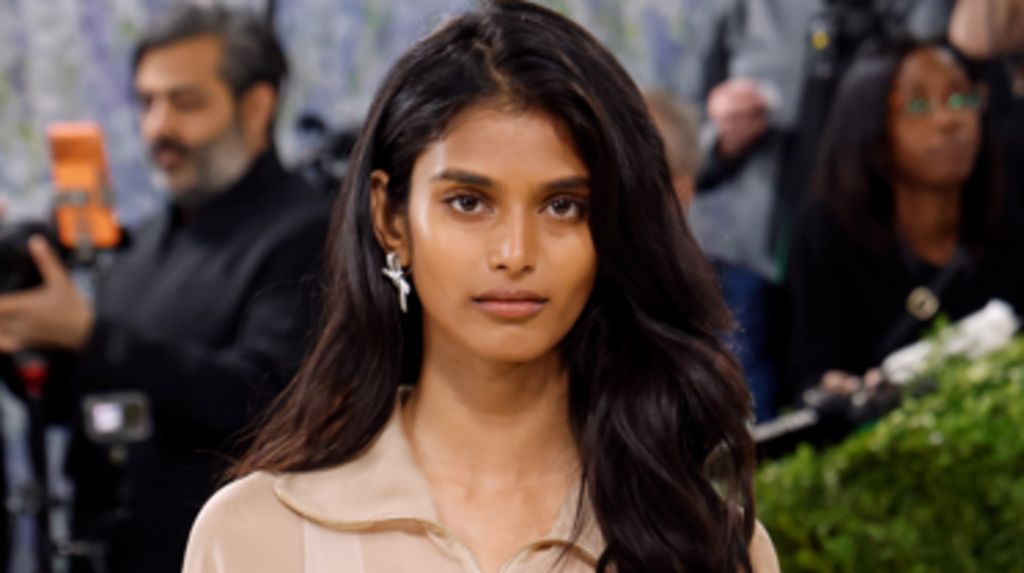
Two years ago, a chance encounter in a New York City subway station launched an unlikely new star onto the global fashion stage. Today, 26-year-old Indian model Bhavitha Mandava’s 2026 Met Gala debut has divided audiences and critics alike, igniting conversations about fashion excess, cultural representation, and the rising appeal of quiet authenticity in an industry defined by over-the-top spectacle.
At fashion’s most high-profile annual event, where guests typically arrive in elaborate, statement-making couture that demands attention before the wearer even speaks, Mandava’s Chanel look read as deliberately restrained at first glance. From across the red carpet, she appeared in a sheer zip-up jacket paired with what looked like casual low-rise denim. Next to the structured gowns, dramatic silhouettes, and bold declarations that define the Met Gala’s red carpet, her outfit felt intentionally understated. But that simplicity was anything but accidental: fashion outlets soon revealed the “denim” was actually handcrafted silk muslin, printed and tailored to mimic textured cotton, turning casual everyday attire into a deliberate, high-fashion artistic choice.
This deliberate contrast between appearance and craft has split public and media reaction. Some fashion observers have praised Mandava’s look as a thoughtful, quiet rebuke of the Met Gala’s typical over-the-top excess, a subtle subversion of the event’s obsession with grandeur. Others argue the understated ensemble failed to live up to the scale and prestige of the occasion, questioning whether it missed a once-in-a-generation moment for global visibility. Indian media has mirrored this divide, with some outlets hailing the outfit’s intentional minimalism and others arguing it undersold the importance of her debut as one of India’s rising fashion stars. On social media, the debate has expanded beyond fashion, touching on how Indian identity is framed, received, and often simplified on global cultural stages.
Mandava’s rapid ascent from anonymous graduate student to global fashion fixture is as unusual as her signature aesthetic. Raised in Hyderabad, a city in southern India, she was pursuing a graduate architecture degree at New York University in 2024 when the 28Models scout approached her on her way to share a plate of biryani with a friend. The completely unplanned encounter quickly upended her life: within months, she was walking runways for luxury powerhouses Bottega Veneta, Dior, and Courrèges, before building a close ongoing partnership with Chanel. Even as her career exploded, Mandava never adopted the flashy persona common to rising modeling stars. In a February interview with *British Vogue*, she joked that her agent still teases her for early castings where she showed up in thrifted jeans and free NYU student t-shirts, wearing whatever was clean that day.
Late last year, Mandava made history as the first Indian model to open Chanel’s prestigious Métiers d’Art show in New York, held on a meticulously reconstructed subway platform that intentionally echoed the setting of her discovery. Her opening look? A simple white t-shirt, half-zipped knit sweater, and loose denim — a template of deliberate understatement that she carried directly to the Met Gala red carpet.
What makes Mandava’s story resonate far beyond fashion circles is its relatable core. Even after her rapid rise, she has carried the quiet authenticity of her former life as a grad student with her. She often speaks of her studies, her family, and the slow rhythm of ordinary life in interviews, rather than leaning into the manufactured myth of overnight stardom. When she opened the Chanel show, she shared a viral clip of her parents watching the live stream from their home in India: her mother repeating her name in stunned disbelief, her father sitting quietly beside her, beaming with quiet pride. The unguarded, intimate moment won millions of hearts online. On social media, she describes herself as a “Brooklyn lab rat”, balancing transatlantic life between architecture research, couture history study, and global runway commitments. It is a low-key persona that fits perfectly with fashion’s current embrace of “quiet luxury” and effortless, unforced style — but it clashed sharply with the heightened expectations of the Met Gala.
In the wake of the social media firestorm over her Met Gala look, Mandava has declined to engage directly with critics, only sharing photos of the evening to her Instagram without additional comment. She later told *British Vogue* that the outfit was a personal tribute: a way to carry forward the memory of the subway encounter that launched her career, elevating the casual clothes she wore that day into couture while keeping it unmistakably hers.
The fashion industry is notoriously fickle, and the current obsession with understatement may soon fade. It would also be unfair to expect Mandava, a young talent still early in her career, to remain frozen in this specific persona forever. But for now, her quiet, unforced presence offers a refreshing breath of air in an industry dominated by performance and overproduction — proof that authentic, understated style can still command the world’s attention.