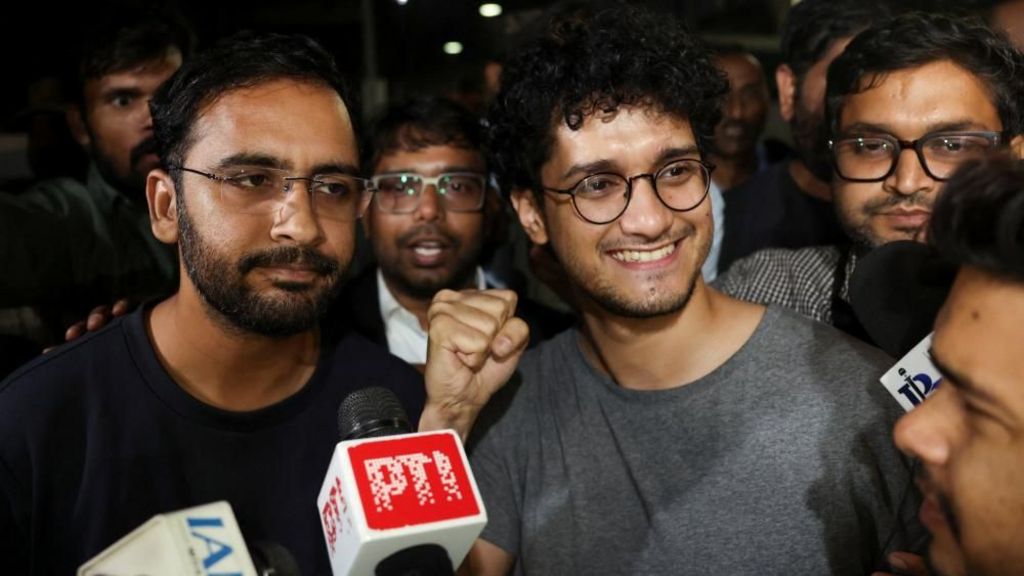
Two prominent youth leaders of India’s Gen Z-driven Cockroach Janta Party (CJP) have walked free from New Delhi’s maximum-security Tihar Jail, just seven days after their arrest on trespassing charges at a recently de-designated protest site.
Saurav Das and Ashutosh Ranka were released hours after a Delhi special executive magistrate court issued the release order, according to Indian legal publication Bar and Bench. The pair were taken into custody last week after they crossed police barricades and climbed a locked gate at Jantar Mantar, a historic New Delhi venue that was recently stripped of its status as an officially designated protest space. Both men have maintained their innocence throughout the proceedings.
Speaking to reporters from a police van after his release was granted, Das declared: “Truth alone triumphs. Long live the revolution.”
The CJP, an unregistered grassroots youth collective that started as an internet meme in May, has rapidly grown into a notable political force in India over the past several months. Its origin traces back to a comment from India’s top judge, who compared unemployed young protestors to “cockroaches” — a label the movement reclaimed as its own identity. The collective first mobilized thousands of young people to protest over a leaked national exam paper, and by July it had cemented its place as a major critic of the ruling government. A July march to India’s parliament ended in violent clashes with police, drawing national media attention and escalating public pressure that ultimately forced the resignation of India’s federal education minister.
More recently, the CJP has shifted its focus to challenging what it says are irregularities in India’s electoral process. Alongside opposition parties, student groups and other government critics, the CJP is calling for the resignation of India’s Chief Election Commissioner (CEC) Gyanesh Kumar over the Special Intensive Revision (SIR), a nationwide voter roll update exercise. Critics allege the SIR process has been manipulated to remove names of eligible voters from rolls in a way that benefits Prime Minister Narendra Modi’s ruling Bharatiya Janata Party (BJP).
Since the SIR launched last year, roughly 130 million names have been struck from India’s national voter lists. Critics warn that large numbers of eligible voters have been incorrectly excluded, disenfranchising them ahead of upcoming national elections. Both the Election Commission of India and the BJP have repeatedly rejected these accusations, with the election body stating the SIR’s sole purpose is to remove ineligible entries including deceased voters and duplicate registrations.