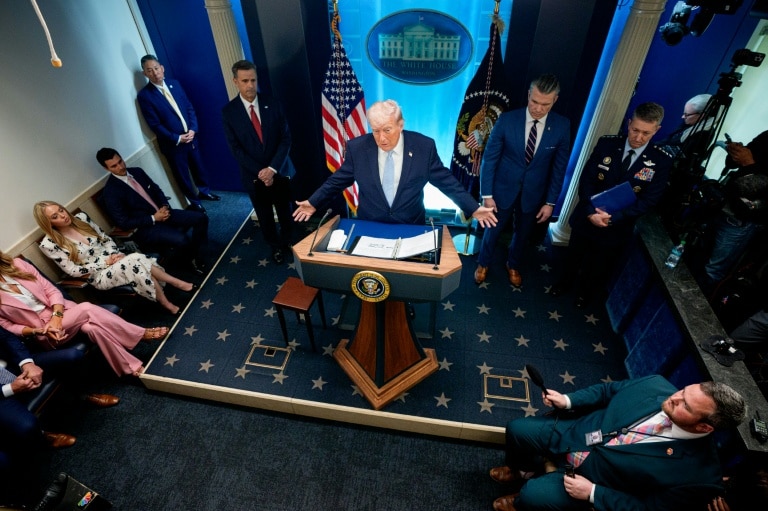
On a Monday press briefing at the White House, top US military and intelligence leaders alongside former President Donald Trump detailed one of the riskiest American combat search and rescue operations in recent Middle Eastern conflict: the recovery of two downed F-15 crew members from inside Iranian territory, after the jet was shot down amid five weeks of ongoing US-Iran hostilities.
The incident contradicts a recent claim Trump made last week that joint US-Israeli military operations had fully degraded Iran’s air defense capabilities, leaving the country with no functional anti-aircraft systems or operational radars. According to official accounts, the F-15 crashed Friday local time after being hit by a shoulder-fired heat-seeking missile, with its two-person crew — a pilot and a weapon systems officer — ejecting safely but landing in separate, undisclosed locations across Iranian soil.
“I immediately was asked to make a decision,” Trump told reporters at the briefing. “I ordered the US armed forces to do whatever was necessary to bring our brave warriors back home.”
The recovery effort unfolded in two distinct phases, drawing on over 170 American aircraft and roughly 200 military personnel, with added support from the Central Intelligence Agency. The first mission to extract the pilot deployed more than 20 warplanes that penetrated Iranian airspace in broad daylight, facing intense enemy fire en route. Joint Chiefs of Staff Chairman General Dan Caine, who spoke alongside Trump, described the operation as a bold incursion into hostile territory.
After search teams located the pilot, rescue helicopters retrieved him, but the aircraft immediately came under concentrated small arms fire from Iranian forces on the ground. One helicopter sustained critical damage, and multiple crew members suffered minor injuries, though Caine confirmed all are expected to make full recoveries. To clear a safe exit corridor for the rescue convoy, US A-10 Thunderbolt II ground attack aircraft carried out close-range suppression fire against advancing Iranian units. One A-10 took heavy enemy damage mid-engagement, but its pilot continued the mission before diverting to a neighboring allied country. Once on approach, the pilot determined the aircraft could not land safely, ejected over friendly territory, and was recovered unharmed. The damaged A-10 was ultimately lost.
“This was an incredibly dangerous mission,” Caine emphasized during the briefing.
The search for the weapon systems officer posed a far greater challenge, with CIA Director John Ratcliffe comparing the task to “hunting for a single grain of sand in the middle of a desert.” With Iranian forces scrambling to locate the downed airman first, intelligence teams launched a broad deception campaign to misdirect enemy search parties, buying critical time for US teams to pinpoint his location. By Saturday morning, US intelligence had confirmed his position. According to Trump, the injured officer evaded capture for more than a day, traversing rugged unmarked terrain, self-treating his wounds, and transmitting his location to US command.
For the second extraction, more than 150 aircraft were deployed to support the operation. To reach the isolated landing zone, two large C-130 cargo planes carried three compact disassembled helicopters that were assembled on-site after landing. However, the heavy cargo planes became stuck in soft sand and were unable to take off. After all US personnel and the rescued airman were evacuated via smaller aircraft on multiple sorties, the stranded C-130s were deliberately destroyed on the ground to prevent sensitive military technology from falling into Iranian hands. The total cost of all aircraft lost during the entire rescue operation exceeds $250 million, according to unofficial estimates.
More than 50 hours after the F-15 was shot down, both crew members were safely brought back to friendly territory, Caine confirmed. “These two operations reflect our nation’s most sacred obligation to our military service members,” he said. “We leave no one behind.”