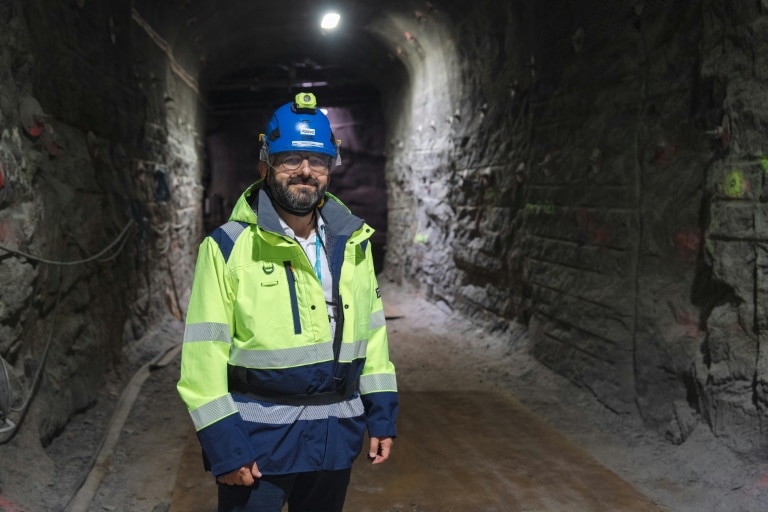
Deep beneath the Finnish soil, 433 meters below the surface in the southwestern municipality of Eurajoki, a landmark engineering project is nearing its final stages. Carved into 1.9-billion-year-old geologically stable bedrock, Onkalo — Finnish for “cave” — is poised to become the world’s first permanent repository for high-level radioactive spent nuclear fuel, closing a decades-long gap in global nuclear waste management.
Since the first commercial nuclear power plants launched in the 1950s, governments around the world have grappled with the intractable challenge of what to do with the toxic, long-lived byproducts of nuclear energy generation. To date, the vast majority of global spent nuclear fuel remains in temporary above-ground or shallow storage facilities, a stopgap solution that leaves future generations to bear the risk of contamination. While other nations including neighboring Sweden and France have plans for similar permanent repositories in development, Finland is on track to commission its facility first, breaking new ground for the global nuclear industry.
The project has cleared most regulatory hurdles already. Finland’s Radiation and Nuclear Safety Authority (STUK) is scheduled to release its final safety assessment this coming June, after which an operating license will be formally granted. Philippe Bordarier, chief executive of Finnish nuclear operator Teollisuuden Voima Oyj (TVO), told reporters the facility is on track to begin operations by the end of 2024, or more likely early 2025. The first canisters of spent fuel, currently cooled in water pools at the nearby Olkiluoto nuclear power plant on the Baltic Sea coast, will be the first to be moved to the permanent underground site.
Once fully operational, Onkalo will hold a total of 6,500 tons of uranium waste, enough to accommodate all spent fuel produced by Finland’s five existing nuclear reactors, three of which are located at Olkiluoto. Developed by Finnish nuclear waste management firm Posiva, construction began at the site back in 2004, with total projected costs now reaching 1 billion euros ($1.16 billion).
The facility is designed for millennia-long safety. Fuel will be deposited incrementally in Onkalo’s sprawling network of underground tunnels over the next century, with operations potentially extended if Finland approves and builds new nuclear reactors in the coming decades. After operations conclude, the entire vault will be sealed permanently, engineered to remain secure for at least 100,000 years. “Basically, it needs to be safe forever,” explained Lauri Parviainen, a Posiva chemist leading facility tours for media. Parviainen noted that after 100,000 years of radioactive decay, the waste will drop to roughly the same natural radioactivity level as the original uranium ore from which the fuel was manufactured.
The multi-layer safety protocol is designed to prevent leakage over that extraordinary timeline. Above ground, spent fuel assemblies are first sealed inside thick, highly corrosion-resistant copper canisters. These canisters are then lowered into individually drilled holes in the tunnel bedrock, and the gaps are filled with dense bentonite clay to block water flow and radiation. Once a 300-meter disposal tunnel is completely filled, it is sealed off with a steel-reinforced concrete plug. “So if the bentonite stays in place, we are safe,” Parviainen said.
STUK safety experts have run detailed risk assessments modeling potential hazards across up to a million years of future geologic change. Jarkko Kyllonen, a STUK nuclear safety specialist, told AFP that the first 10,000 years are the most critical period for maintaining canister integrity, when radioactivity levels remain highest. Key long-term risks include slow corrosion of the copper canisters and seismic activity associated with future ice ages, which could shift bedrock and damage the sealed containers. To date, however, all risk assessments have returned positive conclusions that the probability of leakage remains well within acceptable safety thresholds.
Unlike similar projects in other nations that have faced fierce grassroots pushback, the Onkalo facility has enjoyed broad public support in Finland. Local opposition emerged when plans were first floated in the 1970s, but over time public trust in regulatory oversight has grown. “People have gotten used to it and they trust the assessments made by STUK,” said Matti Kojo, a social sciences professor at the University of Lappeenranta (LUT). He added that public support for nuclear power in Finland is currently at a historic high, amid global efforts to transition away from fossil fuels.
That said, the project is not without its critics. The Finnish Association for Nature Conservation remains publicly opposed, warning that the facility imposes unmanageable long-term risk on future generations. “No one can guarantee the safety of Onkalo for thousands of years,” association director Tapani Veistola said in a statement to AFP.
The facility comes as Finland actively expands its nuclear energy sector. Under current Finnish law, all nuclear waste produced within the country must be permanently stored on domestic soil — a policy that replaced the pre-1994 practice of exporting spent fuel to Russia. Finland’s current right-wing government has prioritized expanding nuclear generation to boost energy independence and cut carbon emissions, and is currently evaluating proposals for new small modular reactors (SMRs) across the country. Climate and Environment Minister Sari Multala told AFP that a framework for managing spent fuel from future SMRs has not yet been finalized, with an official assessment expected to be completed by March 2025.