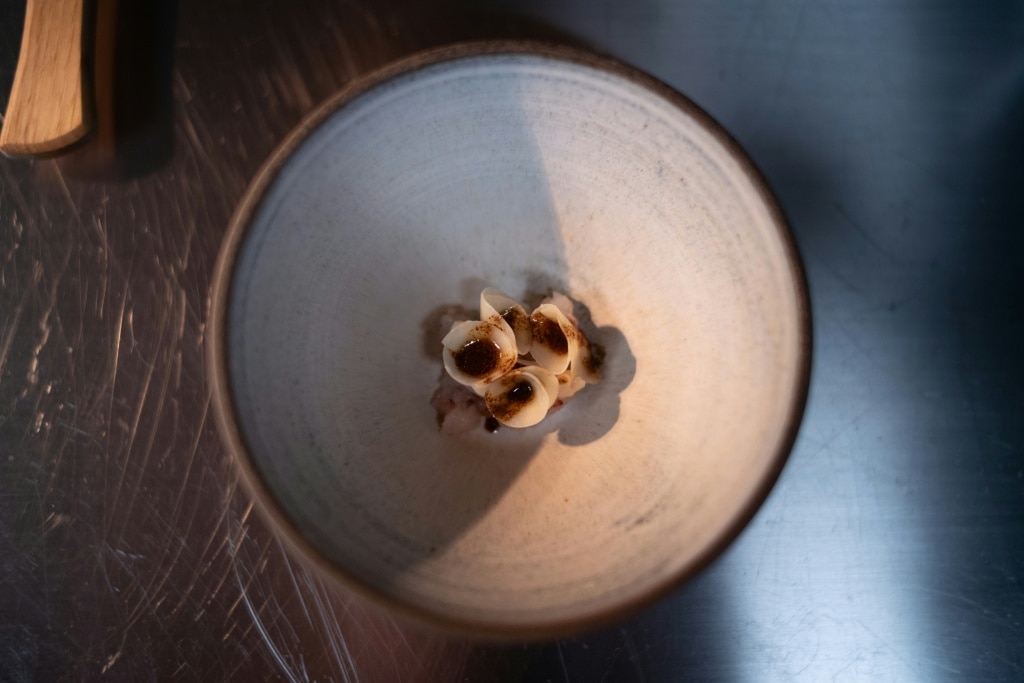
Against a backdrop of soft piano melodies and the rich, warm scent of brown butter drifting through the dining room, 33-year-old chef Habi Khaliqdad puts the final touches on a signature dish: a slice of soy-glazed narwhal, garnished with crispy puffed bacon. For seven years, this single-minded pursuit has anchored his life above the Arctic Circle, so deeply ingrained that the goal is even tattooed on his right arm: to claim the first-ever Michelin star for Greenland.
The culinary world will turn its attention to the Nordic region this Monday, when the iconic Michelin Guide announces its annual list of starred establishments. From the floor-to-ceiling bay window of Khaliqdad’s Ulo Restaurant, tucked in the remote Arctic town of Ilulissat, guests gaze out at a sweeping expanse of snow that blurs into the famous Icefjord, where towering icebergs drift slowly out to the open ocean.
Khaliqdad cuts a distinct figure: sharp, smiling features, arms lined with intricate tattoos, and a plain-spoken style laced with colorful language. Even he sometimes questions why he took on this unprecedented challenge, because every step of building a world-class restaurant in one of the harshest inhabited environments on Earth comes with extraordinary hurdles.
Securing consistent ingredients is the first and most persistent mountain to climb. In late March, shifting winds push packed sea ice to close off Ilulissat’s harbor, forcing local fishermen to suspend operations and leaving Khaliqdad unable to source the tender, flavorful redfish his menu relies on. Even core menu items like his signature Qaqortoq lamb sweetbreads with Italian white truffle and onion jus require logistical feats: Greenland’s harsh Arctic climate supports almost no commercial agriculture, so the lamb travels nearly 1,000 kilometers by boat or plane from the island’s warmer southern region to reach his kitchen. When winter storms roll in, air travel is grounded and cargo ships are trapped by ice, cutting off the town from outside supplies for weeks at a time. “If there’s a storm … you have to wait,” Khaliqdad says simply.
His fight to build a starred restaurant here mirrors the larger paradox of modern Greenland: a land brimming with new opportunity, but held back by deep structural and geographic constraints.
For Khaliqdad, the journey is as much personal as it is culinary. A Dane of Afghan origin, he carried a lifetime of loss, hardship and addiction before finding redemption in the heat of commercial kitchens. He got his start as a teenager washing dishes, and fell in love with the craft through French cuisine, devouring cookbooks from legendary French chef Paul Bocuse. He worked his way up through Copenhagen’s most prestigious dining establishments, earning a nomination as a finalist for the city’s 2017 Chef of the Year award.
Today, Denmark holds 37 Michelin stars across 263 Nordic Guide listed restaurants, transforming the country once known only for heavy, traditional fare into a global destination for innovative gastronomy. But that culinary revolution has never crossed the Labrador Sea to reach Greenland. Deep in debt and looking for a fresh start, Khaliqdad took his former mentor’s advice: “Go to Greenland, man. It’s cold and you’ll find yourself.” He relocated to the Danish autonomous territory to rebuild his life and chase his culinary dream.
In his kitchen, centered on an Italian-made island, Khaliqdad uses a sharp Japanese knife to break down local Arctic ingredients: narwhal, reindeer, and ptarmigan, all sourced from the region. When he first arrived, he pored over botany textbooks to find native flavors that could lighten the traditional heavy, meat-centric Greenlandic diet. It was a local hotel housekeeper named Stella who ultimately taught him where to forage wild mushrooms and angelica native to the tundra. Each summer, during the few short snow-free weeks, Khaliqdad and his team hike the rocky hills outside town to gather their own fresh ingredients. “I learned to not think about Nordic, European, Michelin cuisine. I have to think about this country’s cuisine,” he explained.
Today, Ulo draws a steady stream of well-traveled tourists, who arrive in stylish apres-ski gear to dine while gazing out at the icebergs. Ilulissat, a town of just 5,000 permanent residents, already welcomes 50,000 tourists a year drawn to its iconic Icefjord. Now, the town is positioning itself as Greenland’s emerging gastronomy capital, with a new culinary training program launched recently and a new international airport set to open in October, which is expected to double annual visitor numbers. “Maybe they can help me with this small dream I have in my body, you know?” Khaliqdad says, tapping the star tattoo inked into his arm.
Even with this growing momentum, steep hurdles remain. Travel to Greenland remains expensive and logistically complex, even for anonymous Michelin inspectors. Khaliqdad also struggles to hire trained local kitchen staff, as few Greenlandic workers have formal culinary training. The long, dark Arctic winters also bring a heavy weight: a few years ago, a young kitchen hand died by suicide, a stark reminder of the widespread mental health challenges that plague the island’s remote communities. “It’s hard. It’s fun. It’s sadness too, man… It’s odd,” Khaliqdad reflected.
Still, he continues forward, his eyes fixed firmly on the guiding star that brought him to the Arctic, waiting to see if his seven-year quest will finally be rewarded this Monday.