Near the Sudan-Central African Republic border, in the sweltering, dust-choked Birao refugee camp, Maude Ahmad Fadala’s story of childbirth encapsulates a growing public health catastrophe unfolding across conflict-stricken sub-Saharan Africa. Weakened by typhoid after fleeing Sudan’s ongoing civil war, Fadala went into labor at the camp that offered no obstetric care, and she had no money to pay for transport to the nearest medical facility. Staggering along rough dirt roads, stopping every few steps to ride out crippling contractions, she eventually could go no further. “I gave birth in the street,” she recalled. “There was no doctor, no midwife, and no one holding my hand.”
Fadala’s experience is far from an isolated tragedy. It is one of hundreds of thousands of preventable maternal deaths recorded every year across sub-Saharan Africa, a region home to the world’s fastest-growing population and 70% of all global pregnancy-related maternal deaths – roughly 182,000 fatalities annually. Data from the World Health Organization confirms that nearly two-thirds of all maternal deaths worldwide occur in nations grappling with armed conflict or systemic fragility. For women like Fadala, who cross borders to escape war, the danger of dying in childbirth does not end when they reach safety; displacement itself amplifies risk at every turn.
Displacement strips pregnant women of access to routine prenatal care, forces dangerous multi-mile journeys to access even basic health services, and strains already depleted health systems in host regions. The United Nations estimates that women in the Central African Republic, one of the world’s poorest nations, face a maternal mortality rate of 829 deaths per 100,000 births – 40 times higher than the rate recorded in the United States. Years of internal conflict have gutted the country’s health infrastructure, leaving critical care concentrated almost exclusively in major urban centers. Despite the Central African Republic’s extensive gold reserves, one in three residents survive on less than $2 per day, and health services remain nonexistent for many communities in remote border regions.
In 2024, the Central African government acknowledged the depth of its maternal mortality crisis and announced a plan to increase funding for skilled birth attendants and reproductive care, but officials have not responded to requests for updates on the initiative’s implementation. What has worsened the crisis dramatically in recent years is sweeping cuts to humanitarian aid from the world’s top donors, led by the United States. In Birao, the border camp where Fadala now lives, all four local midwives who had received support from the United Nations Population Fund (UNFPA) lost their jobs last year, after the Trump administration cut all U.S. funding for the UN’s sexual and reproductive health agency.
Before the funding cuts, UNFPA operated four “safe birthing spaces” across Birao that served nearly 50,000 women, providing emergency transport for pregnant people to the local district hospital. All of those facilities have closed, along with two additional U.S.-backed health clinics. Across the entire country, UNFPA’s operating budget has been cut in half over the past two years, falling to just $6.5 million. Before the cuts, the agency was the sole provider of reproductive health supplies across Birao. “The risk of maternal death is going to increase if there is no solution,” said Victor Rakoto, UNFPA’s country director for the Central African Republic. U.N. data underscores this warning: conflict-affected settings like Birao account for six in 10 maternal deaths globally.
A visit to Birao’s understaffed district hospital – the facility Fadala was never able to reach – reveals the full scale of the crisis. On a recent workday, dozens of pregnant women waited shoulder-to-shoulder on hard wooden benches in sweltering, unventilated waiting areas, many having walked for hours or risked complications by riding motorbikes over rutted dirt roads to reach care. Birthing assistant Delphine Zanabe moves between patients nonstop, saying most refugee women only arrive when labor is already well underway, skipping the eight prenatal checkups recommended by the World Health Organization.
For displaced women, survival mode in unfamiliar territory compounds the existing barriers of generational poverty and limited education, all of which increase the risk of life-threatening complications during pregnancy and childbirth. The hospital’s maternity ward houses eight beds crammed into a room so small the mattresses almost touch, and the ward serves 70,000 local residents plus 22,000 Sudanese refugees. Twelve hospital staff members – most from the maternity department – have already lost their jobs due to aid cuts.
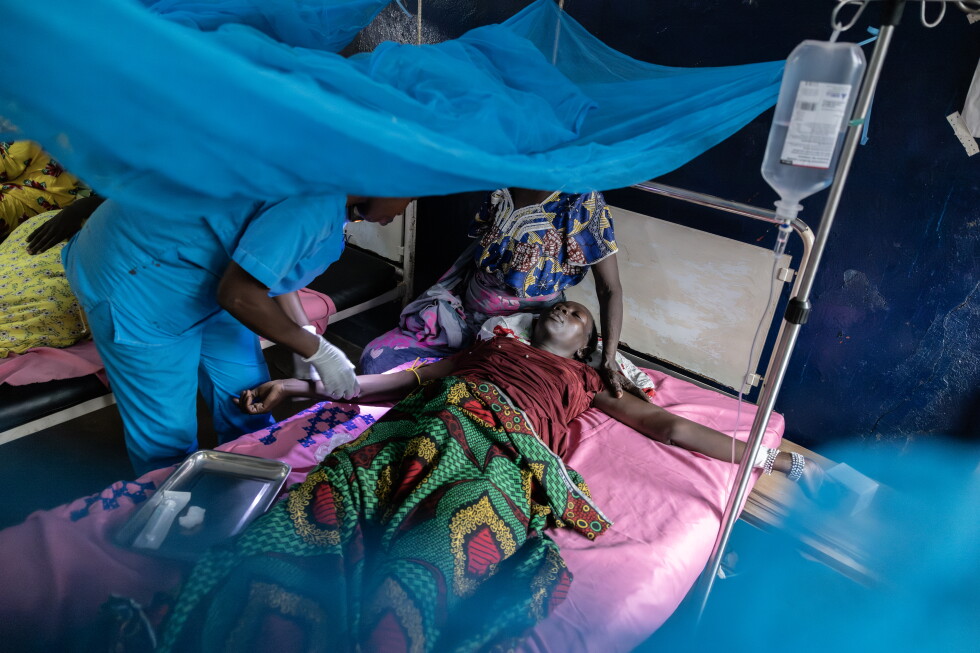
That staffing shortage has already had fatal consequences. Amna Adam Hessen arrived at the hospital the day before her labor, burning with malaria fever. Her unborn child was in a breech position, a complication discovered far too late because she had been unable to attend prenatal appointments. Rushed to the hospital by motorbike from the camp, Hessen suffered severe hemorrhaging during labor and lost her baby. As her mother fanned her in the suffocating heat the next day, Hessen writhed on a bare foam mattress crying out in pain. “Giving birth here is exhausting,” her mother said.
Clara Abessendé, one of the four unemployed Birao midwives, described the guilt of leaving her post as demand for care surged after Sudan’s war broke out in early 2023. After the conflict began, the number of pregnant women arriving at the hospital tripled, and staff quickly ran out of critical supplies including antibiotics and malaria treatments. “As a result, there were more cases of infant and maternal deaths,” she said. “The children born in my hands … I abandoned them like that.”
For women waiting to give birth, the uncertainty is crippling. Katidje Idrisse Tahire, a nine-month pregnant refugee who fled Sudan on foot four months ago, lost all her belongings to armed robbers at the border and has not seen her husband since they fled Darfur. Carrying one child on her back while leading two more to fetch water in the camp, Tahire said she constantly aches, feels exhausted and unwell, and has no way to pay for care when she goes into labor. “I don’t know if anyone will be there to help me,” she said. Currently, more than 40% of all births in the Central African Republic happen outside of medical facilities, a statistic that experts warn will only rise as more aid cuts take hold, turning avoidable complications into fatal outcomes for thousands of women.