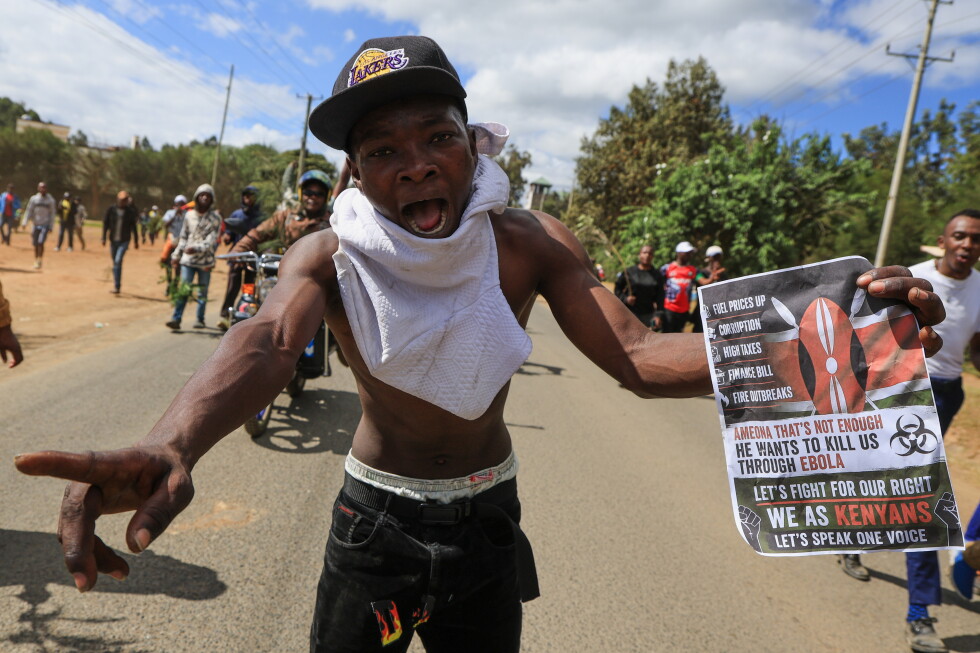
On Monday, hundreds of young Kenyan demonstrators gathered outside the gates of Laikipia Air Base in the central town of Nanyuki, rallying against a planned Ebola quarantine facility that was set to host American citizens exposed to the virus. The public demonstration comes just two days after Kenya’s High Court ordered an immediate suspension of the facility’s construction and any incoming foreign patients, pending a full judicial hearing into the case. The legal challenge was filed by two prominent Kenyan groups: the Law Society of Kenya and a national constitutional watchdog, which argue that Kenya’s overstretched, fragile public health system cannot safely accommodate the risks of hosting quarantined Ebola-exposed patients from abroad. The controversial plan first emerged last week, when anonymous U.S. administration officials confirmed to reporters that the U.S. intended to transfer Americans who had contracted Ebola exposure while working or traveling overseas to this new Kenyan facility, rather than repatriating them to the United States. According to those officials, the site at Laikipia Air Base was scheduled to be operational by this Friday, with capacity for 50 quarantine patients. The initiative has sparked widespread pushback across multiple levels of Kenyan society even before it could launch. On Sunday, Kenya’s Health Minister Aden Duale attempted to ease public tensions, stating that the facility would be open to “everyone” rather than being reserved exclusively for U.S. nationals. But this clarification has done little to alleviate local concerns. Joshua Irungu, the governor of Laikipia County, has publicly joined the opposition, noting that dozens of local residents work on the air base and would face unavoidable exposure risks if the quarantine center opens. For its part, the U.S. has sought to frame the initiative as a contribution to Kenyan public health: U.S. Secretary of State Marco Rubio announced in an official statement that the U.S. government would allocate $13.5 million to support Kenya’s overall Ebola preparedness efforts as part of the plan. Currently, Kenya itself has not recorded any confirmed cases of Ebola, but the threat is close to home. Neighboring Uganda has already confirmed nine cases and closed its border with the Democratic Republic of Congo, where the current outbreak is centered. The DRC has reported at least 282 confirmed cases of the Bundibugyo strain of Ebola, with more than 1,000 additional suspected cases. Critically, this specific strain of the virus has no approved vaccine or targeted treatment available, amplifying global and local concerns about accidental spread. The ongoing legal challenge, public protest, and conflicting statements from Kenyan and U.S. officials have left the future of the quarantine project hanging in limbo as regional authorities work to contain the spreading outbreak.
Hundreds of youths protest outside Kenya’s Ebola quarantine center for US citizens