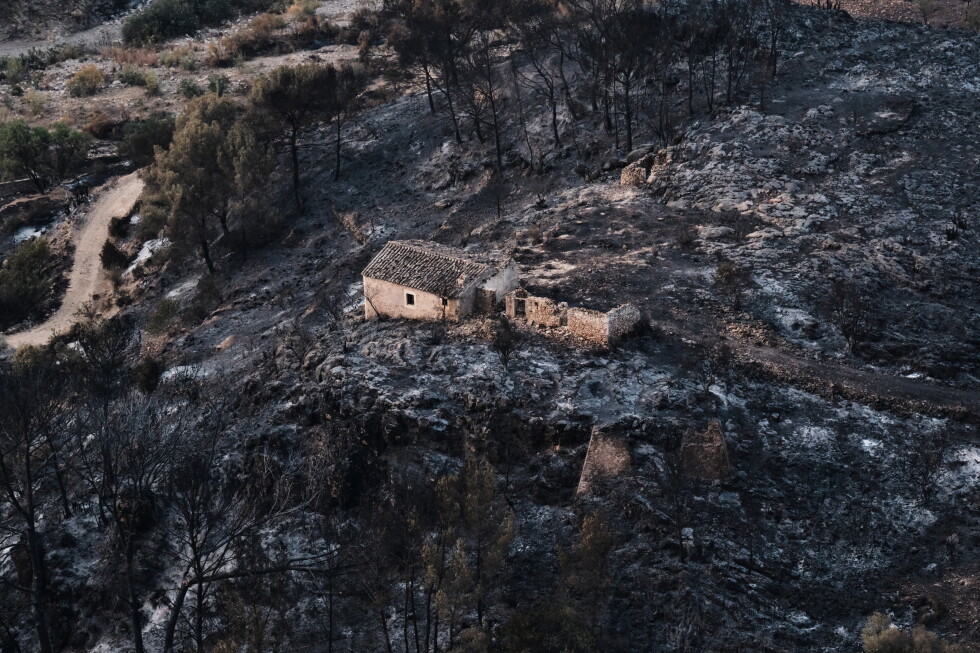
On a sweltering summer weekend in southern Spain, hundreds of firefighters supported by aerial firefighting assets including helicopters and fixed-wing planes fought to bring under control one of the country’s deadliest wildfires in decades, which has already claimed at least 12 lives. The blaze, which ignited late Thursday in a parched semi-arid region near the Sierra de Los Filabres mountains in Almeria province, has already consumed roughly 66 square kilometers of forest and agricultural land — an area nearly matching the total size of Manhattan.
Antonio Sanz, chief of emergency services for the Andalusia region, reported that slightly milder conditions, including light winds and elevated humidity, have given firefighting crews a small opening to gain ground over the inferno. Still, the unprecedented scale of the blaze continues to present major operational obstacles. Overnight, teams carried out controlled back burns along the fire’s perimeter to starve it of fuel and prevent further spread.
Authorities have confirmed that most of the victims are believed to be foreign nationals, and the majority lost their lives after disregarding official shelter-in-place orders as the fire advanced. Seven of the deceased died on foot after abandoning their vehicles to flee the flames. Regional officials say four victims are confirmed to be British citizens, after investigators noted the burned-out vehicle they were traveling in had a right-side steering wheel, consistent with UK vehicle standards. Autopsies have been completed, and DNA samples have been collected to formally identify all victims, Sanz confirmed Saturday. So far, officials have proactively evacuated 1,448 residents across 11 at-risk communities.
The harrowing escape of one British couple, Jeffrey and Christine Kember, who own a farmhouse in Los Pinos, illustrates the chaos of the fire’s rapid advance. The pair were watching a television program when emergency sirens blared, warning of the approaching flames. Both jumped into their separate cars, stopping first to help a neighbor with two young children, but the couple became separated in the smoke and fire, and Jeffrey could not reach Christine because she had left her phone behind. “I was driving straight through the flames. I just thought, I can’t stop, I have to keep going,” Jeffrey Kember told the Associated Press in an interview outside a local evacuation center, with his unharmed wife beside him. “It was surreal — one minute I was surrounded by fire, and the next I came out into bright sunshine. It was ridiculous.”
Per Spain’s state-run EFE news agency, local authorities have already arrested two people who defied evacuation orders and returned to the high-risk fire zone. Search and rescue teams are still conducting grid searches of the Bédar area to locate any additional missing people or victims.
The deadly Almeria fire comes as Southern Europe grapples with a worsening climate-fueled heat crisis that has made extreme heat and large-scale wildfires the new normal. Spain has battled increasingly frequent and severe heat waves in recent years, with temperatures regularly topping 40 degrees Celsius. Hot, dry, windy conditions allow small ignition events to rapidly escalate into out-of-control blazes. Spanish Justice Minister Félix Bolaños said Saturday that the extreme ferocity of the Almeria fire is a direct consequence of the ongoing global climate emergency, noting that at its peak, the blaze advanced at a rate of 100 meters per minute.
Earlier this June, Spain recorded multiple days of all-time record heat, which contributed to more than 1,000 excess deaths across the country. Data from the European Union’s Copernicus Climate Change Service confirms that Europe is warming faster than any other continent on Earth, with temperatures rising twice as fast as the global average since the 1980s. Much of Western Europe is currently facing its third intense heat wave in just six weeks, and 2025 ranks as the third-hottest year ever recorded globally.
The crisis is not isolated to Spain. Neighboring France is also battling multiple active wildfires across the country as temperatures soar. French Interior Minister Laurent Nunez announced Saturday that 32 people have been arrested so far this summer in connection with human-caused wildfires across the country. “These unacceptable acts have disastrous consequences and force our firefighters to operate at great risk to their own lives, and now those responsible face justice,” Nunez said. “We will continue our determined action and will not tolerate this.”
French President Emmanuel Macron recently reminded the public on social media platform X that nine out of 10 wildfires in France are started by human activity. Since the start of 2026, more than 25,000 hectares of land have burned across France — nearly double the total area burned over the same period last year. France is currently experiencing the peak of its third heat wave of the summer, with temperatures hitting 40 degrees Celsius across western and central regions, and reaching 37 degrees Celsius in Paris. Last month was the hottest June ever recorded in France, with mortality surging nearly 30% during the peak of the heat.
Wildfires are not a new threat to the Iberian Peninsula. Last year alone, wildfires burned more than 393,000 hectares of land across Spain — an area twice the size of London — that killed four people, according to the European Forest Fire Information System. Spain’s deadliest wildfire on record dates back to 1979, when 21 people died in the coastal town of Lloret de Mar, northeast of Barcelona. In neighboring Portugal, the 2017 wildfire in Pedrogao Grande killed 66 people, 47 of whom died trapped on a single road while attempting to flee the blaze by car — a tragedy that mirrors the circumstances of many deaths in this latest Spanish fire.
Associated Press reporter Samuel Petrequin in London contributed reporting to this article.