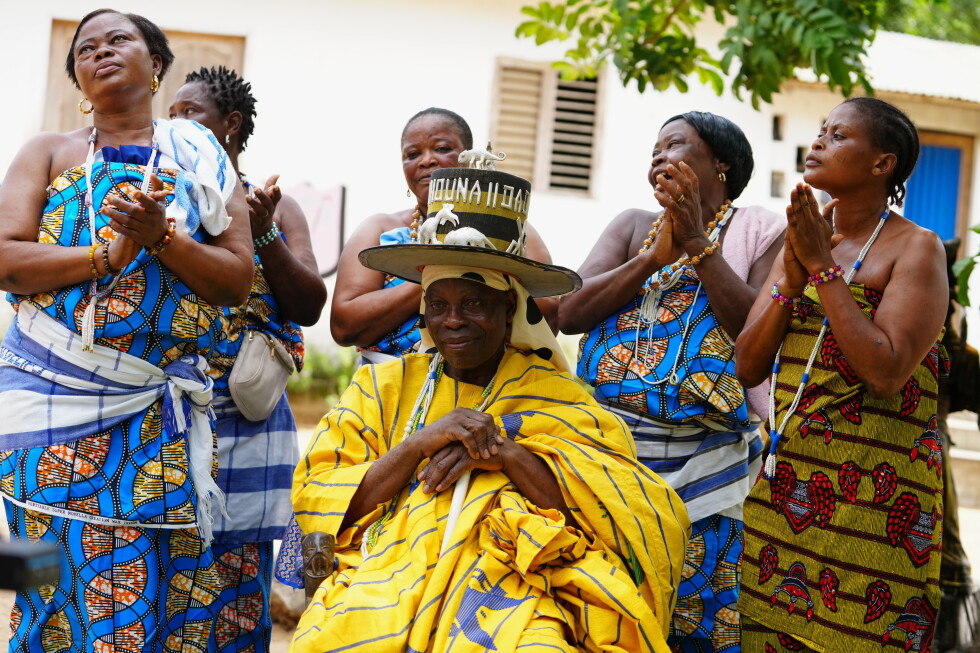
Nestled on West Africa’s Gulf of Guinea, the coastal city of Ouidah holds a unique dual distinction: it is the global birthplace of the indigenous Vodún religion, and an unlikely cradle of the democratic stability that Benin has nurtured across three decades, even as neighboring nations have fallen into a pattern of military takeovers that earned the region the nickname the “coup belt.” That stability, scholars and Vodún devotees argue, is deeply intertwined with the religion’s quiet, unyielding resistance to authoritarian overreach, a story that begins with the rise and fall of former dictator Mathieu Kérékou.
Kérékou seized power in the 1972 coup that renamed the former colony of Dahomey to Benin, establishing a rigid Marxist-Leninist dictatorship that nationalized nearly all major industries. As he consolidated his control, he targeted Vodún, labeling the centuries-old faith a subversive, backward force that threatened his grip on power. Under his rule, Vodún priests were detained, sacred shrines were demolished to make way for urban development, and the practice of the religion was effectively banned. What Kérékou did not anticipate, however, was that this crackdown would spark a resistance that would ultimately force him to abandon his authoritarian approach.
Accounts from devotees and former Kérékou advisers confirm the dictator grew deeply paranoid of spiritual retaliation from Vodún leaders, convinced he faced a curse that could turn him into a zombie. Raised Catholic, he converted to Islam before later embracing born-again Christianity in a frantic search for stronger spiritual protection, even recruiting a notorious Malian marabout known as “the Devil” to counter the perceived threat. His fear grew so extreme that he could no longer safely travel to large swathes of the country, where support for Vodún ran deepest. “This is precisely what led him to reconsider his position regarding Indigenous religions,” explained Léon Bani Bigou, a former lawmaker who once served as one of Kérékou’s top advisers.
By 1990, mounting economic collapse from Kérékou’s nationalization policies, combined with pressure from religious and civil society groups, forced the dictator to call for democratic reforms and a 1991 presidential election he fully expected to win. In a stunning upset, he was defeated by opposition candidate Nicéphore Soglo, who immediately moved to recognize Vodún as an official part of Benin’s national heritage and enshrine religious tolerance as a core national value. When Kérékou returned to power as a civilian democrat after winning the 1996 election, he kept that promise, officializing a national Voodoo Day celebrated every January 10 and establishing a state-led National Voodoo Board to govern the religion’s affairs. By his final campaign in 2001, Kérékou was actively courting the Vodún vote in Ouidah, a far cry from his days as an anti-Vodún dictator.
Today, Benin stands as a rare beacon of democratic stability in West Africa, where eight successful military coups have occurred across the region since 2020. The most recent peaceful transfer of power took place in May 2024, when former finance minister Romuald Wadagni was inaugurated after incumbent Patrice Talon stepped down at the end of his two-term limit. For scholars and religious leaders, this resilience of democracy traces directly back to the resilience of Vodún itself.
Roughly 14 million people call Benin home, with U.S. State Department data recording that half identify as Christian. But prominent Beninese politician Mahougnon Kakpo calls Vodún “the first religion of all Beninese,” noting that even many who identify with other faiths still engage with Vodún traditions privately. An animist faith centered on engagement with the spirit world, Vodún holds that divine power is present in all natural features, from rivers to rock formations. Its ceremonies include ritual incantation, traditional dance, and symbolic animal sacrifice, and it has spread across the Atlantic through the trans-Atlantic slave trade, evolving into the Vodou practiced in Haiti and other parts of the Caribbean.
Ouidah, the historic center of Vodún, was once a major slave trading port, and it is home to the “Door of No Return” monument honoring the millions of enslaved Africans who were forcibly shipped to the Americas. Vodún supreme leader Daagbo Hounon Houna II, who is based in Ouidah, points to a little-remembered chapter of Vodún history to illustrate the religion’s long tradition of resistance: the 1791 Bois Caïman ceremony, where enslaved Africans in Haiti gathered for a Vodún ritual to plot their rebellion against French colonial rule. That uprising led to Haiti becoming the world’s first free Black republic in 1804, proving that even under the most brutal oppression, Vodún could not be suppressed. “The more you attack their religion, the more you raise their spirits,” Houna II said of Vodún adherents during an interview at his Ouidah temple.
Unlike other postcolonial African authoritarian leaders who successfully consolidated personal power by co-opting or suppressing religious traditions, Kérékou ultimately failed to break Vodún because of its deep roots in daily Beninese life. “Kérékou failed to eradicate Vodún because he was attacking a centuries-old social practice deeply rooted in the daily lives of Beninese people, a resource to which he and officials in his regime had been able to turn in the exercise of power,” explained Narcisse Martial Yedji, a political sociologist at Université d’Abomey-Calavi. “Kérékou could not win over all the guardians of Voodoo traditions. Voodoo is not private property.”
Today, the faith remains a central part of national life, with devotees across the country making regular pilgrimages to sacred shrines in Ouidah, leaving offerings of fruit and other gifts to honor ancestral spirits. For its followers, the story of Benin’s democracy and Vodún’s resistance is a clear lesson: no leader, however powerful, can successfully stamp out a faith that is woven into the very identity of the nation. “Voodoo is life,” said Dossavi Yovo, a priestess at Houna II’s temple. “If you want to practice Voodoo, you have got to dedicate yourself to it.”