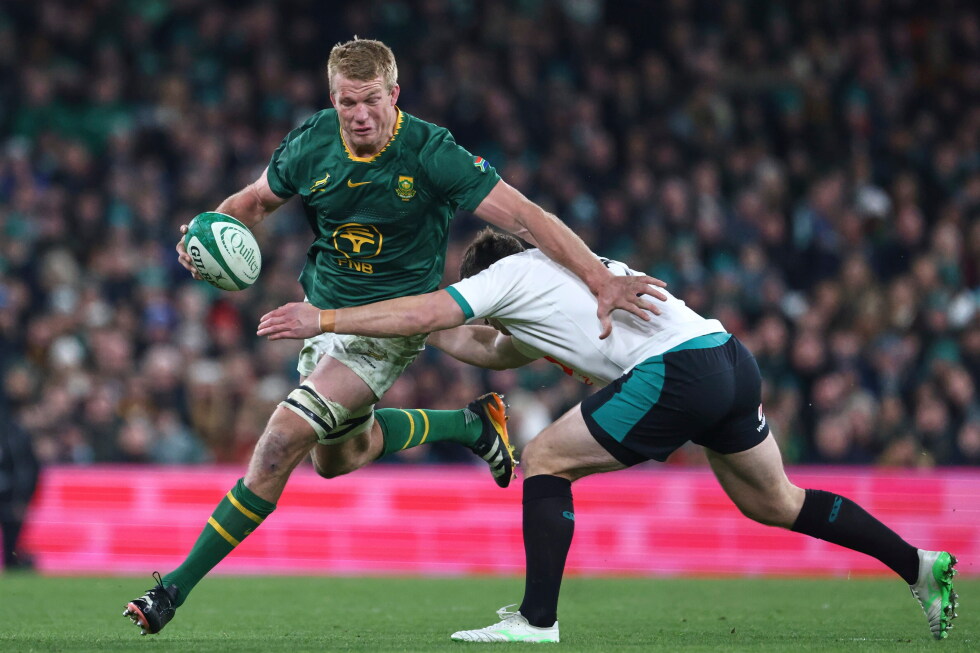
In 2018, when newly appointed South Africa rugby head coach Rassie Erasmus first crossed paths with Pieter-Steph du Toit, the veteran Springbok forward did not match what Erasmus expected. By that point, du Toit had already earned five years of international caps and claimed a South African domestic Player of the Year award, but the pair had never collaborated or met before. Erasmus’s initial assessment was harsh: he criticized du Toit for missing too many tackles, carrying the ball with poor upright form, and misread his laid-back demeanor as a lack of competitive drive. At best, Erasmus pegged him as nothing more than a useful utility option for the bench.
Today, that early assessment stands as one of the most notable misjudgments in modern rugby. “I have never been as wrong about a player as I was with Pieter-Steph, and I have never been as pleased to be so wrong,” Erasmus told SA Rugby magazine ahead of du Toit’s historic 100th test match, which takes place this Saturday against New Zealand at Cape Town. When Erasmus took the reins of the Springboks in 2018, the program was reeling from two consecutive underwhelming seasons, and his mandate was simple: rebuild the side and restore the national team’s reputation as one of the most feared forces in global rugby. It took just two training sessions for him to completely reverse his opinion of du Toit.
What Erasmus discovered defied every initial assumption. Du Toit showed relentless commitment to the Springbok jersey, unmatched tactical understanding of the game, consistent on-field contributions, and an eagerness to learn and push his own limits. He was always the first player on the training pitch and the last to leave, and staff regularly had to force him to take scheduled rest days. Pairing that relentless work ethic were innate on-field instincts, a willingness to put in the unglamorous “dirty work” that wins matches, an ability to break through defensive lines to gain critical territory, and bone-rattling tackles that disrupt opposition attacks and punish ball carriers.
The turning point that cemented du Toit’s place in Erasmus’s starting lineup came in September 2018, almost exactly a year after the Springboks suffered a demoralizing 57-0 defeat to New Zealand in Auckland. South Africa claimed a historic victory on New Zealand soil – their first in nine years – and du Toit delivered a career-defining performance, making 24 tackles over the full 80 minutes. Post-match cameras captured the forward overcome with tears, a moment that still stands as one of the most memorable in recent Springbok history. Today, the idea of leaving du Toit out of the matchday 23 is unthinkable for Erasmus. Even the Springboks’ famous “Bomb Squad” reserve forward pack, which regularly replaces starting forwards early in matches, will sub captain Siya Kolisi before they even consider pulling du Toit, who is legendary for his unrivaled fitness and endurance. He rarely comes off the pitch before the final whistle.
Du Toit’s journey to 100 caps has been defined by hardship and perseverance that stretches back to his childhood and his family’s deep rugby roots. Raised on the wine and olive farm outside Cape Town that his grandfather – legendary 1960s Springbok prop Piet “Spiere” (which translates to “Muscles” in Afrikaans) du Toit – bought in the 1950s and which remains in the family today, du Toit dreamed of being a great Springbok from a young age, raised on stories and mementos of his grandfather’s iconic career.
But his path to this historic milestone has been anything but smooth. Multiple serious injuries delayed his march to 100 tests: a cracked sternum, repeated shoulder injuries, and two ACL reconstructions – the second of which used a hamstring tendon donated by his father to speed up his recovery ahead of the 2015 Rugby World Cup in England. His World Cup debut ended in humiliation, as the Springboks suffered their infamous “Miracle of Brighton” loss to Japan, with du Toit among the players criticized for being deployed out of position.
His most harrowing injury came in 2020, just months after he led South Africa to the 2019 World Cup title and claimed the World Rugby Player of the Year award. A thigh hematoma developed into acute compartment syndrome, a dangerous buildup of internal pressure that required emergency surgery the same night. Surgeons made a 40-centimeter cut along his thigh, and when nerve function failed to improve after the procedure, doctors even discussed the possibility of amputation. Only after du Toit lost 10 kilograms was a fourth successful operation possible to close the wound and save his leg.
Through every setback, du Toit’s relentless drive to improve never faded. In the 2019 World Cup final victory over England, he made 20 tackles and immediately sought out forwards coach Matt Proudfoot after the final whistle to ask what he could do better. “He’s a no-nonsense guy who doesn’t seek validation,” Proudfoot said of du Toit. “He just wants to know what he’s got to do. He doesn’t say much but the group listens. He just puts it out there. Being a Springbok matters to him.”
Du Toit himself acknowledges he is far more comfortable leading by example than delivering rousing speeches. “I’m a strong believer in actions speak louder than words,” he said. “The way you perform on the field or the way you live your life must tell your story, ‘Okay, these are the morals of this guy.’ And if you can do that, nothing has to be said.”
That said, one unscripted, emotional speech from du Toit became a defining moment of South Africa’s 2023 World Cup title run. Trailing England 12-6 at halftime of the Paris semifinal, Erasmus left the changing room to an eerie silence. Du Toit stood up and asked his teammates point-blank – with plenty of profanity – whether they were scared or ready to fight. When the speech was featured in *Chasing the Sun 2*, the documentary covering South Africa’s championship run, du Toit worried his raw language would set a bad example for young fans. But any concerns about his reputation were erased weeks later, when he delivered a masterclass in the final against New Zealand, making a staggering 28 tackles without a single miss and being named Man of the Match on the way to a second world title. Then-head coach Jacques Nienaber joked at the time, “If there’s a white plastic bag that blows over the pitch, he’d probably chase that down as well.”
This Saturday, du Toit will write another chapter in Springbok history as he becomes the 11th player in the program’s history to earn 100 test caps, and the sixth to reach that milestone under Erasmus’s tenure as either head coach or director of rugby. For a player once written off as a bench utility, the milestone is a testament to perseverance, grit, and the power of quiet dedication.