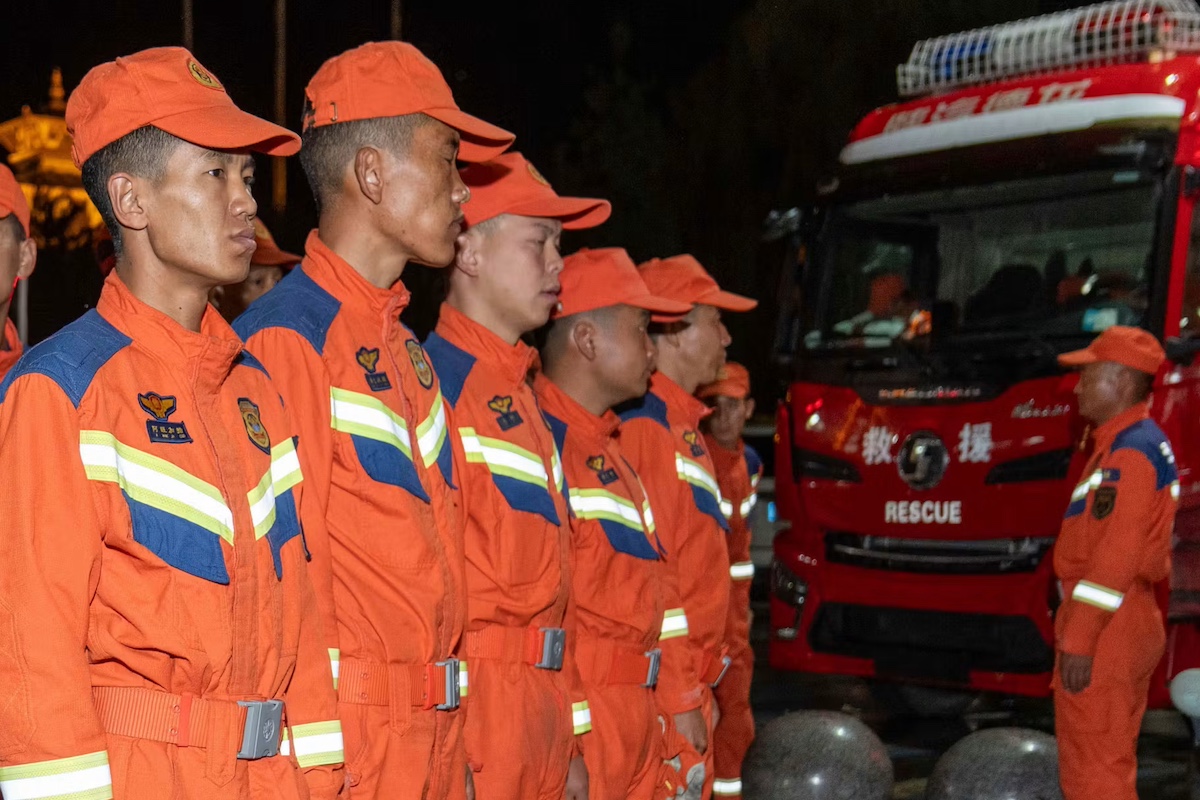
In the wake of catastrophic flash floods and landslides that have devastated cross-border regions of Nepal and Tibet’s Xizang Autonomous Region, ongoing rescue operations have been overshadowed by a heated social media dispute over media coverage and information control of the disaster.
The controversy ignited after a report from Laura Bicker, the BBC’s China correspondent, claimed that Chinese authorities had scrubbed viral footage of a massive flood and mudslide surge that swept through Gyirong Port, a key border trading hub on the Tibet-Nepal border. Bicker argued the removal was rooted in Beijing’s concerns over potential social unrest in the politically sensitive Xizang region.
Critics of the BBC’s reporting quickly pushed back, with social media users sharing screenshots proving the same footage cited by Bicker had already been broadcast by multiple domestic Chinese outlets. One Chinese journalist publicly accused the outlet of spreading blatant misinformation, while other online observers noted nuanced, middle-ground perspectives are often erased in polarized debates over Chinese media censorship.
Long-standing tensions frame this conflict: Beijing has repeatedly condemned what it frames as systemic bias in Western media reporting on Xizang, and pro-government social media users have amplified this narrative this week, centering their criticism on the BBC. At the same time, domestic and overseas Chinese social media users have long documented widespread state control over information in China, a pattern that has reemerged in the aftermath of the floods.
As Bicker outlined in her report, the most tangible evidence of content restrictions is the removal of user-shared footage showing the flood wave swallowing Gyirong Port. While the clips initially spread across domestic platforms WeChat and RedNote, they were later made inaccessible to users. Beyond content removal, independent and foreign journalists are systematically barred from accessing the disaster zone. Allyson Horn, a correspondent with the Australian Broadcasting Corporation, confirmed she had submitted multiple requests to visit the affected area and was rejected each time, with other international reporters facing identical blocks.
This blanket access restriction makes independent verification of official Chinese accounts of the disaster impossible for outside outlets. The combination of removed social media content and barred independent reporting has left Chinese state media with full control over the public narrative of the floods.
State media coverage of the disaster has followed China’s long-standing crisis reporting playbook, which prioritizes content that avoids public panic or perceived threats to social stability. Coverage has centered almost exclusively on People’s Liberation Army rescue missions, President Xi Jinping’s oversight of the response, and Premier Li Qiang’s official visit to the affected region. Reporting has also included updates on road repair efforts and the delivery of relief supplies to impacted communities, but as The Guardian has observed, there has been a stark lack of coverage detailing the disaster’s impact on local residents, their destroyed homes and damaged communities. This stands in sharp contrast to the Nepali side of the border, where international reporters have been allowed to interview survivors without restrictions.
Critics also accuse Beijing of concealing the true casualty toll from the disaster, but the restricted access to the region means no outside observers can confirm or refute competing claims about the number of fatalities.
To contextualize current information controls, it is worth examining shifts in Chinese emergency reporting over recent decades. In some historical cases, Beijing has allowed far more open coverage of large-scale disasters: the 2008 Wenchuan earthquake, which killed over 70,000 people and left millions homeless in Sichuan province, saw Chinese state media launch extensive live coverage within hours of the quake, a practice that continued for weeks. China Central Television published regular updates to the death toll and covered rescue efforts in depth. While foreign reporters raised questions about the collapse of poorly constructed school buildings and calls for accountability for victim families, domestic Chinese outlets even covered some of these controversies, including debates over whether local officials had conducted proper construction quality inspections. This early coverage was widely hailed by international observers as an unprecedented breakthrough in open Chinese disaster reporting, with many noting the extraordinary level of transparency on display. Within weeks, however, the government cracked down on discussions of the collapsed schools over fears the issue would fuel anti-government sentiment.
Over time, the standard approach for state media during crises has solidified: outlets are mandated to focus exclusively on “positive reporting,” while online censors remove any content that criticizes the government’s response or suggests official culpability. The 2011 Wenzhou high-speed train crash, which killed dozens of people, serves as a clear example of this model. Academic research shows that unlike the relatively open early coverage of the 2008 earthquake, the government enforced strict controls on permissible coverage of the crash. Officials ordered outlets not to deploy reporters to the scene, limited how often outlets could cover the incident, and barred any coverage that linked the crash to broader national high-speed rail expansion. Journalists were also forbidden from investigating the root causes and human impact of the crash, or sharing personal commentary on the incident on social media. Instead, they were instructed to prioritize heartwarming stories of bravery and collective action, such as local residents donating blood for victims, to encourage feelings of national unity and compassion rather than criticism.
Since Xi Jinping took office in 2012, concerns over potential threats to party rule have led to even stricter controls on both traditional media and social platforms across China. The restricted, positive-only coverage of the Tibet floods aligns fully with this tightened policy framework.
The ongoing dispute has also been amplified by growing geopolitical distrust between China and Western nations, which has deepened perceptions of biased coverage on both sides. Logistical barriers to accessing the disaster zone and first-hand sources have only further muddied the information landscape. China’s access restrictions leave Western journalists unable to independently confirm details on the ground, creating an information gap that fuels suspicion of censorship in the West and criticism of Chinese state media narratives. In turn, this criticism reinforces Beijing’s long-held claim that all Western reporting on Tibet is inherently biased, creating a feedback loop that justifies further information restrictions.