In the post-industrial São Paulo satellite city of Osasco, long-shuttered manufacturing facilities have made way for sprawling shopping complexes and gig economy tech hubs, earning the municipality the informal nickname of São Paulo’s “Silicon Valley.” Once a reliable stronghold for leftist President Luiz Inácio Lula da Silva in the 2022 national election, Osasco delivered a surprise first-round victory this month for right-wing challenger Flávio Bolsonaro, setting the stage for a high-stakes runoff that breaks a 35-year national precedent: no first-round leader has failed to claim Brazil’s presidency since 1989.
For long-time Lula ally Gilberto Almazan, head of a local metalworkers’ union that formed the backbone of the president’s historic electoral coalition, the shifting political tides are a source of visible distress. He breaks into tears recounting Lula’s iconic origin story: a child raised in crippling poverty in Brazil’s Northeast who climbed from factory floor worker to union organiser to three-term head of state. Even so, Almazan does not mince words about the obsolescence of the traditional labour movement he leads, describing it as trapped in the “Middle Ages” and ill-equipped to represent the drastically transformed local workforce. “We suffered devastating deindustrialisation here,” he explained. “The old working class is gone. Factories for metal, chemicals and textiles all vanished, and in their place we now have five large malls. The vast majority of local workers are no longer on assembly lines, they’re in service, retail or gig roles.”
For the swelling ranks of Bolsonaro supporters in Osasco, the single most repeated phrase across conversations is “change.” Many struggle to name specific policy proposals from Flávio Bolsonaro that draw their backing, but say they are exhausted by persistent economic strain, high crime rates and longstanding political corruption — even as the challenger himself faces unproven (and firmly denied) corruption allegations. Gisele Bonfim, a local lawyer who voted for Lula in 2022, is among these defectors. “He gives us hope that Brazil can be something different than what it is right now,” she said of Bolsonaro’s campaign.
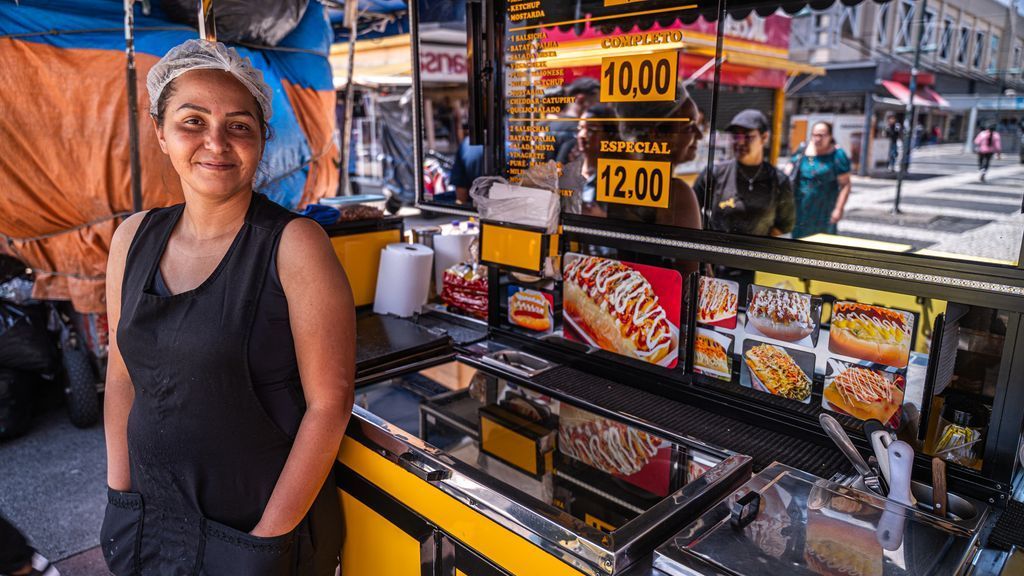
Lula’s path to re-election has been undermined not just by active defections, but by record-high voter abstention not seen since 1998, with 33 million eligible Brazilians skipping the first-round ballot. The seismic shift in the Brazilian working class, embodied by communities like Osasco, is the core driver of this volatility. At a bustling open-air market adjacent to one of Osasco’s new mega-malls, every vendor operates a portable card terminal, selling everything from street food to handmade goods. Tairine, a hot dog vendor who used to skip voting entirely despite Brazil’s mandatory polling rules that impose fines for non-attendance, says she will cast her first-ever ballot for Bolsonaro. She cites cripplingly high taxes on all consumer goods and stubborn inflation that leave low-income families trapped in cycles of deprivation, arguing that “nothing has gotten better for poor people” since Lula returned to office. Flávio Bolsonaro’s platform centres on sharp cuts to federal spending, downsizing government ministries and targeted tax relief, while promising to preserve Lula’s flagship anti-poverty welfare programmes that benefit millions of vulnerable households.
For generations of long-time Lula loyalists, the president remains a legendary working-class champion who led landmark strikes to expand labour rights and lifted tens of millions out of extreme poverty during his prior terms. But today, a growing share of Brazil’s workforce participates in what Almazan describes as widespread “Uber-isation”: gig drivers, food delivery couriers, informal market vendors and independent service workers who crave flexible scheduling and individual autonomy far more than the collective bargaining and state-led welfare systems Lula built his career on. Richard Lapper, a leading political biographer who has published full studies of both Lula and Flávio’s father, former far-right president Jair Bolsonaro, notes that the collapse of manufacturing and rise of individualised informal work are global trends, but their impact has been uniquely sharp in Brazil because the country industrialised late and underwent premature deindustrialisation. He describes Lula as a “victim of his own success”: while the president has overseen a record-low unemployment rate and successfully removed Brazil from the United Nations global hunger map, widespread public frustration stems from a crisis of unmet expectations, as soaring consumer prices, record household debt and elevated interest rates leave many households feeling economically squeezed even as aggregate national metrics improve.
Robson, a 53-year-old municipal civil servant in Osasco who was born in Lula’s home state of Pernambuco and grew up a devoted Lula supporter, is one such disaffected voter. He blames the current administration’s overspending and fiscal mismanagement for Brazil’s ballooning public deficit and record-high tax burdens, saying ordinary families now face impossible daily trade-offs: “You have to choose between making your car payment or putting food on the table.”
In response to the first-round setbacks, Lula’s campaign has launched an aggressive mobilisation drive focused on turning out millions of apathetic non-voters for the runoff, centred on mass street rallies that draw hundreds of thousands of participants, including a São Paulo event the campaign estimates drew a crowd of 1 million. Organisers have intentionally curated viral social media content from these events, including a widely shared clip of a muscular topless Lula supporter waving the president’s flag that racked up tens of millions of views across platforms. The 80-year-old Lula has also leaned heavily into social media to push back against claims he is too old for office, dubbing himself the “king of selfies” and posting fast-paced clips of himself moving energetically between campaign stops. Supporter Leila summed up the campaign’s core messaging: “So many people stayed home because they thought their vote wouldn’t change anything. Our whole fight now is to convince them their voice matters.”
Even as Lula retains strong support among Brazil’s poorest communities, abstention rates ran well above national averages in Rio de Janeiro’s massive Maré favela, a sprawling territory controlled by rival armed gangs. 18-year-old single mother Vitoria, who earns less than £300 per month, still backs Lula, praising his administration’s minimum wage hikes, mandated paid time off for workers and free access to essential prescription medications. But she is deeply fearful of Flávio Bolsonaro’s pledge to designate the local gang Comando Vermelho as a terrorist organisation, a policy the candidate previously lobbied the U.S. government to adopt. She warns the policy would trigger violent, deadly police raids that would “kill, destroy, ruin families, leave blood and bodies on the ground,” referencing a 2023 Rio security operation that killed more than 130 residents. Local resident Andreza Dionísio attributes the high local abstention rate to both last-minute polling station relocations and a pervasive “sense of hopelessness about the future.”
That pervasive sense of disillusionment has created a massive opening for Brazil’s fast-growing evangelical Christian community, which now makes up roughly a quarter of the national population. Mega-churches offer far more than spiritual guidance to working-class neighbourhoods, providing free childcare, employment support, and food distribution, and their influential conservative pastors have become some of the country’s most powerful political kingmakers. Silas Malafaia, a high-profile pastor with millions of social media followers who leads the Rio-based Assembleia de Deus Vitória em Cristo church and officiated at Jair Bolsonaro’s wedding, is currently under investigation for alleged obstruction of the 2023 coup trial targeting the former president, allegations he denies as politically motivated. In an interview with the BBC, he argued that the evangelical movement is the only institution keeping vulnerable communities from collapse. “It gives people purpose, it helps them build better lives,” he said, noting that Flávio Bolsonaro’s platform aligns closely with the church’s conservative priorities, including traditional family values, opposition to progressive gender education policies, and strict anti-abortion rules.
While the church has mobilised a dedicated bloc of voters to support Bolsonaro, most of the shift away from Lula appears to be a rejection of the incumbent rather than an enthusiastic endorsement of his challenger. Back in Osasco, union leader Almazan voices a bittersweet, poignant fear: “There will never be another Lula.” What he intends as a tribute to the president’s historic legacy also doubles as a stark political reality. Lula’s legendary personal story still resonates deeply with older generations of working-class Brazilians, but his hopes for a second full term in office may now hinge entirely on whether he can convince a drastically transformed national electorate that he still has a compelling new story to offer the Brazil of 2024.
How Brazil’s changing working class is reshaping the presidential race