As France braces for a second wave of nationwide demonstrations scheduled for Saturday, the country remains on unprecedented high alert exactly one week after it witnessed some of the most severe civil unrest in recent memory. In response to widespread rioting, looting and property destruction that unfolded across dozens of cities on 17 October, national authorities have rolled out sweeping new restrictions on public assembly, even as organisers representing student unions, labour federations and broader anti-government movements vow to push ahead with planned gatherings.
France’s Interior Ministry has confirmed it will deploy 70,000 law enforcement officers across urban centres nationwide, a sharp escalation of security presence after opposition parties publicly slammed the Macron administration for failing to anticipate the scale of last weekend’s violence. “We will not tolerate a single act of destruction going unaddressed,” Interior Minister Laurent Nuñez stated in a press briefing, adding that authorities had traced multiple calls for targeted violence circulating on social media originating from far-left and radical extremist factions. Over recent days, hundreds of people detained for offences ranging from vandalism and arson to looting have been sentenced via fast-track judicial proceedings, with Justice Minister Gérald Darmanin revealing Friday that 232 individuals have been formally imprisoned, more than 1,100 have appeared in court, and roughly 260 face charges related to organised gang activity. Darmanin has also instructed public prosecutors to pursue maximum punitive measures for convicted offenders, including protest bans, temporary revocation of voting rights, and restrictions on social media access.
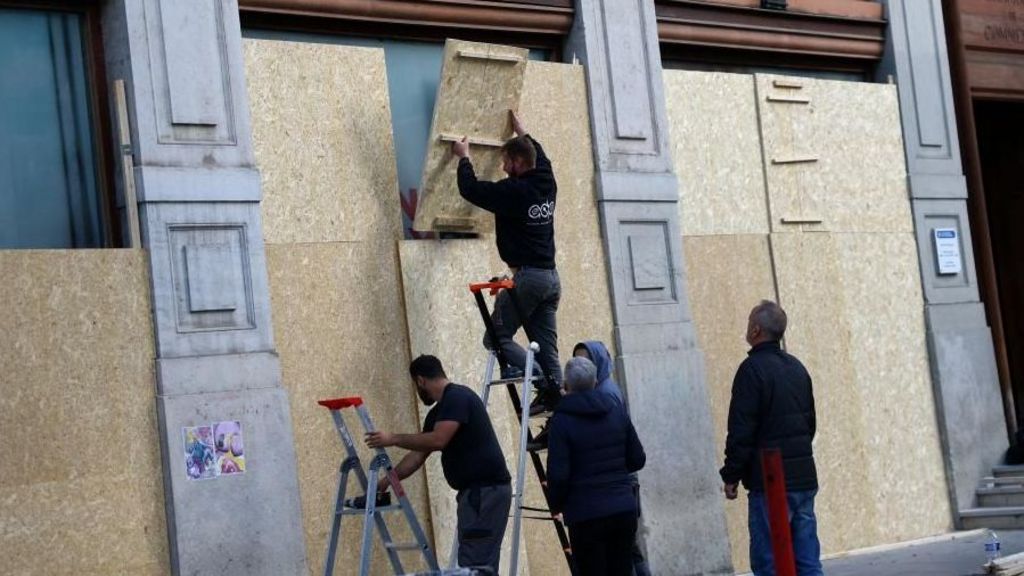
In a series of conflicting local rulings, a patchwork of demonstration regulations has emerged across French cities: the national government initially decreed that only events formally organised by certified trade unions would be permitted on Saturday, while major cities including Lyon, Nice and Montpellier went a step further to impose blanket bans on all public gatherings. Other municipal authorities have reversed initial prohibitions at the last minute: Marseille’s earlier total protest ban was quickly rescinded to allow a union-arranged march to proceed. In Paris, the student union and labour-backed demonstration has been ordered to follow a pre-approved route that avoids the city’s central core, even as iconic cultural institutions including the Louvre, Orsay and Picasso museums announced they will close their doors for the day, and Paris Saint-Germain’s scheduled weekend home football match has been rescheduled to the following Monday. Small businesses and public buildings across the capital and other major urban hubs have boarded up their storefronts in preparation for potential property damage.
The upcoming protests have drawn additional momentum from a resurgence of the gilets jaunes (yellow vest) movement, the populist grassroots campaign that paralysed large swathes of France with disruptive demonstrations during Emmanuel Macron’s first presidential term. A platform affiliated with the group has listed more than 500 separate planned gatherings and 200 smaller direct actions across the country for Saturday, alongside a public demand that Macron resign from office. The movement’s official statement rejected widespread public condemnation of last week’s rioting, claiming law enforcement had initiated unprovoked attacks on peaceful demonstrators.
The surge of public discontent is unfolding against a backdrop of deepening national frustration: French households are grappling with sustained cost-of-living pressures, while successive government warnings of impending drastic public spending cuts to rein in ballooning national debt have further eroded public trust. With Macron set to step down from office next spring, the country is entering what analysts warn could be the most polarised and unpredictable presidential election cycle in a generation. Recent polling indicates that candidates from Macron’s centrist governing bloc may fail to qualify for the two-candidate final run-off, leaving voters facing a choice between Marine Le Pen’s hard-right National Rally party and Jean-Luc Mélenchon’s radical-left La France Insoumise faction. Both opposition leaders have seized on public anger over the government’s handling of the recent unrest to rally their bases: Mélenchon has condemned the administration’s new protest restrictions as an attack on republican institutions and called for his supporters to join Saturday’s marches, while Le Pen’s National Rally is set to host a two-day national party conference in Orléans, roughly 75 miles south of Paris, that local officials have identified as a major potential flashpoint. The Orléans mayor has announced that thousands of additional police officers will be deployed to the city to prevent clashes between far-right conference attendees and planned counter-protests by left-wing groups, with all local public transport suspended for the duration of the event.