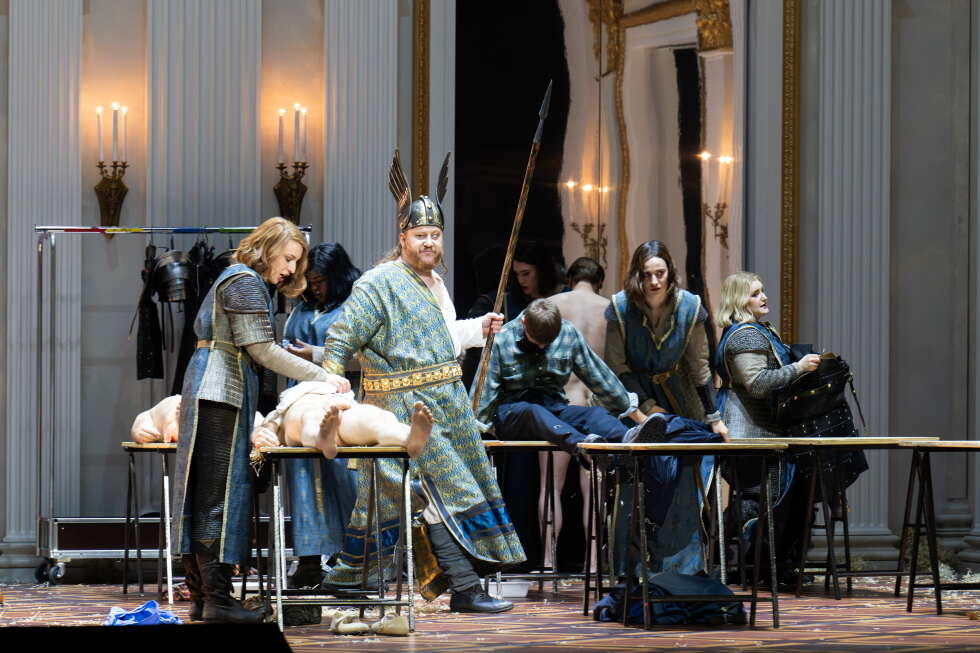
MUNICH, Germany — Three decades ago, a small-town American teenager with a blue-collar background and a childhood knack for imitating country star Conway Twitty had no idea he would one day become one of the most celebrated Wagner singers of his generation. Today, 37-year-old bass-baritone Nicholas Brownlee stands at the pinnacle of the global opera world, his name tied to one of Richard Wagner’s most iconic roles: Wotan, the conflicted king of the gods in Wagner’s monumental Ring Cycle.
Brownlee’s journey to operatic stardom began with youthful overconfidence. Freshly falling in love with opera, he was desperate to test his developing voice against Wagner’s demanding repertoire, even when his college teacher warned him he wasn’t ready. Early on, he brought a lighter excerpt from Wagner’s *Tannhäuser* — Wolfram’s beloved “Song to the Evening Star” — to Thomas Rowell, his voice professor at the University of South Alabama. Rowell laughed off the attempt, noting Brownlee’s powerful natural voice was still a young, unrefined instrument not ready for the heavy demands of Wagnerian repertoire.
Nearly 20 years later, Brownlee smiles at the memory, acknowledging his early overambition. That same relentless drive — what he describes as “a fire in my belly that burns brighter every day” — is what pushed him to the top of his field, where he now headlines major Wagner productions across Europe.
Brownlee recently made his highly anticipated debut as Wotan in *Die Walküre*, the second installment of the full Ring Cycle at the Bavarian State Opera, directed by Tobias Kratzer. He had already earned acclaim for the same role in *Das Rheingold*, the opening work of the cycle, and critics have hailed his performance with the highest praise. German outlet *Merkur* critic Markus Thiel described Brownlee as “a heroic baritone straight out of a textbook, with a powerful, resonant voice, a force of nature.” Writing for *Platea Magazine*, Carlota Moseguí praised both his vocal control and dramatic presence, noting he “possesses all the qualities to become the definitive Wotan of his generation.”
Up next, Brownlee will take the title role in *Der Fliegende Holländer* (The Flying Dutchman) at Bayreuth, Germany’s legendary “Wagner shrine” dedicated exclusively to the composer’s works. His coming season is packed with Wotan performances across the globe: *Siegfried* in Munich, *Die Walküre* in Buenos Aires, *Das Rheingold* in Barcelona, two additional Ring operas in Frankfurt, and two full Ring cycles back in Munich next summer.
For Rowell, who still remains a close friend and even officiated Brownlee’s wedding to mezzo-soprano Jennifer Feinstein, watching his former student rise to such heights feels surreal. “It’s a once-in-a-lifetime thing to have a student who goes that far, especially from a small regional state university like ours,” Rowell said. “I have to pinch myself. I’m enjoying it vicariously.”
Many in the opera world warn that frequent performances of heavy Wagnerian repertoire risk damaging a singer’s voice, but Brownlee says he has no such concerns. “I don’t think you’re supposed to say this, but no, not really,” he admitted. “We like to put this big stamp on Wagner and say ‘Be Careful!’ But he noted that the demands of each role are distinct enough to prevent vocal burnout. He does plan to add more variety to his future schedules, including a return to one of his favorite non-Wagner roles: Baron Scarpia in Puccini’s *Tosca*. Longer-term goals include two iconic Verdi roles: the scheming villain Iago in *Otello*, and the boisterous comic lead Falstaff. “I want to flex a different muscle,” Brownlee explained. “I talk fast, I’m a bubbly, fun guy, but what I do on stage is so serious all the time. Boy it would be fun to just be a jolly fat guy!”
Brownlee’s unlikely path from a working-class small town outside Mobile, Alabama, to international opera stardom began with unexpected roots: his first performance success came as a child doing Conway Twitty impressions for his large extended family, just to win attention. He did not discover classical music until high school, when his choral director sparked his interest. When he enrolled in college, he originally planned to study conducting, until Rowell heard him sing and persuaded him to join the Mobile Opera chorus.
“I went in the first day and I hated it,” Brownlee recalled. “I said, this is in Italian, who cares? That’s for stuffy elite people, not for us blue-collar fellas.” Curiosity got the better of him, however, and he agreed to watch the final emotional scene of Verdi’s *La Traviata* from backstage one night. When the dying heroine Violetta gasped her final line “O, gioia!” and collapsed in her lover’s arms, Brownlee found himself weeping uncontrollably — even though he did not understand a word of the Italian libretto. That moment changed the course of his life.
From that point on, Brownlee dedicated himself to voice training, studying and completing apprenticeships across the United States before moving to Germany to continue his career. He twice competed in the Metropolitan Opera’s prestigious National Council Auditions: in his early 20s, he made it to the New York semifinals but did not advance to the finals, a setback he calls a “great lesson.” Coincidentally, one of the winners that year was Ryan Speedo Green, who will sing Wotan in the Met’s upcoming new Ring Cycle. Brownlee returned to the competition in 2015 and took home one of the top prizes, and major accolades have followed ever since: in 2025, he won best male singer at the International Opera Awards and received the coveted Richard Tucker Award, given to the most promising American opera singer.
Unusually for an American opera star, Brownlee has built almost his entire career in Europe, and remains largely unknown to mainstream audiences in his home country. He and Feinstein currently live in Germany with their two daughters, and are in the process of applying for German dual citizenship. “I can perform anywhere in Europe and be home in two hours to see my girls,” he explained. “In America that’s just not something you can do.”
Though Brownlee has put down roots in Europe for now, major American opera companies are increasingly eager to bring him across the Atlantic. This past spring, he sang the prophet Jochanaan in Richard Strauss’s *Salome* at Chicago’s Lyric Opera, where general director John Mangum called his performance “absolutely thrilling” and said Brownlee is “definitely going be at the top of our list” for future Wagner productions. At the Met, general manager Peter Gelb heard Brownlee sing Wotan during the recent Munich run of *Die Walküre* and said he was “blown away,” confirming that the company will offer Brownlee major roles in upcoming seasons.