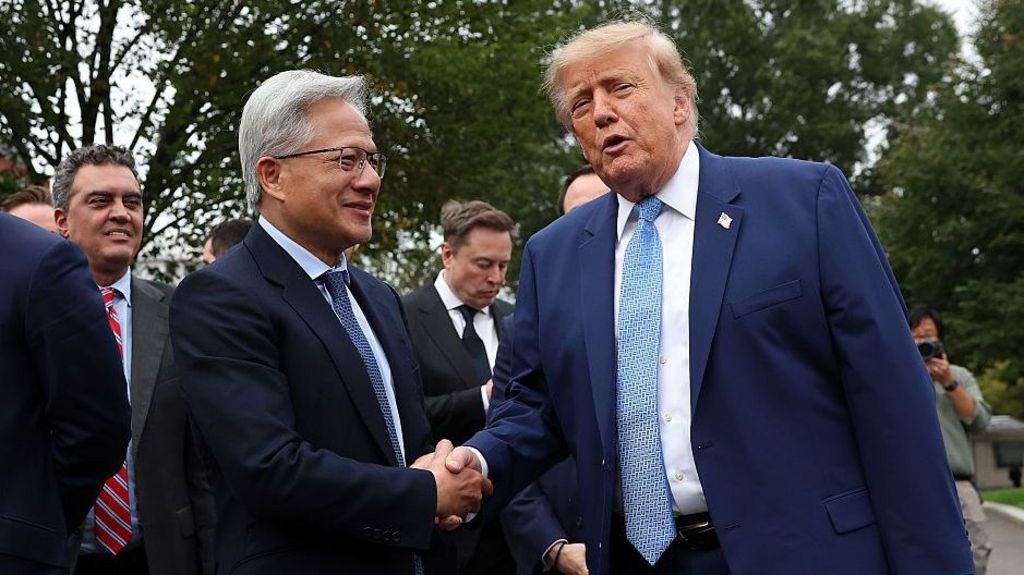
The unfolding controversy surrounding Nvidia CEO Jensen Huang’s intimate access to former (and current, per reported administration context) US President Donald Trump has ignited a sweeping national security debate, with allegations of a targeted foreign intelligence operation threatening to upend established US tech export policy toward China. For years, Huang stood among an extremely small circle of tech industry leaders granted unfiltered, regular access to the Oval Office: he held repeated one-on-one meetings with Trump, joined him on international travel to the United Kingdom, and even accompanied the president aboard Air Force One for a 2017 official trip to China, placing him at the very center of internal administration deliberations over one of Washington’s most sensitive national security dossiers: regulating the flow of America’s cutting-edge semiconductor technology to Beijing. As the architect of the processors that underpin the global artificial intelligence boom, Nvidia occupies a uniquely high-stakes position in US-China tech tensions. Since 2022, federal regulators have imposed strict blanket bans on exporting the company’s most advanced AI accelerators to China, citing official intelligence assessments that the chips would accelerate Beijing’s military modernization and state-led tech dominance efforts. But enforcing these export curbs has long proven porous: high-end chips are routinely purchased by third-party resellers in neutral Southeast Asian hubs including Singapore and Malaysia before being rerouted to Chinese buyers, while domestic Chinese firms also evade restrictions by renting remote access to AI computing power hosted on overseas data centers. For years, Huang has publicly framed the strict export limits as self-defeating for US industry, arguing that locking Nvidia out of the $15 billion-plus Chinese semiconductor market would only fast-track Beijing’s investment in homegrown, fully independent chip alternatives that would eventually displace American products globally. The Trump administration appeared receptive to this lobbying, rolling out a limited carve-out in 2023 that allowed Nvidia to resume sales of slightly less advanced, restricted-performance chips to Chinese customers in exchange for a negotiated revenue sharing arrangement with the US government, even as the top-tier Blackwell processor family remained formally barred from export. That once-cozy dynamic has now collapsed into a cascading political crisis, following explosive unsubstantiated allegations of an extramarital affair between Huang and Alice Huang, a former executive at Singapore-based semiconductor distributor Megaspeed who shares no familial relation to the Nvidia founder. US intelligence community assessments, per leaked official disclosures, suspect Alice Huang of operating as a clandestine asset linked to Chinese intelligence – claims that Beijing has formally and categorically rejected as fabricated. Nvidia’s board of directors has issued a public statement asserting it has found no evidence that proprietary company intellectual property or classified US national security data was improperly accessed or leaked, but the scandal has opened a sprawling, bipartisan congressional inquiry into what senior Trump administration officials knew about the alleged risks, and when they knew it. The scrutiny has landed squarely on Commerce Secretary Howard Lutnick, whose department holds statutory authority over enforcing US advanced technology export restrictions. Internal documents confirm Lutnick received a highly classified intelligence memo laying out full details of the alleged risks posed by Alice Huang and documented red flags that Megaspeed was acting as a key diversion pipeline to smuggle restricted Nvidia chips into mainland China. Despite repeated pressure from other senior cabinet officials – including Treasury Secretary Scott Bessent, who publicly pushed to add Megaspeed to the Commerce Department’s official entity blacklist – Lutnick repeatedly resisted imposing formal penalties on the Singaporean firm. The New York Times has further corroborated that Nvidia’s top legal counsel directly contacted active Commerce Department investigators probing Megaspeed’s alleged chip smuggling operations, invoking the authority of a senior Trump political appointee to pressure the team to pause their probe. The Commerce Department subsequently froze its active enforcement inquiry and transferred the full case file over to the Department of Justice, a move that has drawn widespread criticism from national security experts as an unusual and unexplained break from standard interagency protocol. The episode has laid bare deep, previously unreported rifts at the highest levels of the Trump White House over China tech policy: Huang and his industry allies pushed for maximum market access in China, while national security-focused cabinet officials warned that unregulated chip flows would irreparably erode America’s competitive military and AI advantage. Bipartisan pressure on the administration has intensified dramatically in recent weeks, with lawmakers on both sides of the aisle launching parallel formal oversight investigations. The Democratic side of the Senate Banking Committee is probing gaps in the vetting process for Chinese entities approved to purchase restricted AI chips, while Republican-led House Select Committee on the Chinese Communist Party chairman John Moolenaar released a public statement affirming that while US national interests support the global competitiveness of American AI firms like Nvidia, no company should ever be permitted to undermine core national security by diverting sensitive technology to adversarial nations. Leading Senate Democrat Elizabeth Warren has emphasized that Huang’s recent reported departure from his formal leadership post at Nvidia does not absolve him of accountability, and has publicly demanded that Lutnick provide a full, public explanation for why well-documented export control loopholes were allowed to remain open for years. Huang’s legal team has notified House Republican investigators that the Nvidia founder will voluntarily comply with their request to appear for a closed-door, classified testimony session. While the White House has not responded to formal requests for comment from the BBC, a senior administration official told the New York Post that President Trump retains “complete, unwavering confidence” in Lutnick, hailing him as the most transformative commerce secretary in modern US history – a deliberate, high-profile show of support that comes amid widespread unconfirmed reports that West Wing aides are actively debating whether to force Lutnick to resign over his handling of the Megaspeed case. The controversy has now expanded far beyond the conduct of a single tech executive or a mid-tier federal agency, with confirmed reports that President Trump himself was fully briefed on the classified intelligence warnings about Huang’s potential vulnerability to foreign influence operations. Lawmakers and national security analysts are now demanding answers to a series of unprecedented questions: how much direct policy influence did Huang wield over US export control rules, what specific details did the president know about the alleged intelligence risks, and who bears ultimate responsibility for failing to protect America’s most sensitive and strategically critical semiconductor technology from diversion to China?