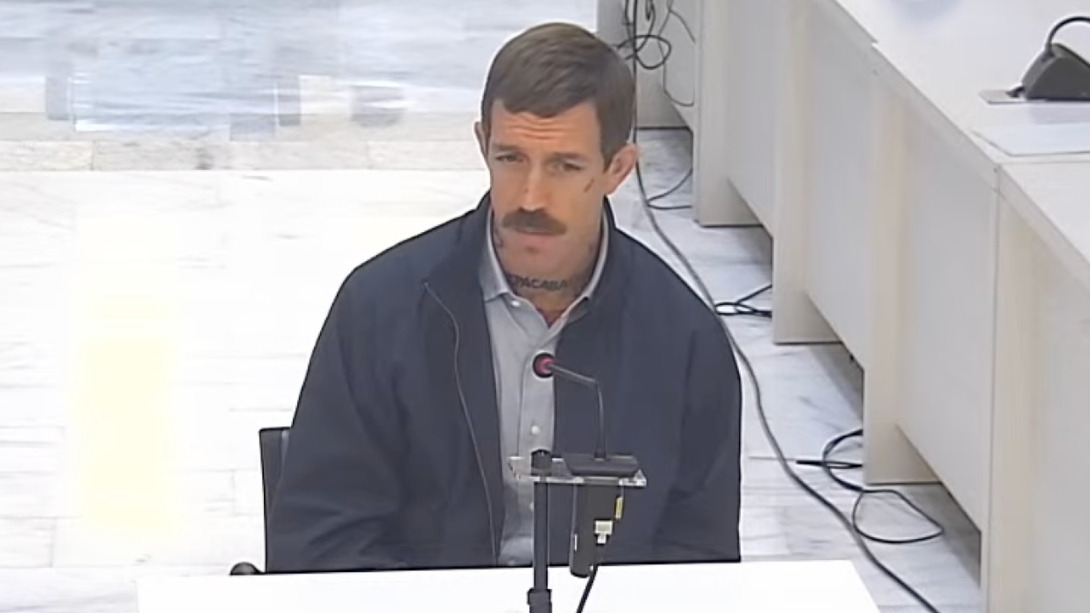
American philanthropist and long-time social justice advocate Fergie Chambers made his first public appearance before Madrid’s Audiencia Nacional on Friday to contest a United States extradition order that has kept him in Spanish custody since his July arrest on the island of Ibiza. Chambers, heir to the multi-generational Cox Enterprises media and services conglomerate fortune, arrived at the hearing dressed in a navy blazer and open-collared grey shirt, a distinct neck tattoo visible above his collar, as he pushed back against US prosecutors’ allegations that he transferred $7.5 million out of the US in 2023 to provide material support to Hamas. The US indictment levels three formal charges against him: international money laundering, riot, and conspiracy to riot, carrying a maximum combined 20-year prison sentence if he is extradited and convicted.
During the hours-long hearing, Chambers emphatically rejected every accusation of wrongdoing, framing his recent financial activity as fully lawful, focused exclusively on non-violent humanitarian aid and legitimate commercial investments across the Middle East and North Africa. He told the panel of judges that his decision to scale up funding for Gaza-focused initiatives in late 2023 and 2024 stemmed from his conviction that the humanitarian crisis unfolding in the Palestinian enclave amid ongoing Israeli military operations represents “the prevailing moral question of our time.” He detailed specific, verifiable aid projects his funds supported: a $100,000 grant to the Zaynab Project to deliver long-term mental health counselling and psychosocial care to orphaned Gazan children, and a $250,000 donation to the Sameer Project that funded a northern Gaza bakery, a local desalination plant, and a free community medical clinic. Chambers noted that operations at the Sameer Project were temporarily suspended following his arrest, leaving tens of thousands of vulnerable Palestinian civilians without access to critical food, clean water, and healthcare services.
Chambers also walked the court through his unrelated, fully documented sponsorship deal with reigning Tunisian top-flight football champions Club Africain, a team he said he connected with shortly after relocating to Tunis in 2023. The four-year, €4 million agreement, structured through a sports firm he launched locally, was designed to clear the club’s years of accumulated debt, pay back unpaid salaries for its women’s team, and fund upgrades to its youth development academy — investments that coincided with the club ending an 11-year title drought in May 2024. He added that Club Africain’s fan base has long been outspoken in its support for Palestinian human rights, making the partnership a natural cultural fit for his values.
The hearing also touched on Chambers’ decades of non-violent social activism in the US, from his early involvement in racial justice and indigenous rights movements to his work running bail funds for demonstrators during the 2016 Standing Rock pipeline protests and 2020 George Floyd uprisings. He confirmed he attended two peaceful, non-violent demonstrations outside a Cambridge, Massachusetts facility owned by Israeli arms manufacturer Elbit Systems in the aftermath of the 2023 Al-Ahli hospital bombing in Gaza, at one point locking himself to the building entrance with a bicycle lock and at another blocking access to the site road, but stressed he never engaged in or funded violent activity of any kind. He rejected the US government’s claim that he fled the country to evade pending legal trouble, noting his Tunisian residence was located directly adjacent to the US ambassador’s official property, with their exterior walls touching.
Chambers’ legal team laid out multiple formal objections to the extradition request during proceedings, arguing that US authorities submitted a materially altered Spanish translation of the original indictment that deliberately exaggerated the severity of the charges, a deliberate manipulation that amounted to serious procedural irregularities. The defence also revealed that an FBI agent coordinated with a Spanish judge to seize and transfer Chambers’ personal mobile device to US officials without notifying his legal team or granting them an opportunity to contest the move, a violation of both Spanish domestic law and the bilateral extradition treaty between the two nations. Lead defence counsel Aitor Martinez emphasized that US prosecutors have never formally charged Chambers with terrorism financing or material support for a terrorist organization, and have failed to submit a single piece of evidence proving any portion of his $7.5 million in transfers was used for violent activity.
In emotional closing remarks, Chambers shared the severe personal toll his seven months of pre-extradition detention has inflicted on his family, revealing he was unable to attend his grandmother’s recent funeral, that his five-year-old son asks daily when he will return home, and that he does not know if he will be present for the birth of his second child, due in March 2025. “I have never had any contact with any terrorist organisation. I’ve certainly never financed any terrorist organisation. And I’ve never had any intent to,” he told the court. “All I’m asking for is justice, reason and mercy.” The Audiencia Nacional is scheduled to issue its formal ruling on the US extradition request next week, and the Spanish national government retains final administrative authority over the outcome of the case. Outside the courthouse, dozens of pro-Chambers demonstrators gathered earlier this fall to demand his immediate release, denouncing what they describe as a politically motivated prosecution targeting a vocal Gaza solidarity advocate.