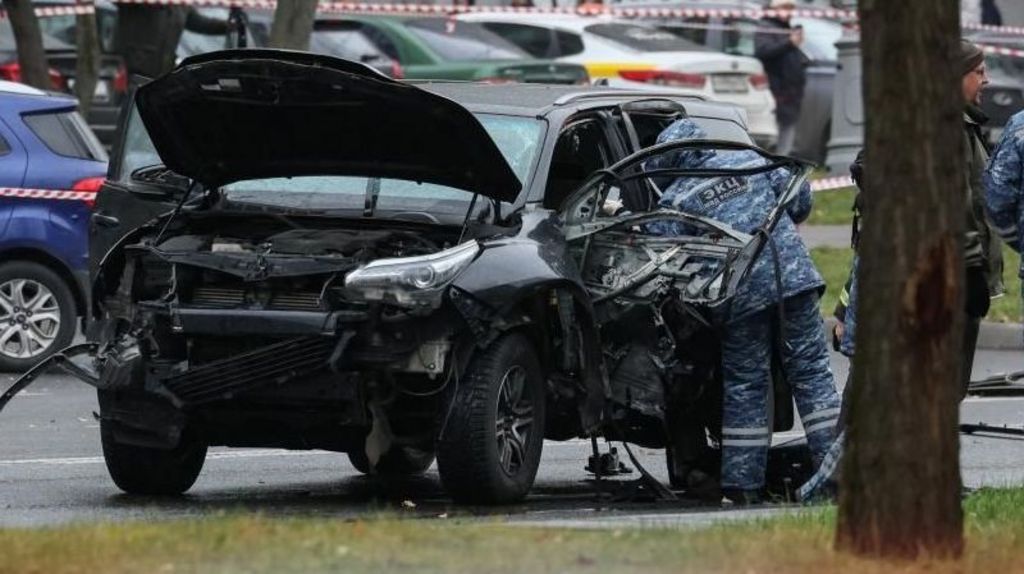
A series of targeted car bomb attacks have unfolded across major Russian cities in consecutive days, unfolding against a backdrop of intensifying cross-border hostilities between Russia and Ukraine and high-stakes, ongoing international peace negotiations to end the 3-year long full-scale conflict. Russia’s official Investigative Committee confirmed via a public Telegram statement that 63-year-old Sergei Zavorotni, a former senior aide to ex-Ukrainian prime minister Mykola Azarov, sustained serious injuries when an explosive device planted in his personal vehicle detonated while he was driving in central Moscow on Friday morning. Azarov, a staunchly pro-Kremlin former Ukrainian head of government, fled to Russia following the 2014 Euromaidan revolution, and Zavorotni remained in close proximity to pro-Russia Ukrainian political circles in exile following his departure from Azarov’s staff. Unconfirmed but widely circulating local Russian media reports indicate Zavorotni suffered catastrophic injuries including the amputation of his left arm, traumatic brain damage, multiple broken ribs, and a fractured right leg, after which he was rushed to a top-tier Moscow city hospital for emergency trauma care. Investigators have launched a full criminal probe, deploying forensics teams to the blast site, and have announced plans to run specialized forensic tests including explosives residue analysis and full medical assessments of the victim to trace the perpetrators. The Moscow blast came exactly 24 hours after a nearly identical car bombing in the Pushkinsky District of Saint Petersburg killed a serving Russian military colonel, marking the latest two incidents in a months-long string of targeted assassinations and attacks on figures affiliated with the Kremlin that Russian security agencies have publicly attributed to Ukrainian intelligence operatives. Simultaneously, the 48-hour period leading up to the Moscow explosion saw a dramatic escalation of mutual cross-border strikes between Russian and Ukrainian forces that left nearly a dozen civilians and non-combatants dead on both sides of the front line. Ukrainian emergency services reported that Russian aerial bombardments targeted a civilian medical facility, alongside residential areas across the southern Odesa and Zaporizhzhia regions, killing three people including a 17-year-old teenage boy. Russian authorities, in turn, documented fatal casualties from Ukrainian drone and missile incursions: four people were killed in a strike on an industrial complex in the central Samara region, four more lost their lives after a drone attack hit an industrial zone in the southern Volgograd region, and one additional civilian was killed in shelling in the border Bryansk region, a frequent target of cross-fire since the 2022 full-scale invasion. Ukrainian officials have repeatedly framed their cross-border operations as proportional retaliation for Russia’s sustained, months-long campaign of mass strikes on Ukrainian civilian infrastructure and populated urban centers. This wave of violence has unfolded even as high-level diplomatic efforts to negotiate a sustainable end to the war move forward at a semi-secret informal peace summit hosted at a military airbase outside Dublin, Ireland. The latest round of shuttle diplomacy saw top US envoys Steve Witkoff and Jared Kushner, who recently held extended face-to-face talks with Russian President Vladimir Putin in Moscow, announce that the Russian leadership has indicated a willingness to accept formal European participation in the peace negotiation framework. Irish Prime Minister Taoiseach Micheál Martin expanded on that commitment ahead of an informal EU Council gathering, noting that European representation in the peace process would not be limited exclusively to EU member states, clearing a path for the United Kingdom to take an official advisory and mediation role. Ukrainian President Volodymyr Zelensky publicly welcomed the commitment to formal European involvement, noting that a sustainable long-term peace deal could not be secured without buy-in from all major European security stakeholders. A planned appearance by UK National Security Adviser Jonathan Powell to join the Dublin talks alongside Zelensky, Witkoff and Kushner was abruptly delayed at the last minute, Downing Street confirmed, forcing the UK official to skip the scheduled session. All previous formal ceasefire and peace negotiation rounds launched since Russia’s February 2022 full-scale invasion, which currently leaves approximately 20% of Ukrainian national territory under occupying Russian military control, have collapsed without producing a durable, mutually agreed settlement.