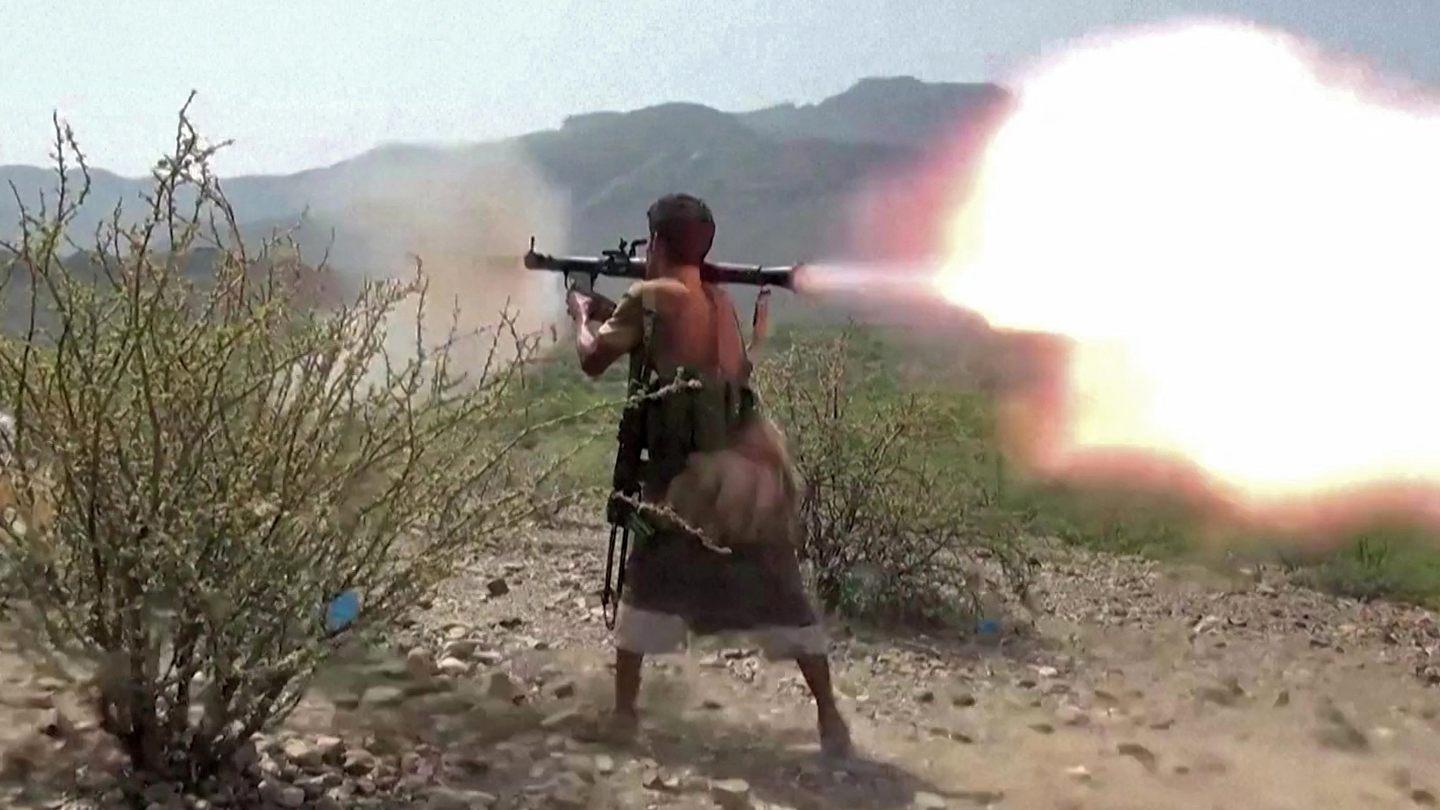
Eight years after a devastating regional war began in Yemen, a sweeping new military campaign has shattered the fragile truce that has held large-scale fighting at bay since 2022, raising fears of a wider regional conflagration. Forces aligned with Yemen’s internationally recognized government have launched a coordinated counteroffensive against the Houthi movement, with top military officials publicly vowing to retake the capital city of Sanaa, which Houthi fighters seized from government control in 2014.
Backed by air support from the Saudi-led coalition that has supported the Yemeni government since 2015, pro-government forces have opened intensive ground battles across three key governorates: Taiz, al-Bayda, and al-Jawf. Al-Jawf holds particular strategic importance, as it serves as a critical geographic gateway for any advance on Sanaa. Government military operations include ground pushes toward the al-Labanat mountain range in al-Jawf, heavy rocket bombardments of Houthi positions in Yatma, and incremental advances into the Dhi Na’im district of al-Bayda. According to government spokesman Majid al-Nuzaili, the overarching goal of the campaign is to fully liberate Yemen from Houthi control and restore Sanaa as an inclusive national capital for all Yemenis. Deputy Defence Minister Major General Samir al-Sabri confirmed the government’s formal decision to retake Sanaa in an interview with Yemeni state television.
Houthi officials have rejected the government advance, claiming their forces have successfully repelled the attack on al-Labanat and inflicted heavy casualties on pro-government fighters, with dozens killed or wounded. Houthi sources added that the group used ballistic missiles to target incoming government reinforcements in al-Jawf. The Houthi-affiliated Saba News Agency also reported that a recent Saudi airstrike on a prison in Al-Hazm, northern Yemen, killed seven people, including one child who was visiting an incarcerated relative at the facility. Local Yemeni media has additionally reported intensive air raids targeting Houthi positions west of Taiz, confirming the sharp escalation of violence across multiple frontlines.
The renewed fighting has already spilled across Yemen’s northern border into Saudi Arabia, triggering retaliatory threats from Riyadh. Houthi attacks on southern Saudi provinces have wounded at least 73 civilians, among them women and children. The Saudi Energy Ministry confirmed that the strikes also hit multiple energy infrastructure facilities in the kingdom’s southern region early Tuesday, wounding several citizens and residents, sparking multiple wildfires, and forcing temporary suspension of some energy operations. Saudi Foreign Minister Prince Faisal bin Farhan bin Abdullah Al Saud condemned the cross-border attacks as a reckless and dangerous escalation, accusing the Houthis of attempting to export their internal conflict to the kingdom and its Yemeni government partners. He called the Houthi actions selfish, but added that diplomatic pathways to resolve the conflict remain open: “The road to diplomacy is not closed. Saudi Arabia will always support diplomatic solutions, but the kingdom will never hesitate to defend itself and its interests.”
Houthi military spokesman Yahya Saree hit back, claiming that Saudi Arabia has launched 121 separate airstrikes across five Yemeni governorates: Marib, al-Bayda, Hodeidah, Taiz, and al-Jawf. He warned that the Houthi movement would respond to the coalition airstrikes with even more powerful and expansive strikes in the future. The group has already announced plans to blockade Saudi commercial and military shipping in the Red Sea and the strategic Bab al-Mandeb strait, a move that comes as Iran has also restricted shipping traffic through the Strait of Hormuz, amplifying regional tensions against the backdrop of ongoing conflict between Iran, Israel, and the United States.
This current escalation marks the most severe breakdown of violence since the United Nations-brokered truce paused large-scale hostilities across Yemen in 2022. The original conflict began in 2014, when Houthi fighters seized Sanaa and pushed out the internationally recognized government, prompting a Saudi-led military intervention to restore the government in 2015. The human cost of the latest flare-up has already been steep: the World Health Organization reports that at least 728 people have been killed or wounded across Yemen since August 23, with the majority of casualties concentrated in Taiz and along Yemen’s western coastline. Multiple humanitarian and local sources also confirm that more than 21,000 people have been displaced from their homes in Taiz alone since last Thursday.
Regional analysts warn that the current fighting is not an isolated Yemeni conflict, but rather a symptom of broader power struggles reshaping the Middle East. “This is not a war that is purely Yemeni. This is part of a struggle for dominance in the region,” explained Nabeel Khoury, a former U.S. diplomat and former chief of mission in Yemen. Al Jazeera has also warned that the ongoing escalation across multiple Yemeni provinces could lead to a full-scale expansion of the country’s decade-long war, threatening to draw in more regional powers and deepen one of the world’s worst humanitarian crises.