One year after Rapid Support Forces (RSF) paramilitary fighters captured the key Darfur city of el-Fasher following a months-long brutal siege, a new BBC investigation has uncovered overwhelming evidence of a coordinated campaign to eliminate the city’s entire healthcare network — a violation of international humanitarian law that the United Nations’ top human rights official says may constitute war crimes.
Sudan’s devastating civil war erupted in April 2023 when tensions between the national Sudanese Armed Forces (SAF) and the RSF boiled over into open conflict. While both sides have faced accusations of targeting medical infrastructure, the destruction in el-Fasher stands out as one of the clearest and most severe examples of healthcare collapse amid the ongoing crisis, according to the World Health Organization (WHO).
Drawing on firsthand testimony from on-the-ground medical workers who survived the siege, the investigation documents at least 43 separate attacks on hospitals and medical sites across el-Fasher between May 2024 and October 2025, with some facilities hit multiple times. Between the start of the war and the RSF’s final takeover of the city, the investigation recorded 55 medical workers killed, 120 injured, and 10 more forcibly abducted or disappeared.
Dr. Muhamed Suliman, a surgeon who remained in el-Fasher through the siege, told the BBC the campaign against healthcare was deliberate and strategic. “The RSF [were] trying to evacuate the hospitals, to put them out of service because the health system is the cornerstone of any city or any state,” he explained. “The RSF started hitting these areas so citizens have no longer any way to stay there. It was intense. It was deliberate. It was planned.”
The collapse of el-Fasher’s healthcare system unfolded gradually as the conflict dragged on. Within weeks of the war’s start in 2023, one of the city’s largest core facilities, the Teaching Hospital located near central SAF positions, was forced to shut down, relocating all operations to the city’s South Hospital. For months, South Hospital continued operating, but service was increasingly disrupted by widespread power outages and rapidly dwindling medical supplies. The situation deteriorated dramatically when the RSF launched its full siege of el-Fasher in May 2024, and South Hospital came under repeated shelling as RSF fighters advanced from the city’s eastern outskirts.
On June 8, 2024, RSF fighters raided South Hospital in an attack that still haunts survivors. Dr. Izzeldin Ahmed Dawaud Asow, the hospital’s director general, was confronted by paramilitaries outside his office who targeted him with ethnic slurs, using a derogatory term that labels non-Arab Sudanese as foreigners. He was beaten unconscious with rifle butts and only survived by playing dead. “They put their hand on my chest, and I stopped breathing. And they said: ‘Leave him, leave him. The rubbish has died. Leave him.’ They left me,” he recalled. After the attack, the hospital shut down and later fell under RSF control when SAF forces retreated.
Dr. Alaa Eldin Nugud, a Sudanese surgeon who now serves as health minister in the RSF-backed civilian administration, has defended the group’s actions, claiming South Hospital was being used as a military base with missile launchers positioned on its grounds. He shared a video of weapon remains filmed more than a year after the hospital closed to support his claim, and also released purported maps of landmines planted by SAF around the adjacent Teaching Hospital. However, the BBC found no independent evidence to verify these allegations, and local Darfur government officials have categorically rejected the claims. El-Fasher doctors also confirmed the hospital was never integrated into the nearby military base and that staff continued to access the facility to retrieve supplies throughout the conflict.
After South Hospital closed, remaining staff and equipment moved to the Saudi Maternity Hospital in western el-Fasher, near the main SAF stronghold. It did not take long for attacks on the new last remaining major medical facility to ramp up. Six doctors who spoke to the BBC independently described a clear pattern of systematic targeting, with the Saudi Hospital hit repeatedly — sometimes as many as 25 times in a single day — by a mix of artillery shelling and precision-guided drone strikes. Smaller clinics and specialized facilities fared no better: when medical sites relocated to escape attack, their new locations were also targeted. The Specialised Children’s Hospital, which closed early in the war, was forced to shut down twice more after moving to two alternate sites, both of which were shelled. The city’s main dialysis center was also struck, then attacked again after relocating.
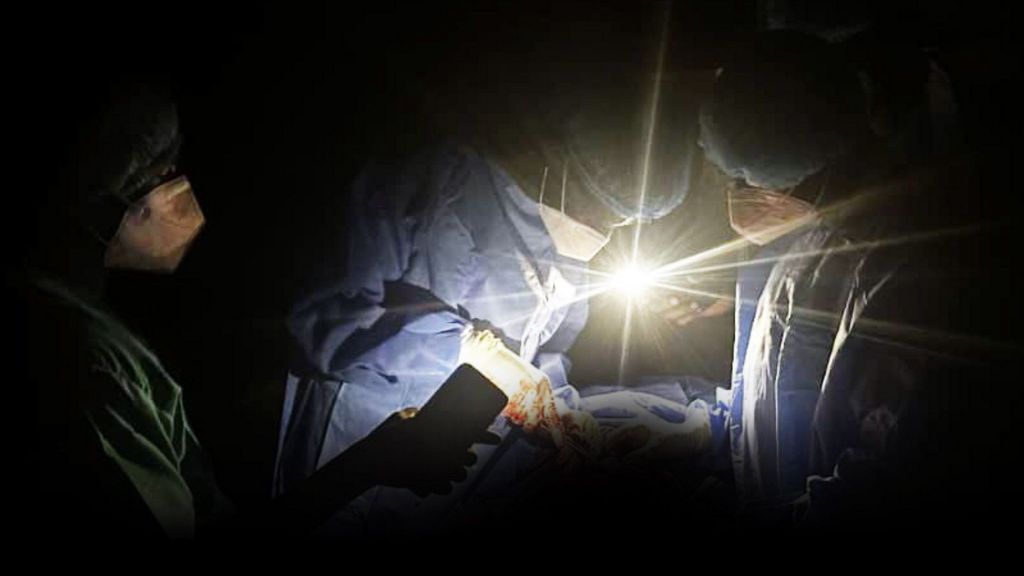
As attacks intensified, medical workers improvised desperate measures to keep care running. They built sandbag barricades around the Saudi Hospital, converted steel containers into underground operating bunkers, and set up a network of secret alternative patient wards and surgical sites to reduce the risk of mass casualties from strikes. Even in these conditions, life-saving care continued: on the day the Saudi Hospital was hit by bombing, medical staff conducted an emergency C-section using only light from their mobile phones.
Dr. Asow, who continued operating through the siege, shared harrowing accounts of close calls and deliberate targeting. On one occasion, he ordered an operating theater deep cleaned before a procedure, forcing the patient to be moved to an alternate site just hours before the room was destroyed by a shell — a twist that led his staff to nickname him “Mr. Deep Cleaning.” On another occasion, he was mid-surgery on a patient’s neck when an explosion shook the building; all other staff fled, but he stayed to complete the procedure. He also described drones systematically tracking patient movements: in March 2025, a drone followed a group of people carrying injured patients to a temporary ward and struck at the hospital gate, killing nine. Five months later, a drone hit a donkey cart transferring patients — all ambulances had already been destroyed — killing two patients, the driver, and the donkey.
By the time RSF fighters seized full control of el-Fasher in October 2025, the Saudi Hospital was the only functioning medical facility left in the entire city. The RSF stormed the facility on October 25, with allegations emerging of a massacre that killed more than 460 patients and accompanying civilians. The RSF has denied the massacre took place, but the WHO has condemned the reported killings, and satellite imagery published after the attack showed clusters of bodies on the hospital grounds.
In response to the BBC’s findings, UN High Commissioner for Human Rights Volker Türk called the evidence “deeply disturbing,” confirming the findings align with his office’s own monitoring. “Our monitoring and documentation shows the RSF repeatedly struck el-Fasher’s main hospitals and makeshift health facilities, destroying or seriously damaging them and severely impacting access to health services for thousands of civilians trapped in the city,” Türk said. He added that the repeated attacks on civilian healthcare infrastructure amount to serious violations of international humanitarian law and may constitute war crimes.
The RSF has uniformly rejected the BBC’s findings, framing the allegations as political propaganda designed to damage the group’s reputation by SAF and its local allies. Dr. Nugud dismissed the testimonies of el-Fasher doctors as lies, claiming their accounts are skewed by tribal and political loyalties to the SAF. He also claimed the RSF has reopened major facilities including the Saudi Hospital and Teaching Hospital, and that South Hospital will soon reopen, asserting that medical workers who stayed did so voluntarily. But multiple doctors who appeared in RSF government videos claiming they were working voluntarily told the BBC they were forced to participate, with one noting “If I spoke out of line, they’d put a bullet through my head.”
A full year after el-Fasher fell, the trauma of the siege remains raw for survivors. Sudan’s civil war shows no sign of ending, with front lines shifted to other regions but attacks on healthcare continuing across the country as part of a worsening nationwide humanitarian catastrophe. UN investigators have previously noted that the violence in el-Fasher carried all the “hallmarks of genocide”, with RSF forces — built from former Arab militias with a history of ethnic violence in Darfur — systematically targeting non-Arab civilian populations that make up most of the city’s population.