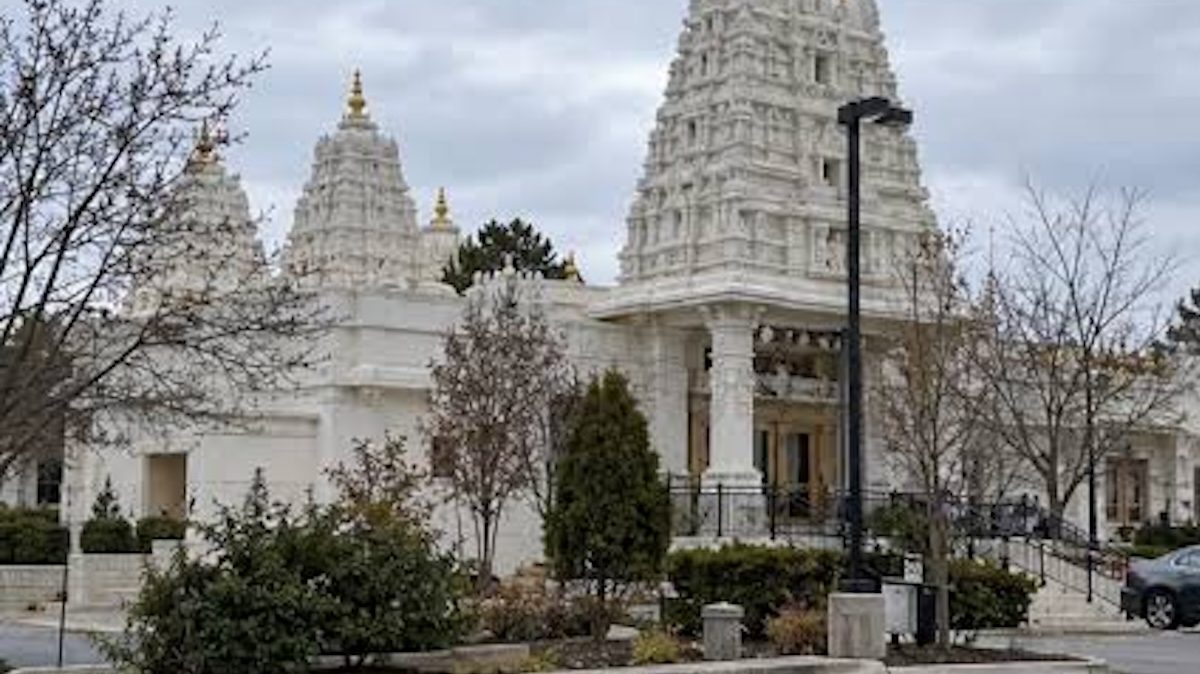
On the first day of Navaratri, the nine-night Hindu festival honoring the divine feminine, hundreds of worshippers had gathered at the Sri Venkateswara Swami Temple in Aurora, Illinois, in October 2026 when a potentially catastrophic attack was derailed only by chance and an alert tip. According to prosecutors, 19-year-old suspect arrived at the temple armed with a rifle and full body armor, ready to carry out a mass shooting. What stopped the massacre was a mechanical malfunction that jammed his weapon, paired with a warning from the suspect’s co-worker who had learned of his violent plans. A search of the suspect’s belongings uncovered a manifesto filled with virulent white supremacist ideology, prompting bipartisan demands for federal authorities to probe the plot as a hate crime.
In a joint letter addressed to the FBI and U.S. Department of Justice, Democratic Congressman Ro Khanna and Republican Congressman Rich McCormick emphasized that this planned attack did not arise out of a vacuum. They warned that the attempted attack is tied to a measurable, nationwide surge in hostility targeting both Hindu Americans and the broader Indian American community. Data from a 2026 Carnegie Endowment survey backs this claim: one in four Indian American adults reported being targeted with racial, ethnic, or religious slurs in the 18 months since January 2025.
Scholars of religious studies argue that this growing animosity stems from two deeply intertwined sources: anti-Indian racial prejudice and anti-Hindu religious bigotry rooted in decades of American cultural bias and modern Christian nationalist ideology. This overlap has been visible in high-profile public incidents in recent months. In September 2026, a Texas Republican candidate for state office, Bo French, posted a viral photograph from a University of Texas at Austin football game, centered on a group of Indian American students, and claimed that “the problem is now obviously far worse than anyone imagined.” Though French did not explicitly reference religion in his post, the resulting wave of social media responses quickly turned to calls for violence against Indian people and threats to desecrate Hindu temples.
This pattern of religious bigotry targeting Hindu worship, framed through the lens of Christian nationalism, has been building for years. In September 2025, a Republican U.S. Senate candidate in Texas, Alexander Duncan, publicly condemned the installation of a large statue of the Hindu deity Hanuman in Sugar Land, Texas, asking, “Why are we allowing a false statue of a false Hindu god to be here in Texas? We are a Christian nation!” The post was viewed more than six million times. Just a year later, prominent pastor Dale Partridge shared an image of the iconic Swaminarayan Akshardham Temple in New Jersey, writing that America’s 18th-century Christian founding fathers would have “this demon temple leveled in 24 hours.”
A September 2026 report from the Center for the Study of Organized Hate confirms that this type of rhetoric is widespread across major online platforms. The report documents that Hindus have been specifically targeted for religiously motivated attacks, with routine social media posts labeling Hindu devotees as “demon worshippers,” mocking Hindu deities, and openly calling for temples to be destroyed and replaced with what posters frame as “American” religious monuments. These posts consistently frame Hindu worship as inherently incompatible with American Christian identity, a core tenet of Christian nationalism—the belief that the United States was founded to be an explicitly Christian nation. Sociological research from Andrew Whitehead and Samuel Perry shows that as of 2017, nearly one-third of all U.S. adults support the federal government formally declaring the country a Christian nation.
Religious scholars trace this anti-Hindu prejudice back nearly 200 years in American culture. As religious studies scholar Michael Altman explains, the claim that Hindus worship false gods and idols became entrenched in mainstream American national culture in the 19th century, when Protestant-influenced school textbooks categorized global religions into “true” and “false” faiths, framing Hindu idolatry as evidence of inherent moral decay. In the early 20th century, even as some white Americans embraced detached ideas from Hindu thought such as yoga, they framed these practices as universal spirituality rather than Hinduism, while immigration laws barred most Asian immigration and kept actual Hindu people out of the country. After the 1965 Immigration and Nationality Act opened borders to Asian immigrants, the Hindu American population grew to more than one million by 2000, according to estimates from religion scholar Diana Eck. As Hindu communities began building public temples across the country starting in the 1970s, they faced immediate, sustained hostility: in 1983, attackers desecrated a temple outside Pittsburgh, smashing sacred murtis (consecrated sacred images that Hindus believe hold the presence of the divine) and scrawled “Leave” on the altar; in the early 1990s, vandals painted “Get out Hindoos” on a future temple site in New Jersey.
This animosity continued into the 21st century, reinforced by popular cultural depictions that frame Hinduism as sinister. Religious studies scholar Sailaja Krishnamurti points to the 1984 film *Indiana Jones and the Temple of Doom*, which depicted Hindus carrying out ritual human sacrifice, and influential televangelists such as Pat Robertson, who publicly labeled Hinduism “demonic.” These distorted depictions have translated into real-world violence: in 2019, a vandal defaced Hindu deity images with anti-Hindu, pro-Christian graffiti.
What makes modern anti-Hindu hate particularly insidious, scholars argue, is the way it blends racial and religious prejudice into a single, overlooked form of discrimination—a dynamic education scholar Khyati Joshi terms the “racialization of religion.” In a society where white identity and Christian faith have long been treated as the unspoken American norm, brown skin is automatically associated with a foreign, “other” faith, leading authorities and the public to often miss the explicitly religious dimension of this discrimination. The Aurora plot illustrates this dynamic perfectly: while the suspect’s manifesto framed his hatred in racial terms, labeling Indians, Black people, Jewish people and other marginalized groups as “sub-human,” law enforcement confirmed he specifically sought out a large Hindu temple as his target. Joshi points to the 1980s New Jersey gang the Dotbusters as a historical example: while media framed their brutal attacks on Indian Americans as purely racial violence, the gang’s name explicitly referenced the bindi worn by Hindu women, exposing the religious core of their bigotry.
U.S. Representative Raja Krishnamoorthi, who was at the Aurora temple with his family on the day of the attempted attack, told an emotional press conference that the suspect was radicalized entirely online, saying “he was radicalized by social media until he told a coworker he could not wait ‘to kill Indians.’” Data from Stop AAPI Hate, a national coalition tracking anti-Asian discrimination, shows this pattern is widespread: 71% of all online violent threats targeting Asian American communities are directed at South Asians, with the most common narrative framing South Asians as an “invading” group that threatens American culture.
Academic research has repeatedly documented that online hate speech directly leads to offline violence, and policy experts say addressing this growing crisis requires coordinated action from major social media platforms to enforce accountability for hate speech. After the foiled Aurora attack, Hindu American communities are increasingly calling for public recognition of the dual racial and religious nature of the hate they face, demanding action to push back against rising bigotry before another attack succeeds.
This analysis is written by Arun Brahmbhatt, assistant professor of religion at Syracuse University.