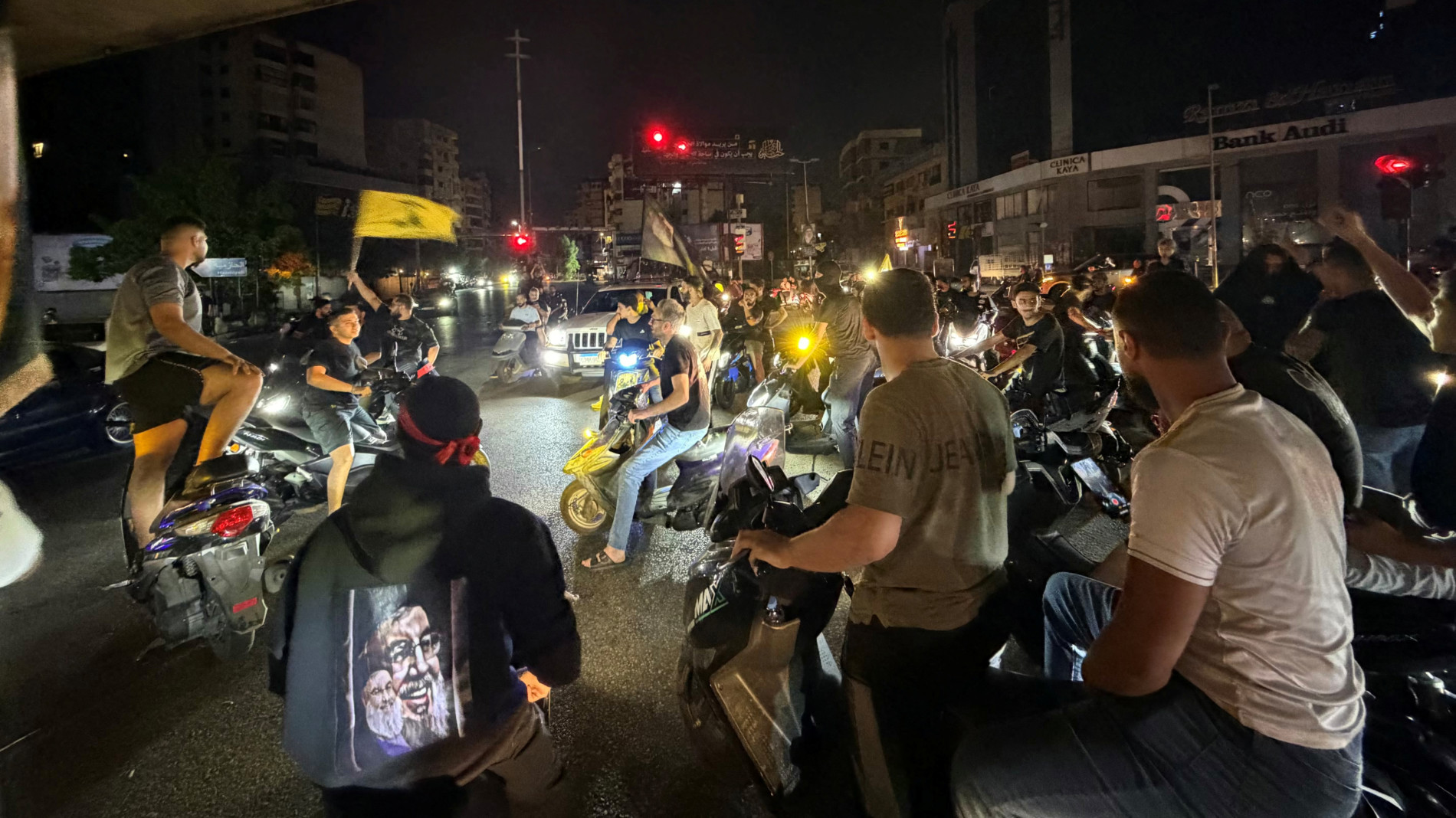
Fresh turmoil has erupted in Lebanon’s capital Beirut after hundreds of Hezbollah supporters launched mass street demonstrations opposing a landmark framework agreement brokered by the United States between Beirut and Jerusalem to end months of cross-border fighting. The protests, which stretched from late Friday into Saturday, saw demonstrators cruise through central Beirut, near the national parliament building, and along the key airport highway on motorbikes and mopeds, just hours after the deal was formally announced in Washington.
Local media and social media footage captured crowds of protesters gathering in Dahieh, Hezbollah’s stronghold in southern Beirut — a neighborhood that was heavily damaged by Israeli airstrikes during the recent escalation of hostilities. Lebanon’s state-run National News Agency (NNA) confirmed that some demonstrators blocked a major arterial road near the prime minister’s office, while other groups used burning tires to shut down the airport road. Lebanese military forces intervened to disperse the blockading protesters, reopened the route, and deployed temporary security checkpoints across multiple districts of Beirut to contain unrest.
The framework deal, hammered out over five rounds of direct negotiations between Israeli and Lebanese delegations in the U.S. capital, outlines a pilot plan that would see Lebanese armed forces take control of two small parcels of territory currently held by Israeli troops, alongside a formal process aimed at disarming Hezbollah, the Iran-aligned militant group that has long operated as a de facto military force independent of the Lebanese state. Critically, the agreement leaves the timeline and conditions for a full Israeli withdrawal from all occupied areas of southern Lebanon undefined, tying any pullout to improved security conditions and the elimination of what Israel defines as threats to its territory — effectively making full withdrawal dependent on the completion of Hezbollah’s disarmament.
Hezbollah has repeatedly rejected any demand to surrender its weapons as long as Israeli occupation of Lebanese territory remains in place and the country faces security threats from Israel. Hassan Fadlallah, a senior Hezbollah member of Lebanon’s parliament, issued a stark warning Friday, arguing that Lebanese national authorities would only be able to enforce the Washington-brokered deal if they launched a civil war against the group with backing from the U.S. He added that the agreement was an intentional effort to undermine a prior U.S.-Iran understanding designed to prevent a full-scale regional war that would engulf Lebanon, and that no provision of the deal would be implemented without Hezbollah’s acquiescence.
Even as protests unfolded in Beirut, cross-border activity continued Saturday: the NNA reported that an Israeli military drone carried out a strike in the Nabatieh region of southern Lebanon, and a second drone dropped an explosive sound device near a Lebanese army checkpoint in the town of Nabatieh al-Fawqa.
Fadlallah reaffirmed that Hezbollah would actively resist all attempts to enforce the deal, and that the group would only strengthen its hold on its weapons stockpiles. He emphasized that Hezbollah’s opposition is uncompromising and would block the Lebanese government from meeting any of its commitments under the framework, but stressed that the group has no intention of clashing with the Lebanese national army. “The army will remain, the resistance will remain and the people will remain,” Fadlallah said.
Israeli Prime Minister Benjamin Netanyahu welcomed the deal, framing it as a diplomatic victory that allows Israeli forces to maintain their occupation of southern Lebanon until Hezbollah is fully disarmed. He positioned the agreement as a significant setback to Iran, which has long backed Hezbollah as a proxy force. “Iran is trying to force us into a withdrawal from southern Lebanon by force. In effect, Israel, Lebanon, and the United States are telling them: this is none of your business,” Netanyahu said.
A senior anchor on Israel’s Channel 12 echoed a common strategic reading of the deal, noting that sowing internal division in Lebanon has long been a core Israeli policy goal. “It seems we’re leading Lebanon to a civil war. Maybe it’s not so bad for us, let the Lebanese government fight Hezbollah… That’s been the goal from the start,” the anchor said.
The emerging standoff over the framework agreement has already raised fears of renewed domestic unrest in Lebanon, a country already grappling with a years-long economic collapse and the lingering fallout of months of cross-border conflict between Israel and Hezbollah.