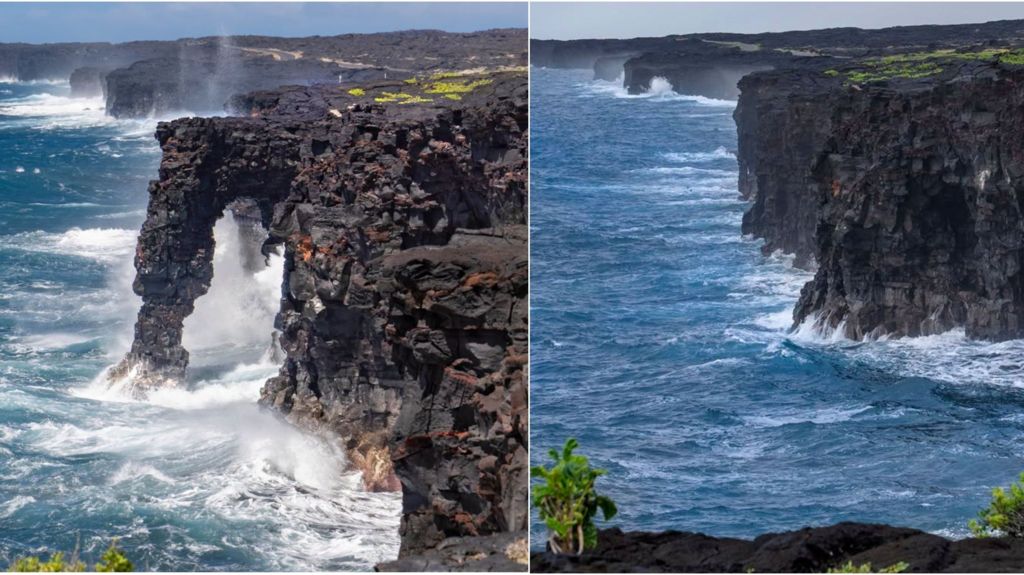
One of Hawaii’s most photographed natural landmarks, the 90-foot-tall Hōlei Sea Arch, a lava rock formation carved by coastal erosion over 550 years, has officially collapsed into the Pacific Ocean, the U.S. National Park Service (NPS) has confirmed.
Though the exact moment of the collapse was not captured, NPS officials confirmed the structure was still standing intact along the Volcanoes National Park coastline on September 23. By September 27, the entire arch had disappeared into the surf.
Park managers have anticipated this event for years, noting long-standing signs of instability along the cliffs flanking the iconic arch. As early as 2021, NPS publicly warned that the fragile formation would eventually crumble, a prediction that has now come to pass.
Nestled at the southern end of the Big Island’s Chain of Craters Road, Hōlei Sea Arch has been a bucket-list stop for tourists and landscape photographers for decades, drawing thousands of visitors annually to capture its dramatic lava silhouette against the Pacific.
Investigations into the collapse point to a combination of long-term geological damage and recent extreme weather as the driving forces. Officials believe the arch fell during the temporary closure of Volcanoes National Park last weekend, when Tropical Storm Nolo brought large swells and powerful storms to the Hawaiian islands. This event capped years of incremental damage: the 2018 Kīlauea eruption and subsequent summit collapse left major structural weaknesses in the surrounding cliffs, and 2020 tropical storm waves already broke off a large segment of rock from the arch’s base. In response to growing safety risks, NPS closed the original close-up viewing area in January 2020 and opened a new overlook at a safer distance several months later.
In a statement following the collapse, NPS framed the event as a natural part of the ever-evolving coastal landscape of Hawaii. “This formation is beautiful, but temporary, and has a limited life span,” the agency reiterated in comments echoing its 2021 warning. “The sea arch will eventually crumble into the sea. However, others will replace it as the cliff slowly migrates inland.”
News of the arch’s disappearance has sparked widespread reflection on social media, where thousands of users have interacted with NPS’s official announcement. Visitors have shared personal memories of visiting the landmark and posted their own photos of the now-vanished formation, with many commenting on the transient nature of natural wonders. One Facebook user summed up the widespread sentiment: “Nothing and no one is here forever. Millions of years from now the sun will die. Appreciate the good, the beauty, now.”