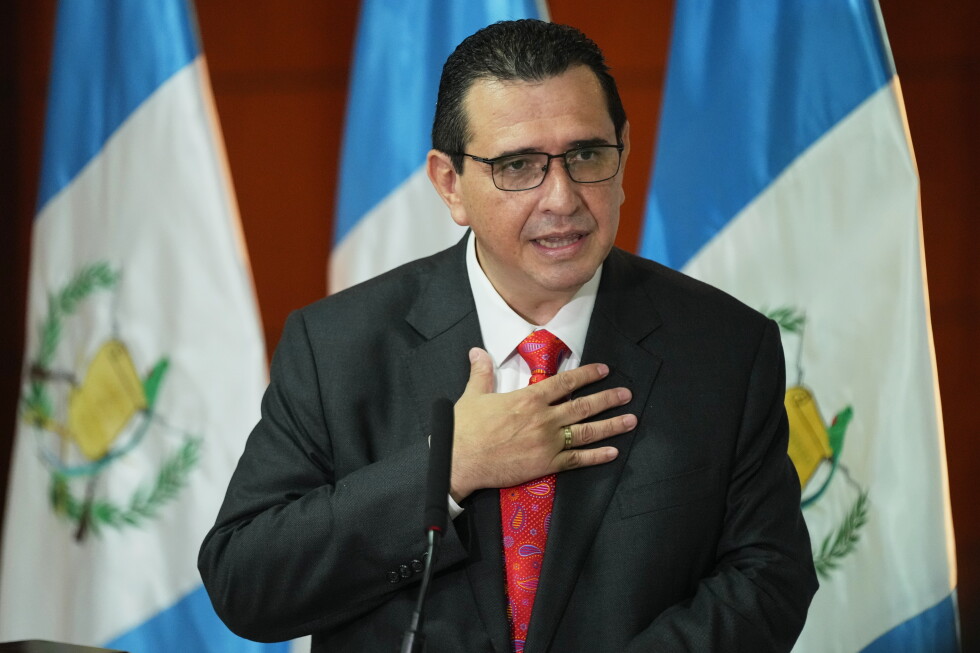
Just months after taking office in May, Guatemala’s new Attorney General Gabriel García Luna has announced a sweeping restructuring of the country’s public prosecution system, vowing to dismantle what he describes as the “repressive and vengeful” infrastructure left by his internationally sanctioned predecessor, Consuelo Porras.
Once viewed as a reliable U.S. partner in regional anti-corruption initiatives, Guatemala shifted dramatically away from transparency and accountability during Porras’ eight-year tenure. Porras, who has been sanctioned by the United States and multiple other nations for obstructing anti-corruption work, stands accused of systematically derailing public corruption investigations, persecuting independent justice officials, human rights activists and investigative journalists, and forcing hundreds of critics into exile. Most notably, she led an unsubstantiated effort to block the inauguration of President Bernardo Arévalo last year, claiming baseless election fraud to invalidate his win.
In an exclusive interview with the Associated Press, García Luna emphasized that the Public Prosecutor’s Office must脱离 its history as a tool for political retribution. “Everyone has a concept of a Public Prosecutor’s Office that can be used in a certain way, and we can no longer have that,” he said. “It is not a political entity, nor a political weapon for anyone, and I do not intend to repeat the actions taken in previous administrations.”
García Luna has already begun implementing his reform agenda, moving quickly to dismantle the network of loyalists Porras installed in key administrative and prosecutorial roles. These appointees were widely accused of leading the criminalization and harassment of former independent justice officials. He has also established a special review commission to re-examine hundreds of cases targeting people wrongfully prosecuted under the previous administration.
Porras has repeatedly denied all allegations against her, with her former office releasing a statement arguing that the claims violate her “right to honor, dignity, reputation and the presumption of innocence.”
Outlining the scale of the overhaul required, García Luna told reporters that Porras built a de facto parallel power structure within the prosecution service that gutted the profession. Over eight years, Porras dismissed between 800 and 1,000 qualified career prosecutors and staff, triggering a mass exodus of experienced personnel that left the institution severely weakened. García Luna’s agenda includes not only reversing these personnel changes but also rooting out systemic abuses from the previous era and rebuilding the depleted prosecutorial workforce.
When asked about potential legal repercussions for Porras, García Luna did not rule out future charges. Porras currently faces multiple formal complaints, including allegations of involvement in human trafficking linked to irregular international adoptions. The new attorney general also confirmed that his office is reviewing and reopening all cases in which Porras’ administration allegedly granted impunity to corrupt officials, drug traffickers and other criminal suspects, with legal action moving forward to hold accountable anyone who benefited from the previous system.
Many advocates and exiled justice leaders are calling for a full, independent probe of Porras and her inner circle. Juan Francisco Sandoval, a former top anti-corruption prosecutor who fled into exile after being targeted for his work on high-profile graft cases, stressed that allegations against the former administration cannot be left unaddressed. “These should not go unresolved, in accordance with the principle of equality before the law and the principle that no one should be above the law,” Sandoval said.
García Luna’s reform push has already garnered broad international backing. The U.S. government and European Union member states have publicly committed to supporting his efforts to combat transnational criminal networks, including drug trafficking and human trafficking rings. Guatemala’s Attorney General’s Office is also partnering with the Inter-American Commission on Human Rights, which has scheduled a public hearing on August 4 to examine claims of political persecution under Porras’ tenure.
For more coverage of Latin American politics and governance, visit AP’s dedicated regional hub at https://apnews.com/hub/latin-america.