A near-disaster on a Flydubai flight carrying 170 passengers, most of whom held Israeli citizenship, has reignited long-simmering national anxieties about persistent terror threats just weeks ahead of Israel’s October 27 general election. What could have become one of the deadliest civilian aviation terror attacks in recent history was averted only by the quick, brave action of the flight’s chief pilot and passengers who intervened to stop the attacker.
The incident came mere hours after Israeli Prime Minister Benjamin Netanyahu published a public video address warning of coordinated plots to target Israeli citizens ahead of the vote. Initially, opposition leaders dismissed the warning as a blatant political stunt. They argued Netanyahu was intentionally shifting public conversation away from his personal responsibility for the catastrophic intelligence and security failures that allowed the October 7, 2023 Hamas attacks to unfold. But in the wake of the foiled hijacking attempt, Netanyahu has seized the opportunity to frame his pre-warning as prescient, doubling down on his decades-long political brand as the ultimate “protector of Israel.”
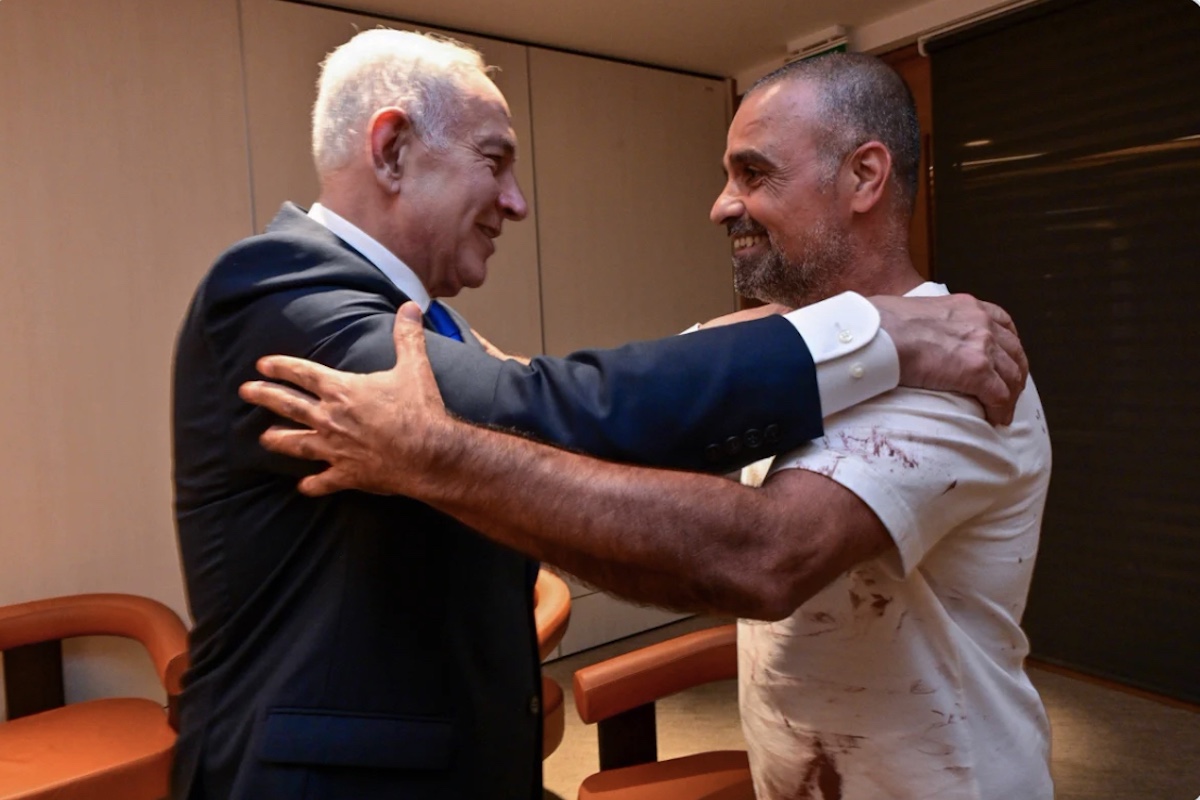
Moving quickly to weaponize the incident for his campaign, Netanyahu posted a viral social media clip and photo set showing him embracing a passenger who stormed the cockpit to stop the attacker — a self-identified Netanyahu supporter, whose shirt still bore bloodstains from the confrontation.
Netanyahu has faced mounting, cross-partisan public anger over his handling of the October 7 attacks, in which Hamas militants killed nearly 1,200 Israelis, abducted 250 more, and carried out widespread sexual violence and destruction of Israeli communities. Despite widespread public outcry demanding accountability, Netanyahu has refused to accept any blame for the failure to prevent the assault. He has blocked the formation of an independent judicial commission of inquiry into the events leading up to the attack, while failing to push through a partisan alternative investigative body stacked with allies who would clear his administration of wrongdoing.
Netanyahu has repeatedly attempted to shift blame to security officials, claiming he was never properly warned of the impending attack, and that “if they had woken me up” earlier on the morning of October 7, “things would have been very different.”
But emerging reporting and new investigations paint a starkly different picture. Multiple independent media outlets have confirmed that both Israel’s top security agencies and Netanyahu personally received explicit, detailed warnings of a large-scale impending attack from senior regional leaders days before the 2023 assault. These warnings came from Egypt’s top intelligence minister and United Arab Emirates leader Mohamed bin Zayed Al Nahyan. A new book further claims that Netanyahu received a direct warning from Yahya Sinwar, Hamas’ top leader and the mastermind of the October 7 plot.
Rather than recognizing the threat, Netanyahu and his senior security team misinterpreted explicit warnings of an impending “earthquake” — Sinwar’s own description of the coming attack — as a demand for economic concessions for Palestinian civilians in Gaza. This misjudgment grew out of what Israelis call a *conceptzia*: a deeply entrenched set of assumptions about an enemy’s intentions and capabilities, a term first coined to describe the catastrophic Israeli intelligence failure ahead of the 1973 Arab-Israeli War.
In 2023, Netanyahu’s *conceptzia* — which was widely shared by senior security officials who were misled by Sinwar — held that funneling Qatari financial aid into Gaza would “buy quiet” on the border, as critics of the policy have phrased it. From 2018 onward, Netanyahu approved the transfer of millions of dollars in Qatari funds to Gaza. Israeli intelligence has since concluded that most of this funding did not reach vulnerable Palestinian civilians, and instead went toward expanding Hamas’ military capabilities and building underground terror infrastructure across the enclave.
For the upcoming election, Netanyahu faces a unified opposition bloc called “ABBA,” short for “Anyone But Bibi Again” — a reference to the Israeli prime minister’s widely used nickname. His main challenger is the *Yashar!* (Straightforward) Party, led by former Israel Defense Forces chief of staff Gadi Eisenkot, who lost his son in the post-October 7 Gaza war. Eisenkot has publicly labeled Netanyahu a “pathological liar” who has prolonged the “forever war” in Gaza solely to maintain his grip on political power.
Pre-election polling has consistently projected that *Yashar!* will emerge as the largest single party in the Knesset after the vote. But forming a stable governing coalition remains an enormous hurdle for the anti-Netanyahu bloc, which is a loose coalition of right, left, and centrist parties that share little policy common ground beyond their shared goal of removing Netanyahu from office. A similar broad anti-Netanyahu coalition, led by Naftali Bennett and Yair Lapid, collapsed in acrimony within just a year of taking power in 2022.
Complicating matters further, many Zionist parties have stated they will refuse to join any coalition that includes Ra’am, an Arab Islamic party. Ra’am was the critical missing piece that allowed the Bennett-Lapid government to form after four consecutive deadlocked elections in 2019 and 2020. Without Ra’am’s support, the ABBA bloc may lack the seats needed to reach a governing majority. The outcome is also made unpredictable by the fate of small fringe parties, which must clear a minimum vote threshold to earn seats in the Knesset. If large numbers of votes for either bloc are “wasted” on small parties that fail to cross the threshold, the final seat distribution can shift dramatically.
Until recent weeks, polling consistently pointed to a high likelihood of a change in government. But polls have tightened considerably in the final stretch of the campaign, in large part because they do not account for support for small unaligned factions including the center-right Hendel/Zelekha party, whose odds of clearing the threshold remain uncertain.
The shadow of October 7 hangs over every aspect of the 2026 election campaign. A few days before Israelis head to the polls, the nation will hold a somber commemoration of the third anniversary of the 2023 attacks. In the Gaza war that followed the attacks, more than 70,000 Palestinians have been killed, according to Gazan health officials, vast swathes of the densely populated enclave have been reduced to rubble, and an estimated 1.2 million Palestinians have been displaced from their homes.
October 7 has reshaped the entire election landscape. An unprecedented number of candidates running in this cycle are family members of October 7 victims or soldiers injured in the war. Polling of young first-time voters, who make up a large share of the electorate this cycle, shows the October 7 attacks have shifted their political views sharply to the right.
For many Israeli voters, the biggest fear is that the election will once again end in parliamentary deadlock. The nation is facing growing international criticism over its conduct of the Gaza war, a rising global wave of antisemitism, and persistent terror threats targeting Israeli citizens at home and abroad — all of which create an urgent need for a stable government that can address these challenges. Netanyahu is positioning himself as the only leader strong enough to tackle these threats, but his opposition rivals are making the same case to an electorate hungry for accountability and stability.