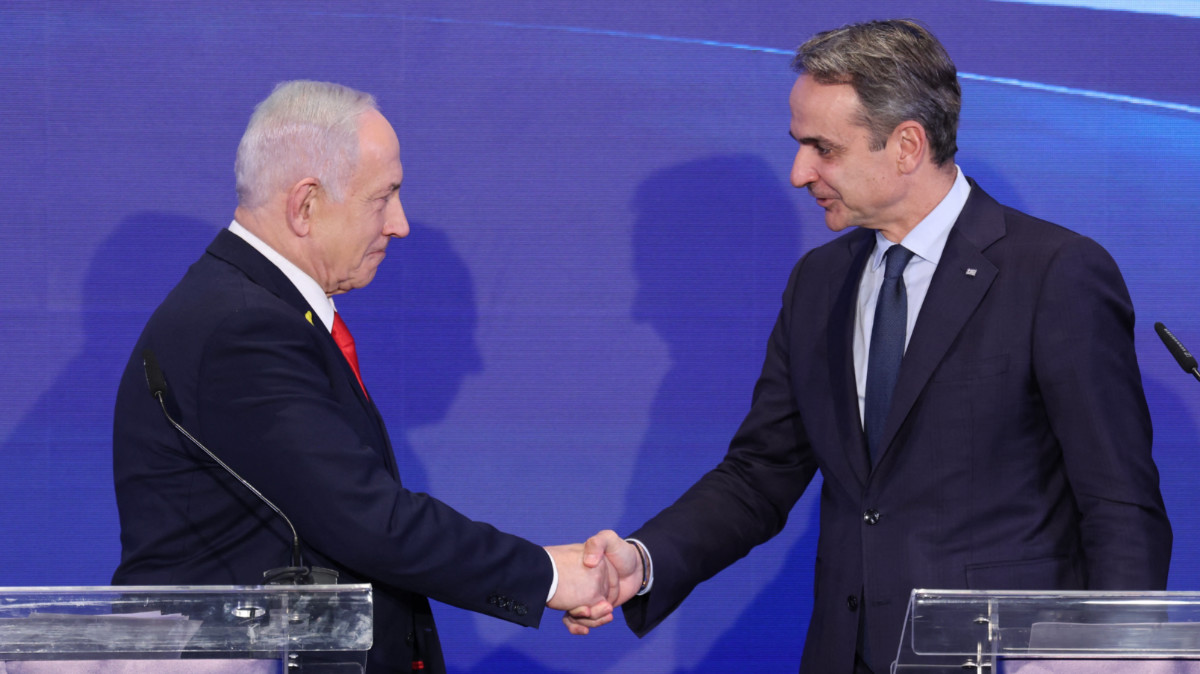
On Monday, Greece and Israel formalized a historic $3.5 billion defense agreement that will see Israel construct a multi-layered national air defense network for Greece, marking a major milestone in the rapidly deepening strategic partnership between the two Mediterranean nations.
The Israeli Ministry of Defense emphasized in an official announcement that the pact stands as the largest bilateral defense export deal in the history of Israeli-Greek relations, and ranks among the top largest defense contracts ever secured by the State of Israel. The agreement forms a core part of Greece’s broader national defense initiative, named the Achilles Shield, which aims to build a fully integrated defensive system capable of countering drones, ballistic missiles, and fixed-wing aircraft. The full program carries an estimated total cost of $28 billion and is scheduled for completion by 2036.
Under the terms of the deal, Greece will acquire three key Israeli defense systems: the David’s Sling and SPYDER platforms manufactured by Rafael Advanced Defense Systems, and the Barak MX air defense system produced by Israel Aerospace Industries (IAI). The purchase also includes advanced MMR multi-mission air surveillance radars built by ELTA Systems, an IAI subsidiary. Notably, Greece becomes only the second international customer for David’s Sling, following Finland – another NATO member that shares a border with Russia. Designed to intercept large-caliber rockets and intermediate-range ballistic missiles, David’s Sling fills a critical capability gap in Israel’s own integrated air defense architecture: it complements the short-range Iron Dome system, which counters low-altitude rockets and drones, and the Arrow 2 and Arrow 3 systems, which target long-range ballistic missiles, with the Arrow 3 capable of intercepting hypersonic targets outside the Earth’s atmosphere.
In addition to the core air defense systems, the agreement includes the delivery of a new national command-and-control network developed by Rafael. A separate $26 million secondary contract will see Rafael supply Greece with Drone Dome counter-drone systems, designed to protect critical national infrastructure and strategic sites from unmanned aerial threats.
The defense pact comes as the growing strategic alignment between Greece and Israel reshapes the geopolitical landscape of the Eastern Mediterranean. The deepening partnership coincides with long-running frictions between both nations and Turkey: Greece has been locked in territorial and diplomatic disputes with Turkey for nearly two centuries, while tensions between Ankara and Jerusalem have surged in recent years, with open clashes across multiple regional hotspots from Syria to the Horn of Africa. Earlier this month, Israeli forces launched an airstrike on Syria’s Abu al-Duhur airbase, following intelligence that Turkey planned to deploy a permanent military contingent to the site. Tom Barrack, the U.S. Ambassador to Turkey and special envoy to Syria, warned that the strike carried a serious risk of direct military confrontation between Israel and Turkey, suggesting the attack may have been a deliberate provocation to draw Ankara into a wider regional conflict.
While Greek Prime Minister Kyriakos Mitsotakis has pursued a policy of de-escalation with Ankara in recent months, emphasizing potential areas of bilateral cooperation during a NATO summit hosted in Ankara earlier this year, analysts note that the new defense pact with Israel introduces significant uncertainty to this reconciliation strategy.
Beyond regional geopolitical risks, the agreement has sparked substantial domestic controversy in Greece. Greece has historically been a vocal advocate for Palestinian statehood: in 1947, Athens joined India and a bloc of Muslim-majority nations including Egypt, Saudi Arabia, Iran, and Turkey in voting against the UN Partition Plan for Palestine. Greece also maintains deep historic and religious ties to occupied East Jerusalem and the West Bank through the Greek Orthodox Patriarchate of Jerusalem, whose leader is a Greek national, and whose church properties have faced repeated attacks from Israeli settlers in recent years.
Current public outrage over the ongoing military campaign in Gaza has fueled widespread opposition to the Greek government’s closer alignment with Israel. Data from a 2026 Pew Research Center poll shows that 65 percent of Greek citizens oppose the deepening bilateral partnership, even as many respondents characterize the alliance as a necessary safeguard against what they view as expansionist Turkish ambitions in the Eastern Mediterranean.
Parallel to the growing defense ties, the Greek government also faces growing public anger over a sustained boom in Israeli real estate investment in Greece. Israeli buyers entered the Greek property market en masse following the country’s 2010 sovereign debt crisis, when depressed prices offered attractive entry points for foreign investment. Continued high volumes of purchases have since driven up housing prices across the country, pushing many native Greek buyers out of the market and exacerbating a national affordable housing crisis.